
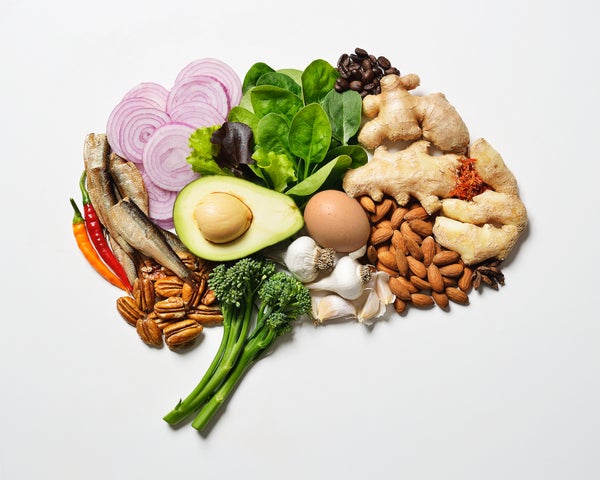
Have you heard about the brain benefits of blueberries? How about caffeine? Or red wine? And let's not forget kale, which seems to be good for all that ails you.
There's no end to the assertions about how one food or another will sharpen your concentration, even out your moods or protect your brain from the ravages of time. Alas, such magic exists only in our hopeful hearts (and popular media). As medical journalist Bret Stetka writes in our cover story: “There is probably no single ingredient, no happy seed from the jungles of beyond, that is sure to secure a better mood or mental acuity into old age.” But the good news, he reports, is that evidence indicates there are “specific dietary patterns—calibrated by millions of years of human evolution—that boost our cognitive and psychological fitness.”
Stetka serves up the evidence for dietary patterns—such as the fish-and-vegetable-rich Mediterranean diet—that are associated with better brain health. He explores why a growing number of mental health experts are incorporating diet into treatment for major depression and other disorders as part of a burgeoning new field called nutritional psychiatry.
On supporting science journalism
If you're enjoying this article, consider supporting our award-winning journalism by subscribing. By purchasing a subscription you are helping to ensure the future of impactful stories about the discoveries and ideas shaping our world today.
Other kinds of behavioral patterns are at the heart of several features in this issue. For decades the criteria for diagnosing autism have been largely defined by how the disorder appears in boys, who are roughly four times as likely as girls to be diagnosed with the disorder. But what if symptoms follow a different pattern in females? Writer Maia Szalavitz presents new evidence that this is the case and that, as a result, many girls and women with autism have been overlooked or misdiagnosed. Click here to read about “The Invisible Girls.”
Fragile X syndrome is well established as the leading genetic cause of autism. In the late 1990s, however, researchers began to notice some odd patterns of behavior and health affecting the mothers and grandfathers of kids with this condition. In “The Carriers,” Columbia University psychiatrist Anne Skomorowsky unwinds the mystery of how variants of the fragile X gene can cause a stunning array of symptoms, including infertility in women.
Over the past 20 years an entirely new human activity has exploded globally: social media. In “Status Update,” on page 62, data scientist Johannes C. Eichstaedt of the University of Pennsylvania shows how researchers are using telltale patterns in tweets and Facebook posts to predict the mental and physical health of communities and individuals. Think about that the next time you update your status!