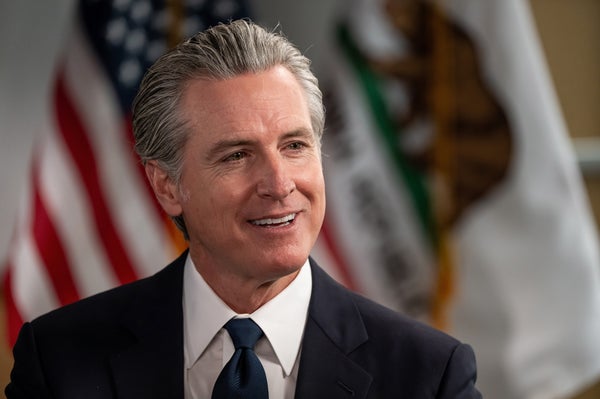
Gavin Newsom is the 40th governor of California, serving since 2019. Previously, he was lieutenant governor of California and mayor of San Francisco.
[This interview was edited for length and clarity.]
How would you describe the current state of American science?
On supporting science journalism
If you're enjoying this article, consider supporting our award-winning journalism by subscribing. By purchasing a subscription you are helping to ensure the future of impactful stories about the discoveries and ideas shaping our world today.
Complicated. Donald Trump and his administration are sowing doubt about the basics that used to be universally agreed upon: climate change, the dangers of pollution and the importance of public health. But at the same time, we also have some truly incredible progress being made, from private companies such as Genentech and Nvidia to public research institutions that make up the University of California and California State University systems. Artificial intelligence is a game changer across so many fields, and I think we’re only seeing the tip of the iceberg of what it can help us find.
What needs to change in American science?
There are so many parts to the whole of “American science.” In some cases, I think we need to push harder, be bolder. In others, I think we need to slow down for a second and assess what better guardrails could be put in place to protect the people we hope to serve. We should be risk-takers but not reckless. We need to find that balance—and we need to restore trust in science and research.
What gives you optimism right now?
Seeing how resilient people are. We tend to focus on the bad, and we forget how much good there still is. I go all around California, and everywhere there are still people seeking new ways to improve the world and reaching out to one another for connection and collaboration, whether that’s in the lab, in the classroom or in the community. Around the world, we are seeing people and even countries come together to find solutions to some of the biggest challenges facing humanity today. They are holding themselves and their governments accountable, even and especially when it’s difficult to do so.
Humans do not give up—we keep fighting; we stay curious. It’s in our DNA. And I see that strength in the next generation—that’s how I know we’ll be okay.
Is the U.S. still the undisputed destination for the world's brightest minds, or are we losing that pull?
California certainly is. But I do think America is at risk of losing that. Nationally, we are seeing the highest office in the land attack education systems, dismiss foundational facts, defund research, and target and terrorize immigrant students, researchers and entrepreneurs.
Our national labs are the envy of the world, producing incredible scientific breakthroughs every year. Lawrence Berkeley National Laboratory alone has earned 17 Nobel Prizes. Yet the Trump administration is proposing to cut research funding by double digits at five science national labs in their Fiscal Year 2027 budget—it makes no sense.
This is not how we attract talent, especially not from around the world. People want to go where they’re respected and supported.
So California is stepping up, doubling down on our world-class conveyor belt of talent. We’re investing in our schools and higher-ed facilities. We’re working with leaders across the private and public sectors to develop our innovation infrastructure and ecosystems, nurturing an environment that not only welcomes brilliance but helps it flourish.
Is American science funded in the right ways? If not, what needs to change?
Well, first of all, it needs to be funded, full stop. The government should fund this work. In addition to that, we also need public and private funding to work in a more complementary, smarter way. If we can find a way to streamline funding and avoid a piecemeal, start-and-stop approach—especially on a partisan basis between federal administrations—we can achieve so much more. Public-private partnerships can accelerate progress by utilizing the speed and focus of the private sector, with the scale, resources and broader vision of the public sector.
What’s the one thing that hasn’t been invented that you wish were real?
That’s a tough question. A sustainable, large-scale desalination that is affordable and has no impact on the environment is a good place to start.
Who would you put on the Mount Rushmore of American Science?
If we’re limited to only four, I would say: Bill Nye because of how he’s changed the face of science; for countless kids (and many adults), he made science accessible and even cool. He is, hands down, one of the best scientific communicators out there.
There’s Rachel Carson, who was pivotal to the creation of the Environmental Protection Agency and critical conservation policies. And of course, some of the biggest names in science history, like Nikola Tesla, who laid the groundwork for much of our current technology, are among the most prolific inventors in modern history. Of course, Carl Sagan—how can you not include him, given the successful Artemis II mission recently, and where we plan to go in the years to come?
All of these people have made immeasurable impacts, as each of their contributions will snowball with each new breakthrough, made possible by their own discoveries or by inspiring people to pursue science and research.