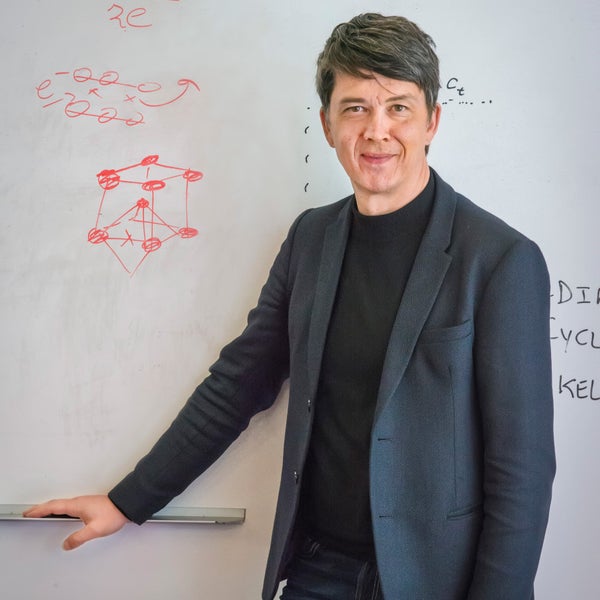
Gerbrand Ceder is a materials scientist and Samsung Distinguished Chair in Nanoscience and Nanotechnology Research at the University of California, Berkeley, and is known for pioneering the computational design of materials. He is also a co-founder of Radical AI, a company focused on developing advanced materials using artificial intelligence.
[This interview was edited for length and clarity.]
How would you describe the current state of American science?
On supporting science journalism
If you're enjoying this article, consider supporting our award-winning journalism by subscribing. By purchasing a subscription you are helping to ensure the future of impactful stories about the discoveries and ideas shaping our world today.
I think science is a global sport. It’s not just one country, so I think, overall, the world of science is in good shape, while we may see sometimes occasional hiccups. I think we see science grow all over the world; we see more collaboration. I think it’s a field that still attracts a lot of talent. So, overall, I’m quite optimistic.
What needs to change in American science?
I think that, as the science community has grown, there has been an enormous amount of information overload that the community has not figured out how to address. There are millions of research papers published per year now—in popular topics, there are often multiple dozens of papers posted each day. We have to address this issue of the way we do science today, which is: we’re all working in our laboratories by ourselves, then writing papers, and that’s our mode of dissemination of knowledge. I think we may have to question whether that’s still the way forward to go. That system may be hanging on by a thread.
What gives you optimism right now?
What gives me optimism is that science has a sort of intrinsic way of renewing itself generationally. I think that science regularly needs change, and it needs a lot of it now. But we could either try to change old people like me, or we just let the young people take over, so that’s where my optimism comes in. I see young people just learning AI, applying new approaches to science and loving science in the same way that we did but approaching it in a very different way. So that’s where my optimism is, that it doesn’t really matter how we redirect science; they will redirect it for us.
I think AI will have a tremendous impact in science. Not everybody’s willing to accept that; people don’t like to accept things that may change them or displace them. But from a rational perspective, I think AI will have tremendously positive effects in science. It will help us deal with information overload. It will help us to do things faster, more efficiently. And I see the young crowd just totally buying into that. They are sold completely.
What’s your best advice for an early-career scientist?
Pick a good topic. I think that just following in other people's footsteps isn’t always the best thing to do. I tell my students that it’s really not that hard to predict the future. Usually, it’s all around you; you just have to see it. So I just tell them to open their eyes and see.
There are things that may not be big today but that seem exciting and improvable. Go with that, you know? You can either be first or best in a field. It’s much easier to be first. There are a lot of smart people in science, so trying to be best in a field that’s been around for 30 years, it’s really hard. Being early and being at the frontier of a field is sometimes the better way to make a career.
How has your field changed in the past few years?
I’m in materials design and development, and that has gone through a few revolutions. In the 1990s, the field of computing led to computational modeling of materials. In the past five years, machine learning has radically transformed the ability to model systems, to do bigger things. I think we’re seeing a truly transformative effect of machine learning and AI. It’s on a rocket booster, honestly, moving unbelievably fast.