
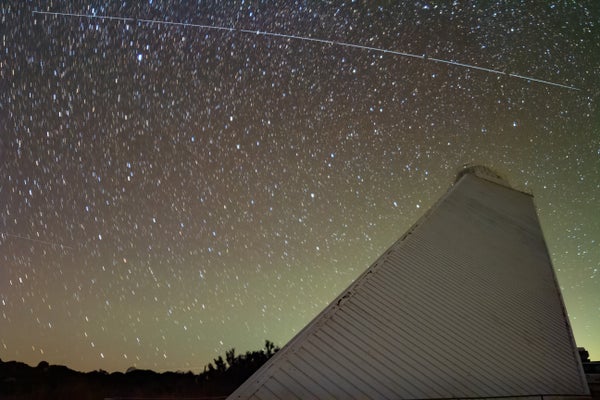
On some nights, one of the brightest objects in the sky is neither a planet nor a star. It is a telecommunications satellite called BlueWalker 3, and at times it outshines 99% of the stars visible from a dark location on Earth, according to observations reported today in Nature.
BlueWalker 3 is the most brilliant recent addition to a sky that is already swarming with satellites. The spaceflight company SpaceX alone has launched more than 5,000 satellites into orbit, and companies around the globe have collectively proposed launching more than half a million satellites in the coming years — a scenario that astronomers fear could hamper scientific observations of the Universe.
The study “shows us that there are no boundaries to satellite brightness,” says Patrick Seitzer, an emeritus astronomer at the University of Michigan, Ann Arbor, who was not involved in the study. “I’m concerned that we’re going to see a very large number of large satellites launched in the next decade, and it will change the appearance of the night sky forever.”
On supporting science journalism
If you're enjoying this article, consider supporting our award-winning journalism by subscribing. By purchasing a subscription you are helping to ensure the future of impactful stories about the discoveries and ideas shaping our world today.
Twilight star
Telecommunications firm AST SpaceMobile in Midland, Texas, launched BlueWalker 3 on 10 September 2022 as a prototype for a satellite fleet designed to make mobile broadband available almost anywhere. The satellite’s huge array of antennas and white colour mean that it reflects a considerable amount of sunlight back towards Earth, making it shine even at twilight.
To quantify its effects, professional and amateur astronomers embarked on an international observation campaign, ultimately spotting the satellite from locations in Chile, the United States, Mexico, New Zealand, the Netherlands and Morocco. The researchers assessed the satellite’s shine using a standard astronomical index called the magnitude scale, on which the brightest objects have the smallest numbers. The brilliant Venus, for example, can reach a magnitude of –4.6, whereas the North Star is much dimmer, at magnitude +2. That is roughly the magnitude limit visible from a city with the naked eye.
On 10 November 2022, the satellite unfurled its array of antennas, causing it to brighten to magnitude +0.4. If it were a star, it would have been one of the ten brightest in the sky. But its apparent brightness changes as the satellite rotates, and by late December, it had dimmed to a magnitude of +6. It then brightened again, reaching magnitude +0.4 once more on 3 April 2023.
The International Astronomical Union, a group of professional astronomers, recommends that artificial satellites in low-Earth orbit have a maximum brightness of magnitude +7. BlueWalker 3 can be hundreds of times brighter, the authors found. And AST SpaceMobile says it plans to provide broadband coverage with a fleet of 90 similar satellites, including 5 that are scheduled to launch in early 2024.
Breakaway debris
Moreover, the team observed a bright object separating from the main satellite during deployment, and later learnt that this was the container that protected the folded antennas during ascent, before being jettisoned into space. It, too, was relatively bright at magnitude +5.5.
In a statement to Nature, AST SpaceMobile said that it is currently working with NASA and astronomy groups to address these concerns.
Many astronomers were caught by surprise in mid-2019, when SpaceX successfully launched 60 satellites, creating a ‘train of stars’ that glided through the night sky. Now, low-Earth orbit is littered with thousands of commercial satellites. If captured by a telescope during a long exposure, such objects can leave a bright streak that renders the data unreadable.
Astronomers have long steered their telescopes to avoid the brightest of these objects. That workaround will still be possible if AST SpaceMobile launches a fleet of satellites similar to BlueWalker 3, says Jonathan McDowell, an astronomer at the Center for Astrophysics | Harvard & Smithsonian in Cambridge, Massachusetts, who was not involved in the study.
The bigger concern, he says, is that other companies might also launch constellations of large satellites. If that happens, Seitzer says, “then the night sky will be irreversibly changed.”
A search for solutions
To avoid such a scenario, astronomers are working to find mutual solutions. Some of the study’s authors, for example, are a part of a newly formed coalition called CPS that aims to tackle the issue and has been in contact with companies including SpaceX and AST SpaceMobile. SpaceX is already trying methods to make its satellites less visible, and coalition members say that AST SpaceMobile also seems amenable to dimming its satellites. The company says it is planning to use anti-reflective materials on its next-generation satellites, as well as certain flight manoeuvres to reduce the crafts’ apparent magnitude.
“They left us with a very good impression that they would work more with us,” says coalition member Constance Walker, an astronomer at the National Science Foundation’s NOIRLab in Tucson, Arizona, and also a study author.
Such discussions are the way forwards, she says. “No one is going to return to yesterday, when we had darker skies.”
This article is reproduced with permission and was first published on October 2, 2023.