
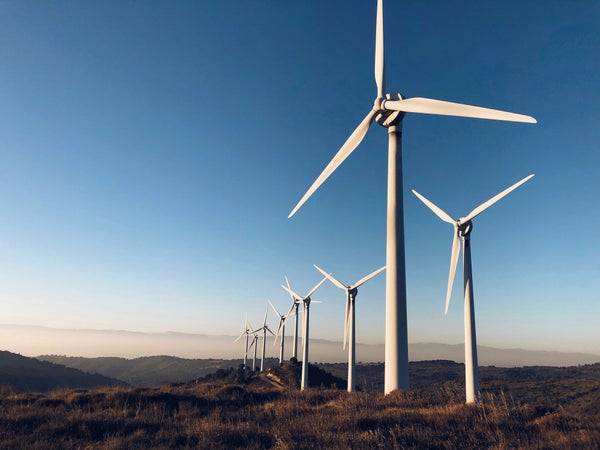
The wind industry is growing, literally. American wind developers are installing increasingly large turbines, capable of generating twice as much power as their predecessors and opening up new areas of the country to wind development.
The trend arrives at a critical time for the industry. The production tax credit, a federal subsidy, is set to end at the end of the year. But unlike in previous years, when wind development ground to a halt when subsidies dried up, industry representatives are predicting only a modest slowdown.
“We are confident we will remain one of the most competitive forms of energy,” said John Hensley, vice president of research and analytics at the American Wind Energy Association (AWEA), a trade group.
On supporting science journalism
If you're enjoying this article, consider supporting our award-winning journalism by subscribing. By purchasing a subscription you are helping to ensure the future of impactful stories about the discoveries and ideas shaping our world today.
Among the reasons for the sunny outlook: improved turbine technology. Today, only six land-based projects with a combined capacity of 767 megawatts employ turbines with a generating capacity of 3.5 MW or higher. The majority of today’s turbines have a capacity between 2 and 3 MW.
Turbines with a capacity of 3.4 to 3.6 MW accounted for 14% of all installations in the second quarter. And orders for larger turbines are starting to add up, according to AWEA’s most recent market update. Some 22 projects boasting a combined capacity of 3,907 MW reported buying turbines with a listed capacity of 3.5 MW or greater in the second quarter of the year, a 35% increase over the first three months of 2019.
Developers in the United States only first started ordering 4 MW machines in the third quarter of 2018. Orders for those turbines increased to 2,190 MW in the second quarter, AWEA reported.
The advantages of larger turbines are several. Larger turbines mean fewer towers are needed to generate the same amount of electricity, decreasing projects’ costs and the size of their footprint. That opens areas of the country like the Great Lakes, Mid-Atlantic and West Coast, where open land is at a premium, to wind energy, Hensley said.
“The 4.5 MW turbines can power twice as many homes as the average turbine in the last few years,” said Celeste Wanner, a senior analyst at AWEA.
Overall, the pipeline for new wind projects continues to grow. Roughly 41 gigawatts of new wind capacity was under construction or in the advanced stages of development during the second quarter of 2019, an industry record.
Texas continues to lead America’s wind-building boom. The Lone Star State already boasts 25.6 GW, and the local grid operator recently reported that turbines there had generated more electricity than coal through the first half of the year (Climatewire, July 23). AWEA’s figures show that even more wind is on the way. Another 7.6 GW is under construction in Texas, while 1.4 GW is in advanced development.
The question for the industry is how much growth levels off after the production tax credit terminates. The impact of the subsidy’s end likely won’t be immediate, as many companies will still be able to qualify for the federal money, provided they began construction before the end of the year.
AWEA is projecting a short-term slowdown but expects other factors will ultimately boost the industry. They include falling costs and strong consumer demand. Corporate power purchase agreements represented slightly more than half of all wind contracts in the second quarter.
Ultimately, the industry has benefited from the recent policy certainty, with the PTC laying the foundation for the industry to reduce cost, Hensley said.
“We’re seeing the fruits of our labor coming to fruition in the next couple years,” he said.
Reprinted from Climatewire with permission from E&E News. E&E provides daily coverage of essential energy and environmental news at www.eenews.net.