New Issue: Orbital Catastrophe Ahead? Read Now

Glowing “Mystery Mollusk” Finally Identified

This strange sea creature stumped scientists for 20 years. Here’s what it really is

Photograph of the mystery mollusk (Bathydevius caudactylus) as observed by MBARI's ROVTiburon in the outer Monterey Canyon, showing a bottom-up angle on its translucent hood and paddle-like tail.

The mystery mollusk Bathydevius caudactylus observed at a depth of approximately 1,550 meters. It has a wide, paddlelike tail with several fingerlike projections called dactyls that may help with defense.

© 2021 MBARI

Join Our Community of Science Lovers!

Absolute darkness. Crushing pressure. Icy cold. The Pacific Ocean’s “midnight zone”—between 3,300 and 13,100 feet deep—is not a welcoming place. But that hasn’t deterred one delicate, baffling “mystery mollusk” species from setting up shop in this inhospitable water column.

For more than 20 years scientists at California’s Monterey Bay Aquarium Research Institute (MBARI) have occasionally encountered this five-inch translucent creature with a bizarre medley of traits. Its face is surrounded by an oversized hood that it uses to enfold prey and jet-propel itself like a jellyfish. Its tail is fringed with tentacles, and if provoked, it can detach one. When touched, its hood and tail glow with a constellation of blue-green dots like an underwater planetarium.

Now scientists have determined that this deep-sea enigma is a nudibranch, or sea slug—but one so odd that it merits the creation of an entirely new nudibranch family, the researchers report in Deep Sea Research, Part I: Oceanographic Research Papers. Dubbed Bathydevius caudactylus, it’s the first nudibranch known to live in the deep-sea water column rather than, for example, lurking on the seafloor or floating near the surface.


On supporting science journalism

If you're enjoying this article, consider supporting our award-winning journalism by subscribing. By purchasing a subscription you are helping to ensure the future of impactful stories about the discoveries and ideas shaping our world today.
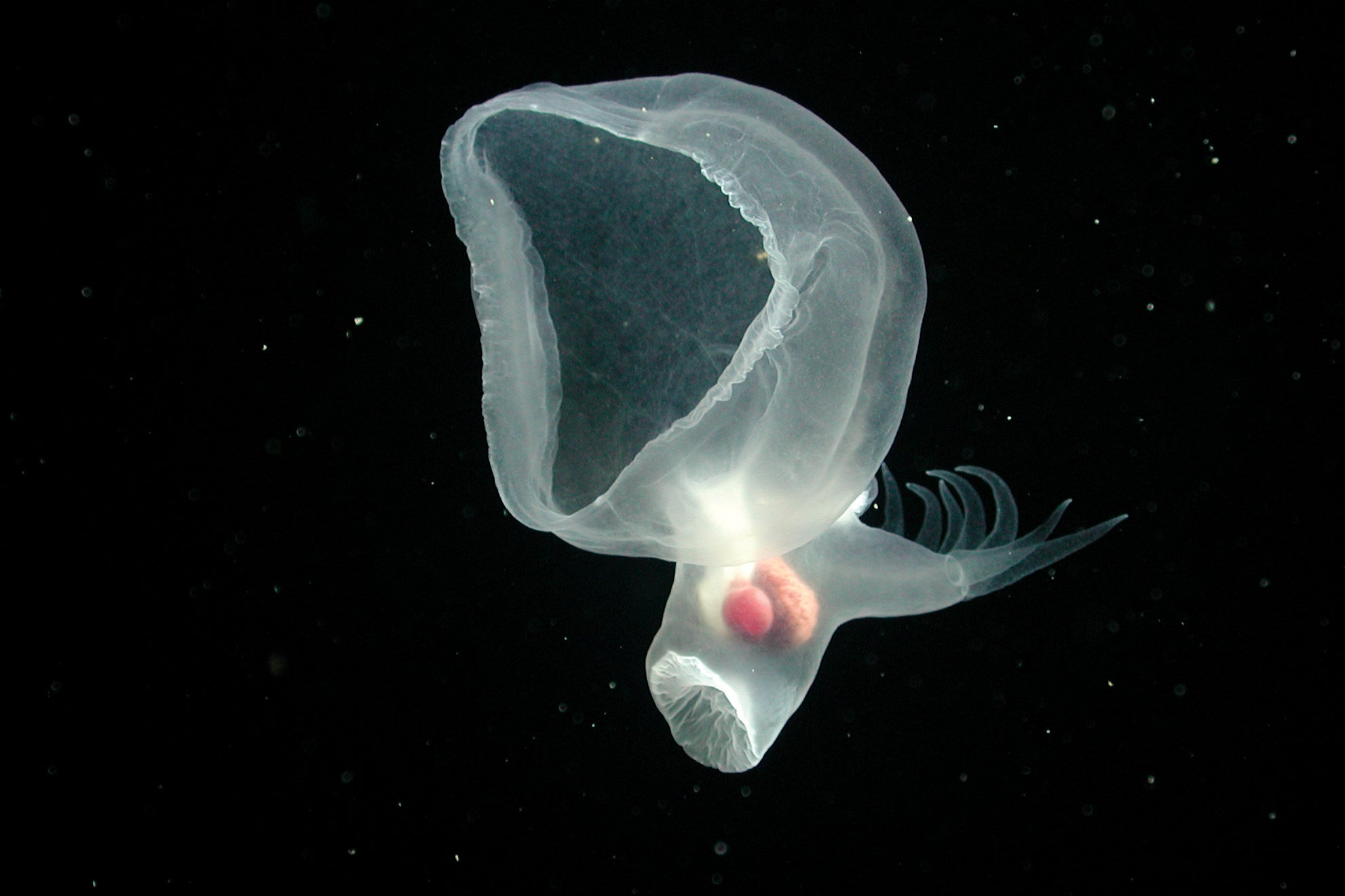

Photograph of the mystery mollusk (Bathydevius caudactylus) as observed by MBARI's ROVTiburon in the outer Monterey Canyon, showing a ghostly translucent outline and a wide hood to catch prey

A mystery mollusk observed by MBARI’s remotely operated vehicle Tiburon in the outer Monterey Canyon at a depth of approximately 1,900 meters.

© 2021 MBARI

The animal features a unique grab bag of traits of other nudibranchs, says study co-author and MBARI marine biologist Steven Haddock. Haddock was present when scientists first spotted the mollusk, during exploration using a remotely operated vehicle in 2000. “We were all spitballing what we thought it was,” he recalls.

In the two decades since then, the researchers have observed more than 100 B. caudactylus and studied some in their laboratories. Genetic analysis revealed the creature probably belongs to a family that split from the other nudibranchs long ago—so even though it shares some features with other species, it evolved its eclectic range of traits independently. “Similar features can evolve multiple times, but to see it happen in such a unique kind of organism under such different circumstances than what we see in other nudibranchs is pretty cool,” says Jessica Goodheart, a mollusk researcher at the American Museum of Natural History in New York City. “Maybe [such features] can evolve much more easily than we anticipated.”

Jude Coleman is an Oregon-based freelance science journalist who covers stories about ecology, climate change and the environment.

More by Jude Coleman
Scientific American Magazine Vol 332 Issue 4This article was published with the title “Mystery Mollusk” in Scientific American Magazine Vol. 332 No. 4 (), p. 14
doi:10.1038/scientificamerican042025-fRC0aDRJSA38uTC2xEiKc

Subscribe to Support Independent Journalism

Great science journalism requires human expertise, time, effort and creativity. And it costs money. That’s why I and the journalists here at Scientific American hope you’ll join our community.

When you subscribe, you are supporting staff and freelance journalists who are passionate about telling science stories that are true, important and compelling. Our editors and reporters are often experts in their fields, which means they understand the nuances of big discoveries and can untangle the breakthroughs from the hype. With a subscription, you are also supporting rigorous fact-checking to ensure the words we publish are precise and accurate. And you’re supporting original illustrations, graphics and photos that bring you closer to an advanced laboratory, an ice sheet in Antarctica or a space mission in orbit. You’re helping us craft other types of high-quality journalism as well: Our newsletters are carefully written, edited and curated by staffers you have or will come to know and love. Our Science Quickly podcast is based on original reporting, collaboration with editors and scientists and exacting production.

Subscriptions keep this engine running so we can continue to deliver thoughtful, rigorous and independent science journalism to you. In an era of viral misinformation, this work is crucial. If you value what we do, I hope you’ll consider joining us as a subscriber

Thank you,

Jeanna Bryner, Editor in Chief, Scientific American

Subscribe