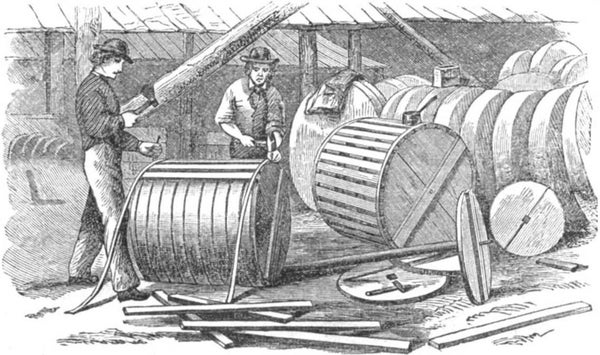
Grindstones for Manufacturing: A very old and useful tool, with a modern distrubution method. Grindstones made in quantity in Ohio are crated for shipping on the Cleveland, Columbus and Cincinnati Railroad.
Image: Scientific American, April 7, 1866
Join Our Community of Science Lovers!
On supporting science journalism
If you're enjoying this article, consider supporting our award-winning journalism by subscribing. By purchasing a subscription you are helping to ensure the future of impactful stories about the discoveries and ideas shaping our world today.
The patent system in the 19th century was a driver of economic expansion (or so it is said). That was problably true for a tiny minority of devices and processes that worked well and saved money. Some devices, such as the grindstone, were old tools, but improved manufacturing and distribution systems enabled them to have a greater impact in the industries of the day. Most of the 15,269 patents granted in 1866, however, were more optimistic than useful. The gizmos they covered may have demonstrated a desire to improve some aspect of the human condition but these inventions seem to lack some aspect of true usefulness or efficiency, or they were simply a more expensive method for getting the same result that could be achieved with existing and cheaper tools.
Take courage, or take heed, from the history of invention from 1845 to today in the Archive of Scientific American at ScientificAmerican.com/magazine/sa
Subscribe to Support Independent Journalism
Great science journalism requires human expertise, time, effort and creativity. And it costs money. That’s why I and the journalists here at Scientific American hope you’ll join our community.
When you subscribe, you are supporting staff and freelance journalists who are passionate about telling science stories that are true, important and compelling. Our editors and reporters are often experts in their fields, which means they understand the nuances of big discoveries and can untangle the breakthroughs from the hype. With a subscription, you are also supporting rigorous fact-checking to ensure the words we publish are precise and accurate. And you’re supporting original illustrations, graphics and photos that bring you closer to an advanced laboratory, an ice sheet in Antarctica or a space mission in orbit. You’re helping us craft other types of high-quality journalism as well: Our newsletters are carefully written, edited and curated by staffers you have or will come to know and love. Our Science Quickly podcast is based on original reporting, collaboration with editors and scientists and exacting production.
Subscriptions keep this engine running so we can continue to deliver thoughtful, rigorous and independent science journalism to you. In an era of viral misinformation, this work is crucial. If you value what we do, I hope you’ll consider joining us as a subscriber
Thank you,
Jeanna Bryner, Editor in Chief, Scientific American