
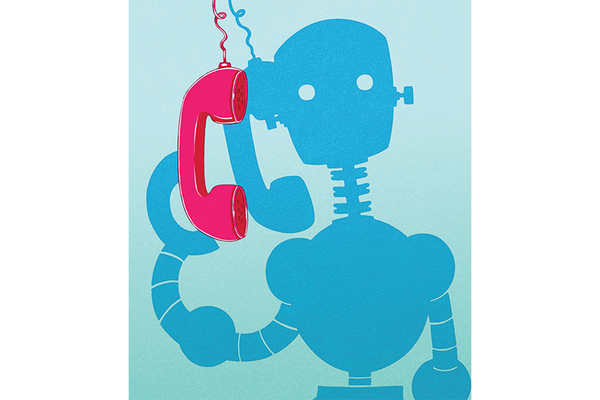
“Any sufficiently advanced technology is indistinguishable from magic,” Arthur C. Clarke famously wrote. That line must have zoomed through 5,000 audience brains when, at Google's developer conference in May, CEO Sundar Pichai demonstrated a new artificial-intelligence product called Google Duplex.
What Duplex does is to make reservations at restaurants and hair salons—by placing a phone call to their human receptionists. It perfectly impersonates a human voice, complete with “ums,” hesitations and realistic inflections. Here's an excerpt from the demo:
Duplex AI: “Hi. I'm calling to book a woman's haircut for a client. Um, I'm looking for something on May 3?”
On supporting science journalism
If you're enjoying this article, consider supporting our award-winning journalism by subscribing. By purchasing a subscription you are helping to ensure the future of impactful stories about the discoveries and ideas shaping our world today.
Human receptionist: “Sure. Give me onnne second....”
AI: “Mm-hmm.”
Human: “Sure, what time are you looking for, around?”
AI: “At 12 P.M.”
Human: “We don't have 12 available. The closest we have to that is a 1:15.”
AI: “Do you have anything between 10 A.M. and, uh, 12 P.M.?”
Human: “Okay, we have a 10 o'clock.”
But here's the key: in the examples Pichai played onstage, the receptionists clearly didn't know they had been talking to an AI. Many in the Twittersphere were aghast. “I am genuinely bothered and disturbed at how morally wrong it is for the Google Assistant voice to act like a human and deceive other humans,” tweeted @BridgetCarey. “This is horrible and so obviously wrong,” tweeted @Zeynep. Nobody wants to be duped by a robot.
After the demo, however, I interviewed Rishi Chandra, vice president for home product management at Google. “We're gonna be spending a bunch of time on different ways we can let the restaurant know,” he reassured me. “We want to be very transparent that this is coming from Google.” In states where it is required, Duplex will also inform the human that the call is being recorded.
The other worry, of course, is that once this technology is out in the wild, it will be a handy tool for scammers, robo callers and other sinister social engineering hacks. But that fear, too, is overblown. Duplex is incredibly limited; it must be individually coded for each kind of situation. For now, all it can do is call restaurants (where it anticipates queries such as “How many in your party?” and “Any vegetarians?”) and hair salons (“Is this for a man's cut or a woman's cut?”). Duplex can't call a dentist, a nail salon or an airline, let alone voters or potential customers.
Duplex is also in its very earliest stages. Google plans to proceed with what it calls a “small experiment,” using only the hair salon and restaurant routines (plus one that asks businesses of any kind for their hours). Meanwhile Duplex really does fill a need. “The reality is that many businesses today are not digital businesses,” Chandra says. “How do we bridge this notion that I want a haircut or I want to order a pizza, but my local pizza joint's not online? [Today] a very narrow, small number of people can have personal assistants doing all these things for them. Now can we make that accessible to everyone?”
Look, it's natural to fear new technology. Our minds always leap to dystopian extremes. We once feared the automobile, the airplane and the microwave oven, too. But we work it out. We test, we observe side effects, we design guidelines and we accept the technologies that are worth accepting.
Google Duplex will quickly stop seeming scary. Receptionists will become accustomed to getting calls from Duplex just as we got used to speaking to other AI voices, such as Siri on our phones or automated menu systems on customer service hotlines. YouTube will probably fill up with recordings of pranksters trying to lead Duplex conversationally astray. We'll tell our grandchildren about how we used to have to spell our last name six times on the phone.
Someday small businesses will get their own versions of Duplex so they don't have to waste time on phone calls, either. Your AI will call their AI—no human interaction required. Then the only question is, What will we do with all our new free time?