
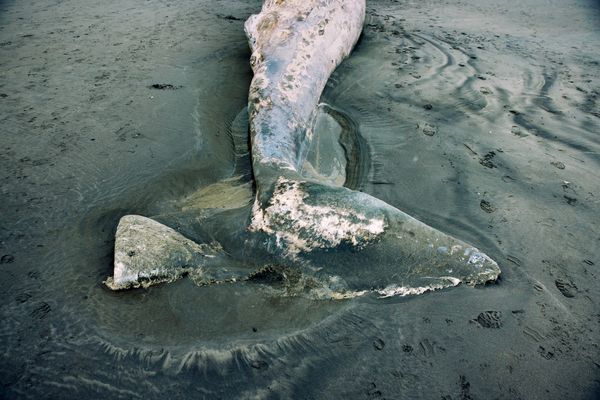
The bodies kept appearing as if out of nowhere. In March a whale corpse was found floating in San Francisco Bay, seagulls perched on top like vultures at carrion. Then, in April, a whale was found dead and beached in Oregon, the arc of its carcass camouflaged against the surf. That same month, another whale, this one a juvenile, was found lifeless and lodged among woody debris in a Washington State river, miles from the ocean.
As of mid-August, 187 gray whales have been found dead this year along the West Coast, from Mexico to Alaska. Scientists have scrambled to investigate, hoping to prevent further deaths in a species that has been in decline for years—gray whales lost 35 percent of their population between 2020 and 2025.
There’s been a “complete decline [and] a collapse of reproduction,” says Steven Swartz, co-director and senior scientist at the Gray Whale Research in Mexico program. The whale corpses now washing up on the West Coast hold clues as to why: many of them were emaciated, so much so that one scientist described them as “a bag of bones.”
On supporting science journalism
If you're enjoying this article, consider supporting our award-winning journalism by subscribing. By purchasing a subscription you are helping to ensure the future of impactful stories about the discoveries and ideas shaping our world today.
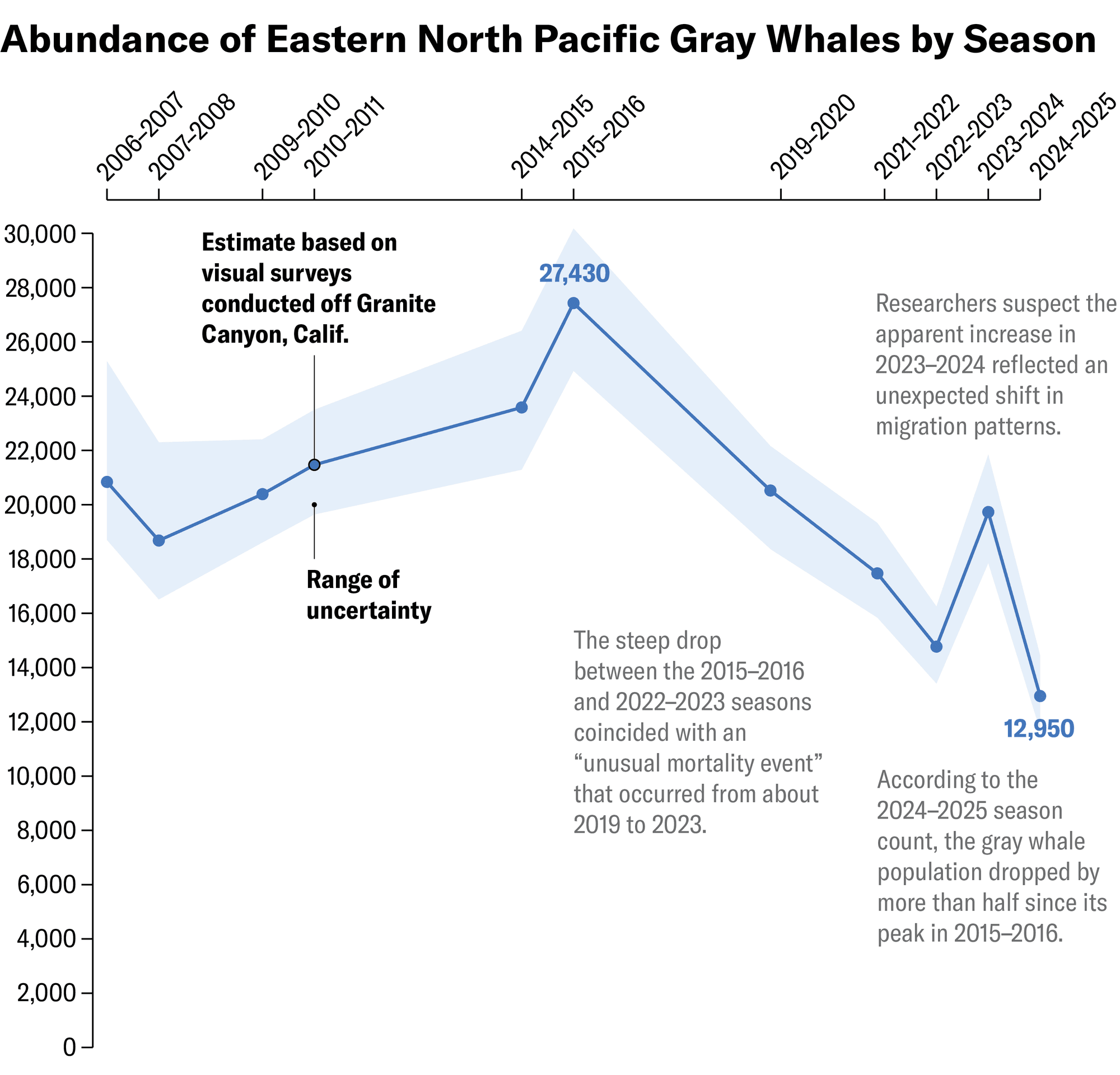
It’s an incredible and horrifying twist of fate for a whale that had until recently been a major conservation success story. Decimated by whaling in the 19th century, the eastern North Pacific gray whale population had bounced back from near extinction to roughly 20,000 animals by 1994, when the species was removed from the U.S. Endangered Species List. By 2016 the whales numbered some 27,000 individuals. But as of 2025, the population had plummeted to 13,000 or so, as whale after whale washed up on shores up and down the West Coast.
Scientists, meanwhile, have been racing to explain what is happening to the whales by studying the stranded corpses for signs and clues that could illuminate why they are dying in droves.
From Rebound to Population Plummet
Gray whales are baleen whales that have mottled skin, a dorsal hump, pointed pectoral fins and eyes set low above permanently frowning mouths. They can reach 49 feet long and weigh up to 90,000 pounds, as much as six large elephants. Each year they make one of the longest known mammal migrations on Earth, a roughly 10,000-mile round trip between Mexico and the Arctic. The whales are seasonal ecosystem engineers, stirring up nutrients on the seafloor as they feed.
The mysterious strandings began in earnest in mid-December 2018. And in 2019 the National Oceanic and Atmospheric Administration (NOAA) declared an unusual mortality event, triggering an international investigation. Scientists rushed to study the stranded whales, searching for clues. They took the whales’ measurements, inspected their bodies for signs of starvation or trauma, cut them open to examine their blubber and took samples from their organs. The analyses pointed to malnutrition as a common cause of death, followed by blunt force trauma consistent with being struck by boats.
In other words, the whales were either dying as a result of a lack of food or because boats had crashed into them.
The unusual mortality event officially ended in 2023 after strandings slowed—but the whales haven’t stopped dying. Instead the decline has only become “more alarming,” says John Calambokidis, senior research biologist and co-founder of the nonprofit Cascadia Research Collective. Though overall population numbers ticked up slightly this year, to an estimated 18,000, “the overall trend is still a decline,” says Aimée Lang, a research scientist with the U.S. National Oceanic and Atmospheric Administration’s Southwest Fisheries Science Center.
As scientists gather more evidence, it is becoming increasingly apparent that gray whales are starving to death. The reason why lies in the changing environment of the Arctic Ocean.
How Melting Sea Ice Is Starving Whales
Gray whales are mostly bottom-feeders, scooping up mouthfuls of sediment and invertebrates as they swim along the seafloor. They trap shrimplike amphipods and filter out the muck through baleen plates attached to their upper jaws, leaving wallows and billows of mud—a nutrient feast for other organisms—in their wake. This buffet is intricately linked to the Arctic sea ice and the algae that grows beneath it.
When the algae die, they fall through the water column to the seafloor, where they feed the crustaceans that gray whales eat. But with Arctic temperatures skyrocketing, the sea ice is melting earlier and faster, disrupting the food web the whales rely on.
That was the conclusion of a study published late last year in the ICES Journal of Marine Science that examined decades worth of data on the population sizes, births and deaths of gray whales and the biomass of Arctic crustaceans. It turns out that the health of the whales and the crustaceans ebbs and flows in near perfect synchrony, says study co-author Joshua Stewart, an assistant professor at Oregon State University’s Marine Mammal Institute. And though gray whale populations have dipped periodically before, this time is different: “We’re not seeing signs of the population quickly bouncing back like we did previously,” Stewart says. Essentially, the ecosystem can no longer support as many gray whales as it once did. As a result, the whales are starving.
“The whales are just basically running out of energy as they try to migrate and dying,” Swartz says. For years, he’s seen more and more skinny gray whales returning to the San Ignacio Lagoon, one of their breeding areas off the Baja coast. He is also seeing far fewer calves being born. Lang, who helps count mothers and calves as they migrate north along the California coast, says that last year the team counted just 17 whale pairs. From that, they estimate 85 calves were born in 2025, well below the 1,600 or so born in 2014.
Sign of Hope
As dire as the situation is, there is still a chance that gray whales can survive this. For one, the animals could adapt to changing conditions in the Arctic by looking for food elsewhere, Lang says. They’ve “shown pretty amazing behavioral flexibility already,” she adds.
Already there is evidence some gray whales are switching it up. A small group of gray whales called the Sounders detour from their northward migration to feed in Puget Sound, and then there is the Pacific Coast Feeding Group, which eschews the Arctic to feed between northern California and British Columbia.
There’s other evidence to suggest more whales are joining those alternative routes. Gray whales have also been seen more frequently in San Francisco Bay since 2018, and scientists suspect they’re searching for food there, too. But the heavy marine traffic in the Bay makes it a dangerous place for a whale: at least 18 percent of the whales that entered between 2018 and 2025 died there, according to a recent Frontiers in Marine Science study,many of which were killed by ships. A nascent system using AI and thermal cameras could help ships better spot the whales and reduce ship strikes, but it’s still being tested.
These efforts also do little to address the core threat to gray whales. “The challenge with this case is that the lever we have to pull is slowing or reversing climate change,” Stewart says. “It’s something we know we need to do, but we haven’t done it.”
As the summer turns to fall and gray whales begin their return journey south, scientists will be watching closely to see how many make it back and what condition they’re in when they get there.
“The big question in all our minds is just, where’s the bottom?” Stewart says. “I hope they turn around soon.”