
On supporting science journalism
If you're enjoying this article, consider supporting our award-winning journalism by subscribing. By purchasing a subscription you are helping to ensure the future of impactful stories about the discoveries and ideas shaping our world today.
Just in time for the Winter Olympics a glacier in Greenland is racing toward the sea.
During the summer of 2012 the Greenland glacier Jakobshavn Isbræ flowed into the ocean at the fastest speed ever observed for a glacier in Greenland or Antarctica, according to a paper published February 3 in The Cryosphere. At its speediest, satellite data indicate, the glacier was careering oceanward at a rate of 17 kilometers per year.
Although the glacier does slow some in the winter months, its average annual speed is still nearly three times what it was in 1992. The glacier is already believed to contribute measurably to global sea level rise. “We know that from 2000 to 2010 this glacier alone increased sea level by about one millimeter. With the additional speed it likely will contribute a bit more than this over the next decade,” said Ian Joughin, the lead author of the study and a researcher at the University of Washington, in a press release.
The glacier’s acceleration probably stems from a combination of warming temperatures and the local underwater topography. As temperatures have increased, the calving front of the glacier—where parts of it break off into the ocean to form icebergs—has moved closer inland. Right now that front has reached a deep basin, which means that there is more room for the glacier to flow into the ocean. “Basically, there’s less holding the glacier back, so it tends to flow faster,” Joughin says. He compares the phenomenon with a pipe through which the glacier is moving. If the end of the pipe expands, he says, everything flowing down the pipe can move more quickly.
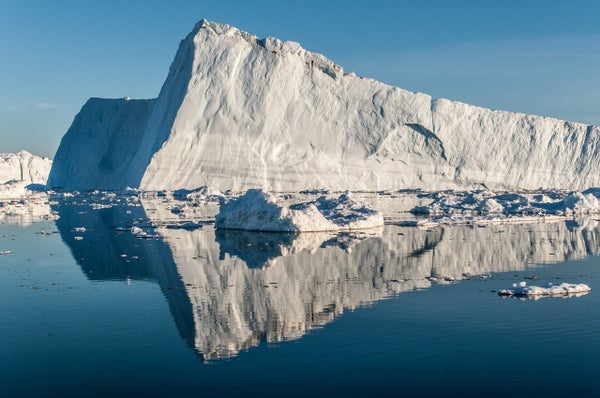
The photograph depicts an iceberg that has calved from the glacier.
—Geoffrey Giller