
Editor’s Note (12/16/24): This story is being republished following a shooting that left at least three people dead (including the shooter) and six others injured at Abundant Life Christian School in Madison, Wis., which has students from kindergarten through 12th grade.
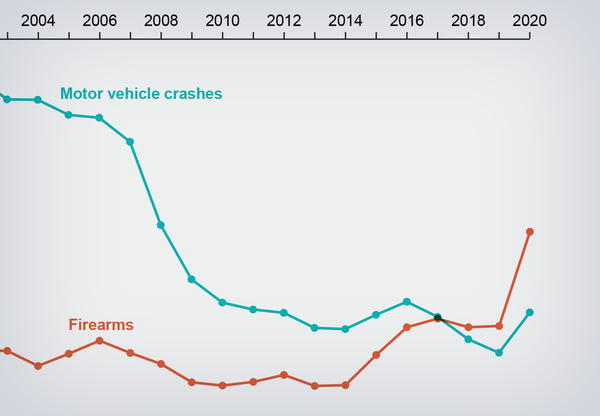
For much of the past few decades motor vehicle crashes were the most common cause of death from injury—the leading cause of death in general—among children, teenagers and young adults in the U.S. But now a new analysis shows that, in recent years, guns have overtaken automotive crashes as the leading cause of injury-related death among people ages one through 24.
The switchover, which happened in 2017, stems from both a reduction in vehicle-related deaths and a grim uptick in gun-related fatalities. From 2000 to 2020, the number of firearm-related deaths in the one-to-24-year-old age group increased from 7.3 per 100,000 people to 10.28 per 100,000, age-adjusted data from the Centers for Disease Control and Prevention reveal. During the same period, motor-vehicle-related deaths declined from 13.62 to 8.31 per 100,000.
On supporting science journalism
If you're enjoying this article, consider supporting our award-winning journalism by subscribing. By purchasing a subscription you are helping to ensure the future of impactful stories about the discoveries and ideas shaping our world today.
“The crossing of these trend lines demonstrates how a concerted approach to injury prevention can reduce injuries and deaths—and, conversely, how a public health problem can be exacerbated in the absence of such attention,” wrote Lois Lee, a senior associate in medicine at Boston Children’s Hospital, and her colleagues in the recent analysis of CDC data, which was published as a Perspective piece in the New England Journal of Medicine.

Credit: Amanda Montañez; Sources: Web-Based Injury Statistics Query and Reporting System, Centers for Disease Control and Prevention; “Crossing Lines—A Change in the Leading Cause of Death among U.S. Children,” by Lois K. Lee et al., in New England Journal of Medicine, Vol. 386, No. 16; April 21, 2022
The decline in vehicle deaths is largely the result of a concerted effort to track and study motor vehicle crashes. Congress established the National Highway Traffic Safety Administration (NHTSA) in 1970 with the goal of saving lives and preventing traffic-related injuries. One of the agency’s key actions was to create and maintain a public database of automobile deaths on U.S. roads, allowing researchers to identify ways to improve safety.
By contrast, no such federal agency exists to regulate the safety of firearms—and it took decades just to develop a national database for tracking firearm deaths, Lee and her colleagues noted in their paper. Furthermore, from 1996 to 2018, a rider in a government spending bill called the Dickey Amendment effectively discouraged CDC funding for research on preventing gun injuries. It prohibited the CDC from using its funds to “advocate or promote gun control,” which resulted in a freeze on gun violence research at the agency. That broadly interpreted directive was extended to the National Institutes of Health in late 2011. In 2018 Congress reinterpreted the Dickey Amendment to allow such research, and funding was finally granted in late 2019.
“There is robust funding for motor vehicle related research and interventions,” Lee says, yet “we have just begun to see federal funding for firearm research after 25 years of nearly no funding.”
Lee and her colleagues credited a number of safety improvements in vehicles for saving lives among children and teens. These measures include automatic braking and side airbags, as well as booster-seat laws and graduated licensing. Although all U.S. states require that people get a license and registration in order to drive a vehicle, a loophole in federal law allows people in many states to buy a gun from an unlicensed dealer without so much as a background check. And federal law shields gunmakers from some liability in negligence claims, including when guns fall into the hands of children—with lethal consequences, according to Lee and her team.
Linda Degutis, a lecturer at the Yale School of Public Health and former director of the CDC’s National Center for Injury Prevention and Control, says the new findings about cause-of-death trends in young people are not surprising. “We have not focused as much on interventions, on how we can keep people safe, given that there are firearms in our environment—and that includes children,” says Degutis, who was not involved in the new analysis. “We have been able to decrease fatalities from motor vehicle crashes in children and in young adults, [and] we’ve done it by using interventions that didn’t eliminate motor vehicles.... We have not focused on that same kind of strategy with guns.”
Many experts assert that the high rate of gun deaths among young people is not an inevitability and that it is possible to prevent such deaths by gathering data and doing research.
“As the progress made in reducing deaths from motor vehicle crashes shows,” Lee and her colleagues wrote, “we don’t have to accept the high rate of firearm-related deaths among U.S. children and adolescents.”