
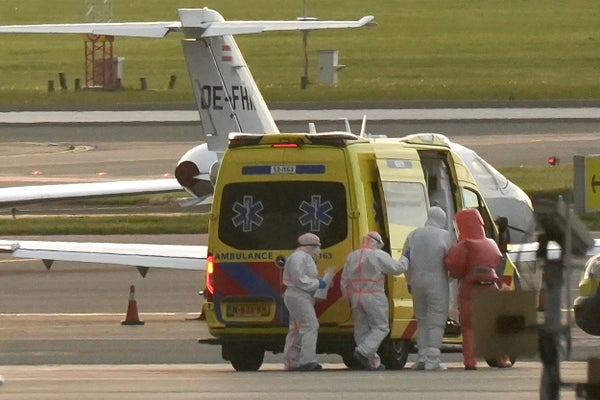
Several research groups are chasing antibody treatments for hantavirus, but a lack of funding and urgency means that potential therapies for humans are years away. In the meantime, public health officials and clinicians are working to contain an outbreak that began on a cruise ship last month that has so far sickened at least nine people, resulting in three deaths. Still more are suspected to be infected, and because of the virus’s long incubation time, more cases are almost certainly going to emerge.
Hantavirus is typically spread to humans who are exposed to infected rodents or their feces or urine. But the Andes virus, the type of hantavirus at the center of the current outbreak, is capable of spreading from person to person. There is no specific treatment for hantavirus; rather clinicians try to support patients and treat symptoms as they arise. This can range from ensuring that infected people get rest and hydration to intubating patients with a severe case in which breathing is impaired, among other actions. Still, there are potential therapies on the horizon that experts say deserve more attention as the outbreak unfolds.
Tony Schountz, an immunologist at Colorado State University, has studied antibody responses to hantavirus in rodents for years. More recently, his team has focused on searching for ways to prevent or treat the illness in people. Using white blood cells from humans infected with hantavirus, the researchers identified antibodies—proteins in the immune system that can identify and neutralize pathogens—that may be able to combat different strains of the virus.
On supporting science journalism
If you're enjoying this article, consider supporting our award-winning journalism by subscribing. By purchasing a subscription you are helping to ensure the future of impactful stories about the discoveries and ideas shaping our world today.
“We have animal data, and almost certainly they would work great, but we do not have human clinical trial material,” he says. “That’s unfortunate, because nobody cares until an outbreak occurs. Then there’s a brief period of interest, and then it goes away.”
Having shown the antibodies’ efficacy in animals, Schountz says that a next step would be to produce a cell line that could be used for larger-scale antibody production. Safety studies and human trials would follow, but those would require large monetary investments. “That’s where people like us always get stuck,” he says. “We have the lead candidates, but we don’t have the $25 [million] to $50 million to go the next step.”
Part of the reason for the lack of funding is the rarity of hantavirus outbreaks. While mortality rates from infection can be as high as 50 percent, depending on the virus type, as few as 10,000 infections occur globally each year, and most of these are in Asia and Europe, where the typical types are less fatal. In the U.S., fewer than 1,000 cases have been confirmed between 1993 and 2023.
Funding aside, that rarity has also posed a problem for researchers.
“Even if you got the funding to do [a clinical trial for hantavirus], another holdup could potentially be ‘Where’s the population to test the efficacy of this product?’” says Jason Botten, a professor at the University of Vermont’s Larner College of Medicine, who also researches potential antibody treatments for hantavirus. “That’s pretty hard. In the United States, you may only see five cases of infection in a year.”
Botten’s research has identified antibodies that attach to the surface of the virus’s glycoproteins—similar to the spike proteins found on the COVID-causing virus SARS-CoV-2. Once the antibodies attach to that protein, they can disrupt hantavirus’s ability to bind to host cells.
He notes, however, that it can take a decade or more for treatments to go through all the steps to be approved for use in humans. Certain past emergency cases, such as the COVID pandemic, were exceptions in which those wait times were drastically shortened. But hantavirus isn’t COVID, and even under a similarly accelerated timeline, any therapies would come too late to treat anyone who was infected on the cruise ship.
Meanwhile, the remaining passengers of the MV Hondius are starting to make their way back to their home countries. They include 18 Americans, 16 of whom are currently in the National Quarantine Center at the University of Nebraska Medical Center. Another two are quarantined at Atlanta’s Emory University Hospital.
World Health Organization director general Tedros Ghebreyesus said at a press conference on Tuesday that all the passengers have left the ship and will be monitored; the boat itself is sailing to the Netherlands.
Ghebreyesus also noted that 34 passengers who left the boat before the outbreak was confirmed have been identified and located. But because of the virus’s up-to-eight-week incubation period—the time between infection and when symptoms show up—more cases are likely.
Botten says that he hopes the global attention on hantavirus will register with policymakers and research funding groups.
“My hope is, out of this tragedy, maybe one of the good things that would come out is some new opportunities will be put in place to try and take some of these therapeutic candidates that our group and others have and move them forward in ways that we couldn’t have previously.”