
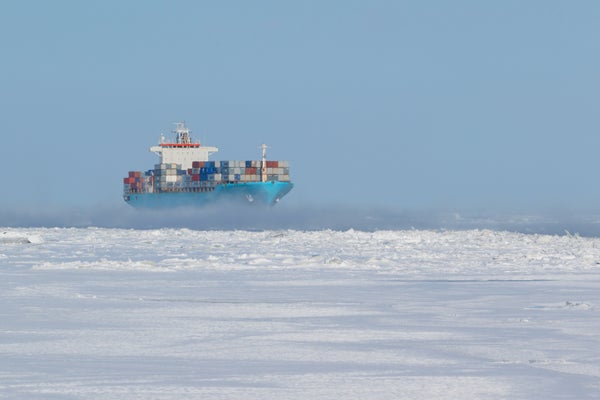
CLIMATEWIRE | Climate change is thinning Arctic sea ice, but contrary to conventional wisdom that’s making shipping through the North American Arctic more difficult.
A study published in Nature looked at Canada’s Northwest Passage over 15 years. It found that the melting of local ice due to global warming enables thicker ice from Greenland to flow into the corridor’s choke points, reducing the length of time when ships can move through the passage.
“First-year ice, that's retreating. But it means the thick ice — multiyear ice — is then more able to flow down into those areas,” lead author Alison Cook, a researcher at the Scottish Association for Marine Science and the University of Ottawa, said in an interview.
On supporting science journalism
If you're enjoying this article, consider supporting our award-winning journalism by subscribing. By purchasing a subscription you are helping to ensure the future of impactful stories about the discoveries and ideas shaping our world today.
That thicker ice poses hazards for ships, such as damage or sinking if there’s a collision.
The results contradict the common view that the Northwest Passage, the Arctic Ocean waterway linking the Atlantic and Pacific, is an increasingly practical option for commercial shipping. It even surprised Cook.
“I certainly was assuming the season length was becoming longer everywhere, and it just wasn't,” she said.
Cook and her colleagues looked at historical ice charts of the Northwest Passage and converted those into season lengths. The seasons indicate the number of weeks where medium ice-strength ships can traverse the passage without taking extra safety precautions.
Four regions saw significant changes. In three, the shipping season was shortened by 50 to 70 percent between 2007 and 2021. In one — the eastern Lancaster Sound — the season length grew by 15 percent.
Shipping seasons typically run between 15 and 25 weeks, though it fluctuates heavily between years and regions.
Changing ice has discouraged at least one passenger cruise line from sailing the passage.
Scenic Luxury Cruises and Tours crossed the Northwest Passage in 2022, but “because of the sensitive environment and ever-changing ice conditions and weather conditions of the Arctic, they redeployed their sailings after that season,” said Michelle Abril, vice president of Coyne PR and a spokesperson for Scenic. “They are not currently sailing there or have itineraries set through Q1 2027 to visit that region.”
Despite the shrinking seasons, crossings have — on average — increased over the past decade, according to data provided to POLITICO’s E&E News by the Canadian Coast Guard.
“Over the coming years, the Canadian Coast Guard anticipates an increase in arctic traffic, due to increased tourism, commercial shipping, and adventuring opportunities,” the Coast Guard said in a statement.
While the trends show voyages rising and season lengths decreasing, there are a couple of explanations for that apparent contradiction.
The first is demand. Shipping companies are eyeing alternatives to the narrow and congested Panama Canal. And adventure tourists are eager to trek into the Arctic.
Then, there’s the location of multiyear ice. The three regions where the study found shorter shipping seasons are along the northern route of the Northwest Passage. The southern route remains mostly unaffected by the thicker ice coming down from Greenland.
“The southern route of the Northwest Passage, that's where there is an increase in ships going through,” Cook explained. “People have their eye on the northern parts of the Northwest Passage. It's shorter. People would want to go that way more than the southern, but they still haven't really because of the presence of ice.”
The Danish maritime logistics company Royal Wagenborg, which ships through the Northwest Passage, declined a request for comment citing “confidential information.”
Stephen Howell, one of Cook’s co-authors and a research scientist for the Climate Research Division at the Environment and Climate Change Canada government department, said the thicker ice from farther north will continue to flow down and endanger ships along the northern route for decades to come.
“Ten years, 20 years — as long as that ice is still there, the risk is going to be still there,” Howell said in an interview.
Yet even the thicker ice will eventually melt because of rising temperatures, said Julienne Stroeve, a scientist with the National Snow and Ice Data Center at the University of Colorado, Boulder.
“I would imagine if we don’t drastically reduce GHG emissions, after 2050 there will not be a lot of ice to enter into the [Canadian Arctic Archipelago] from the Arctic Ocean and thus the [Northwest Passage] will mostly be ice-free in summer,” Stroeve said.
Reprinted from E&E News with permission from POLITICO, LLC. Copyright 2024. E&E News provides essential news for energy and environment professionals.