
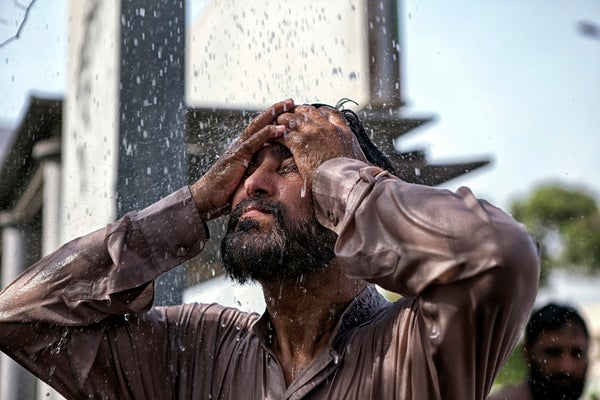
Over the hundreds of thousands of years of our existence on the planet, modern humans have managed to adapt to a huge range of climates—from the arid heat of the Sahara Desert to the icy chill of the Arctic. But we have our limits. If temperatures and humidity rise high enough, even a robustly healthy person sitting still in the shade with access to water will succumb to the heat.
As heat waves grow hotter and more frequent, research has suggested some places will begin to see events that reach that limit of human tolerance in the coming decades. But now a new study shows they already have. The findings, published on Friday in Science Advances, underscore the need to rapidly curtail emissions of heat-trapping greenhouse gases and develop policies that will help vulnerable populations stay cool.
High temperatures prompt the human body to produce sweat, which cools the skin as it evaporates. But when sky-high humidity is also involved, evaporation slows down and eventually stops. That point comes when the so-called the wet-bulb temperature—a measure that combines air temperature and humidity—reaches 35 degrees Celsius (95 degrees Fahrenheit).
On supporting science journalism
If you're enjoying this article, consider supporting our award-winning journalism by subscribing. By purchasing a subscription you are helping to ensure the future of impactful stories about the discoveries and ideas shaping our world today.
Previous analyses using climate models suggested that parts of the Persian Gulf region, the Indian subcontinent and eastern China would regularly see heat waves breaching this limit by later in the century. But they looked at broad areas over several hours, which can mask more localized, shorter-term spikes in extreme conditions. To see what other researchers might be missing, “we decided to zoom in a little bit closer,” says Colin Raymond, who conducted the new study when he was a Ph.D. student at Columbia University.
Raymond and his co-authors examined temperature data from more than 7,000 weather stations around the world going back to 1979. They found that extreme humid heat occurs twice as often now as it did four decades ago and that the severity of this heat is increasing. Many places have hit wet-bulb temperatures of 31 degrees C and higher. And several have recorded readings above the crucial 35-degree-C mark. Identifying that trend is “important because it builds on [weather] station data, which is the most direct evidence that we usually have,” says Massachusetts Institute of Technology climate scientist Elfatih Eltahir, who was not involved in the new research but has done previous work on the topic.
These humid heat extremes have already emerged in the same places that earlier modeling studies had identified as future hotspots. Most are coastal areas that are both near warm bodies of water, which can supply abundant moisture, and subject to soaring overland temperatures. Others, particularly in the Indian subcontinent, are regions where monsoon winds usher in moisture-laden air.
Given the paucity of weather stations in some of the involved places, such as parts of Pakistan, “there’s probably even higher [wet-bulb] values out there,” says Raymond, who now works at NASA’s Jet Propulsion Laboratory. The highest extremes were typically only reached for an hour or two, so they do not yet necessarily hit the limit of human tolerance. But such events will start to last longer and cover larger areas in a warmer future. Also, even much lower wet-bulb temperatures can be deadly, particularly to the elderly or those with underlying health conditions. The historic heat waves that killed thousands of people across much of Europe in 2003 and in Russia in 2010 never had a wet-bulb temperature above 28 degrees C. “These are very, very nasty conditions,” Eltahir says.
The new paper also found that parts of the world will regularly see wet-bulb temperatures higher than the 35-degree-C limit if global average temperatures rise just 2.5 degrees C above those of the preindustrial climate. The world has already warmed about 1 degree C above that level. “These kinds of events can become a regular occurrence with not much more warming than we’ve experienced,” says Kristina Dahl, a senior climate scientist at the Union of Concerned Scientists, who was also not involved with the study.
That projection underscores the need to rapidly reduce greenhouse gas emissions to limit global warming as much as possible, which would restrict how often such events might happen in the future. It also raises several questions, including what policies governments will need to develop to safeguard vulnerable groups, such as establishing cooling centers for elderly residents or sending out warnings before heat waves. And industries whose workers toil outdoors—such as agriculture and construction—may need to shift their schedules to cooler times of day. Even in the abundantly air-conditioned U.S., heat currently kills more people than cold, floods or hurricanes.