
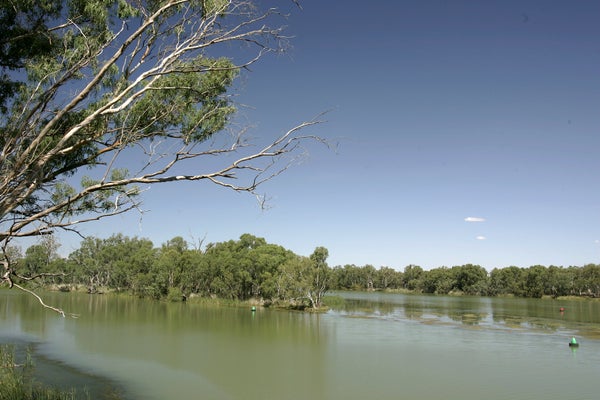
Hundreds of thousands of native fish in Australia’s Darling River have died following a major outbreak of blue–green algae and some severe weather. Two mass die-offs have been reported near Menindee in western New South Wales—the first was late last year, and the second last week.
Outbreaks of blue–green algae (cyanobacteria), which thrive in warm water, are not uncommon during droughts. The algae did not directly cause the mass die-off; rapid cooling and intense rainfall might have disrupted the bloom and depleted the amount of dissolved oxygen in the water, killing the fish, said Anthony Townsend, a senior fisheries manager at the New South Wales Department of Primary Industries, in a statement.
But low water levels in the river have compounded the die-offs, which have greatly affected native species such as bony herring (Nematalosa erebi), golden and silver perch (Macquaria ambigua and Bidyanus bidyanus, respectively) and the vulnerable Murray cod (Maccullochella peelii) . “Unfortunately, the main causes of this distressing event are the lack of water flowing into the northern rivers, and the impact of 100 years of over-allocation of precious water resources throughout the entire basin,” says the Murray–Darling Basin Authority, a statutory agency that oversees the basin through which the river flows.
On supporting science journalism
If you're enjoying this article, consider supporting our award-winning journalism by subscribing. By purchasing a subscription you are helping to ensure the future of impactful stories about the discoveries and ideas shaping our world today.
Basin plan
The basin supports around 40% of Australia’s agricultural production by value, with much of the water going to dairy farming, cotton and rice. But removing water for agriculture has caused major environmental problems, including increased salinity and reduced river flows, and the system is now under threat.
In 2012, state and national governments agreed on an Aus$13-billion (US$9.4-billion) plan to reallocate 3.2 trillion litres of water to the environment, through a mix of buying back water allocations from farmers and installing water-efficiency infrastructure, by 2024.
But an independent assessment of the basin plan in 2017 concluded that its progress had stalled and was at risk of failing, in part because the national government had reduced the amount of water that could be bought and returned to environmental flows. Sarah Hanson-Young, a member of the Australian Greens party, says this has contributed to the current low water flows, and has urged the government to return more water to the environment.
Bill Shorten, the leader of the country’s opposition Labor party, has called for the government to establish an emergency scientific taskforce to investigate the die-offs.
Agencies have warned that further die-offs are likely over the next few months, with heatwaves forecast across south-eastern Australia this week and dry conditions set to continue.
This article is reproduced with permission and was first published on January 15, 2019.