
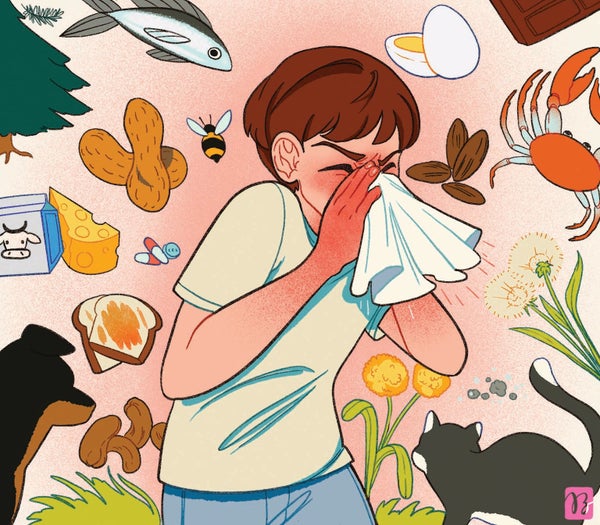
I stopped sending peanut butter and jelly sandwiches to school with my kids around 2007. That was roughly the moment when people started talking about a dramatic rise in the number of children with serious nut allergies. Cases of all kinds of allergies in youngsters have increased since then. The prevalence of asthma has doubled since the 1980s, and more than one quarter of children have eczema, food allergies, or hay fever or other seasonal allergies.
A host of studies from around the world strongly suggest that our allergy epidemic is the result of reduced exposure to germs in early life. During this critical window of time, an infant’s immune system learns to defend against dangerous microbes and to tolerate good ones that can live in the gut and aid in processes such as digestion. This immune education comes from encountering a wide variety of germs. But as social habits have changed, leading us to spend more time indoors, these encounters have been reduced, and immune overreactions—allergies—have climbed.
This idea, introduced decades ago as the “hygiene hypothesis” and refined over the years, is supported by epidemiological studies showing that having older siblings, attending day care, living on a farm and having pets protect against allergies. But more antiseptic early lives—delivery by cesarean section, not receiving breast milk and getting antibiotic therapy in the first year of life—seem to increase risk.
On supporting science journalism
If you're enjoying this article, consider supporting our award-winning journalism by subscribing. By purchasing a subscription you are helping to ensure the future of impactful stories about the discoveries and ideas shaping our world today.
Now stronger evidence is emerging that clarifies the ways that microbes inside children’s guts can trigger allergies. Scientists are working out how the presence or absence of certain bacteria in kids’ digestive systems affects allergic risk, thanks to technological advances that let researchers identify more types of gut microbes. Someday it might be possible to replace certain microbes in children and in the population at large and thereby lessen people’s susceptibility to allergies.
The presence of certain innocuous bacteria early on creates a welcoming environment for other, helpful bacteria to follow.
In infancy, the gut microbiomes of children who later develop allergies or asthma look different from those of children who don’t go on to have allergies. “Children who are at the highest risk are missing important health-promoting bacteria in that first year of life,” says Stuart Turvey, a pediatric immunologist at the University of British Columbia and British Columbia Children’s Hospital.
Among other things, the presence of certain innocuous bacteria early on creates a welcoming environment that allows other, helpful bacteria to follow in predictable waves. If those first “keystone” bacteria are missing, the subsequent waves of colonization are delayed or disrupted. “Microbial exposures in early life can really shape the immune system in ways that they can’t much later in life,” says Supinda Bunyavanich, a pediatric allergist and immunologist at Mount Sinai in New York City.
In a study of more than 1,100 children published in 2023, Turvey and his colleagues found that children who had these microbiome disruptions at age one were more likely to be diagnosed with eczema, food allergies, allergic rhinitis or asthma at age five. “Not every kid gets all four [diagnoses], but often the kids who had two or more had a more pronounced microbiome imbalance signature,” he says.
Work in mice has helped researchers determine which microbes are especially influential and why. Talal Chatila, a physician who directs the food allergy program at Boston Children’s Hospital, found that giving allergy-prone mice microbes from the orders Clostridiales and Bacteroidales protected the animals from developing food allergies. “Particular microbes within a healthy gut act to suppress allergic responses,” Chatila says. One way they do that is by promoting the formation of regulatory T cells, which help to control immune system responses.
Another type of bacteria that has a positive effect on humans is Bifidobacterium infantis, which eats sugars in breast milk and is more abundant in some children who are breastfed. B. infantis was once common in people’s guts but is much less so now in Western countries. “Only 16 percent of Canadian kids have this, and rates are lower in the U.S.,” Turvey says. Among youngsters who had to have antibiotics in infancy, the presence of B. infantis protected them against developing asthma by age five, Turvey’s studies have shown. Antibiotics reduce microbial diversity in the gut, but these particular bacteria seem to counter those negative effects.
Multiple clinical trials are underway to test allergy treatments with “cocktails” of selected bacteria. Most of these trials involve treating infants who are at high risk for allergies and then following them through childhood to see whether the treatments keep the children allergy-free. For prebiotics and probiotics now on the market, there is no convincing evidence that they can make allergies go away.
Biotherapeutics are not the only answer. Avoiding unnecessary cesarean sections and antibiotics and enacting policies that support breastfeeding could also help, Bunyavanich says. She is working on a trial comparing children born vaginally, who are exposed to microbes in the birth canal, with children born by C-section who had the mother’s vaginal fluids applied at birth. Both will be compared with children born by C-section without any microbial exposure.
The scientists will follow the kids through early childhood to see who has an increased risk of allergies. If this and the other trials do reduce allergies, bringing back the microbes we’ve lost could turn out to be a key health strategy.