
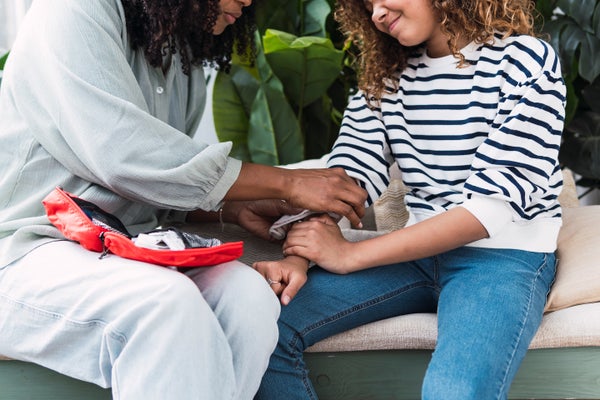
A few years back I cut myself on a broken glass. I scampered about my apartment looking for a Band-Aid. As an anesthesiologist and cardiologist, I had airway equipment to insert a breathing tube, medication for a heart attack, resuscitation equipment that included an automated external defibrillator (AED). But no basic first aid. Needless to say, that was rectified quickly. It brought me to thinking, though, about what is medically essential for monitoring our health and wellness—not a breathing tube—in addition to addressing minor household injuries.
We always hear about the wisdom of having canned food, extra bottled water, a flashlight and other sundries in the event of a calamity. Similarly, there are certain medical items that everyone should keep on hand, regardless of age. Despite social media, smartwatches, smartphones and clever apps, first aid kits should hold some relatively inexpensive, but valuable, devices:
Oximeter: This probe with the little red light—often compared to E.T. The Extra- Terrestrial’sglowing fingertip—is an extremely valuable product. (Yes, I am dating myself with that analogy.) It measures our oxygen saturation, which reflects how well our lungs, and indirectly our heart, are ensuring that our organs are getting enough oxygen. In operating rooms in the 1980s, they were bulky, heavy and very expensive (over $5,000), but with time, they have become extremely portable (the size of an ear pod case) and reasonably priced (as little as $25). They also provide heart rates, and some can determine whether your heart is beating at a regular pace. With respiratory illnesses from seasonal flu to RSV loose, this is very valuable. It will help your doctor decide on whether you need to visit the office or more seriously, proceed to the emergency room.
On supporting science journalism
If you're enjoying this article, consider supporting our award-winning journalism by subscribing. By purchasing a subscription you are helping to ensure the future of impactful stories about the discoveries and ideas shaping our world today.
Blood pressure cuff: In decades past, the monitoring of high blood pressure required frequent visits to the primary care physician, and the measurement was only reflective of one specific moment on one day. Perhaps a hectic bus ride, a challenge finding a parking spot, or a waiting room delay—not to mention “white-coat hypertension”—caused added stress, resulting in an elevated number. A blood pressure cuff should be in every home. Though some simply slip onto the finger, I personally believe that the best choice is designed for the upper arm. The most accurate recordings are obtained after resting in bed for a few minutes, lying flat with your legs uncrossed. And probably not watching a suspenseful movie or with the need for a bathroom visit. It is wise to check it a few times, one minute apart from each other—just for accuracy. Lastly, it never hurts to keep a log of what the readings are so that you can share it with your doctor.
High blood pressure, or hypertension, is called the silent killer as it puts us all at risk of stroke or heart attack, and can even contribute to dementia. Checking it is an easy preventive measure and wise for all of us. When I was a medical student first learning how to take a person’s blood pressure—in the days before automated machines—I convinced my mother to let me check hers. She always had low blood pressure, so when I found it was elevated, she reflexively said that I must be doing it wrong. My father, a physician, was called in to check, and that is how we diagnosed her hypertension.
Thermometer: Mercury in the glass thermometers have been replaced with newer devices to measure temperature. Their infrared technology can rapidly determine forehead temperature within a second with varied accuracy by product and measuring location, where the very middle of your forehead is best. A notable fever (temperature greater than 100.4 degrees Fahrenheit or 38 degrees Celsius) is important to track and perhaps seek medical attention over, depending upon other medical conditions, signs and symptoms; including breathing problems, shivering and confusion, all signs of possible sepsis.
For those with children at home, early identification of a fever helps pediatricians. Rapid elevations in temperature, particularly in children of ages six months to five years old, can cause febrile seizures
Eyewash: We sometimes forget how easy it is to splash something into our eyes. Available over the counter, eyewash is worth having at your disposal. Just keep it in an easy-to-remember place. After all, the last thing you want with an irritated eye is a long search for the very product than can help you see better. Dangerous chemicals, splashes and small foreign bodies are best to flush as soon as possible. Don’t touch the tip of the container to your eye as it risks contamination. Discard it after such use. Finally, don’t confuse eye drops with eyewash; the former lubricate whereas the latter cleanses eyes.
Humidifier: Humidifiers can alleviate allergy symptoms, improve sleep and help those with sinus problems or skin irritation. They also help during cold and flu season. By soothing the tissues that make up our nose and throat, humidified air decreases the itchiness and nasal discharge that we experience with a respiratory illness. Humidifiers may help with snoring, by thinning nasal secretions, which will make for a more comfortable sleep (the dangers of sleep apnea include increased chances of heart disease so it should be evaluated by your doctor). Besides the benefits of humidifiers, though, one should always keep them clean to prevent mold or bacteria.
Prevention is a key component to health and wellness These five items contribute to that goal. Remember to keep available, with the appropriate supply, any prescribed medicines. Check the expiration dates on over-the-counter products as well. I have made it a habit to do this twice a year, using the day we change our clocks as my reminder. This includes antihistamines, acetaminophen, ibuprofen and even topical solutions for cuts and bruises. Patients who have specific medical conditions should be sure to have products tailored for their health care; glucometers for diabetics, inhalers for asthmatics, EpiPen for those with a risk of serious allergic reactions, and it never hurts to have a rapid COVID test and a mask or two sitting in the medicine cabinet. Don’t let a broken glass, or other mishap, serve as your reminder to restock the medicine chest. Stay well, stay healthy!
This is an opinion and analysis article, and the views expressed by the author or authors are not necessarily those of Scientific American.