
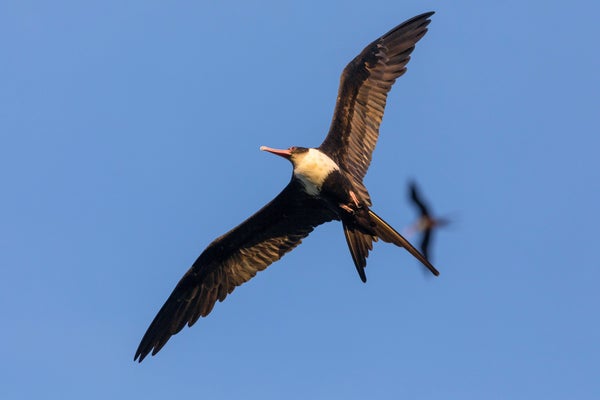
CLIMATEWIRE | Great frigatebirds are among nature’s most effortless fliers, routinely soaring more than a mile above the ground and sometimes staying aloft for weeks at a time.
Now scientists have a new reason to be impressed with their skills. Researchers have recently discovered — by chance — that great frigatebirds can collect helpful climate data as they traverse the high skies.
They found that frigatebirds fly high enough to skim the edge of the planetary boundary layer, a low layer of the atmosphere that interacts with the surface of the Earth to influence clouds, winds and other weather-related factors. They can collect all kinds of useful atmospheric measurements when they’re outfitted with special sensors.
On supporting science journalism
If you're enjoying this article, consider supporting our award-winning journalism by subscribing. By purchasing a subscription you are helping to ensure the future of impactful stories about the discoveries and ideas shaping our world today.
“I would call it serendipity,” said NASA scientist Ian Brosnan, who presented the findings last week at the annual fall meeting of the American Geophysical Union, the world’s largest Earth and space science society.
The happy accident began about two years ago with a NASA project known as the “Internet of Animals,” an initiative aimed at developing satellite-based animal tracking systems to aid with conservation and ecological research.
Brosnan, who was working on the project, hired several researchers to join his team. One of them — NASA ecologist Morgan Gilmour — had previously worked on a project involving frigatebirds.
That initiative, a collaboration among the U.S. Fish and Wildlife Service, the U.S. Geological Survey, The Nature Conservancy and other institutions, was aimed at assessing the effectiveness of a marine protected area around Palmyra Atoll, part of a chain of Pacific islands southwest of Hawaii. The researchers attached special sensors to the birds to monitor their movements around the area, a routine form of ecological research.
When Gilmour showed him the frigatebird data, Brosnan suddenly had an idea.
“Immediately I was like, ‘I’ll bet these birds are sampling the planetary boundary layer,’” he said.
In the past, scientists have used ground-based instruments, planes or satellites to measure the height of the planetary boundary layer. The researchers compared some of these previous measurements with the bird sensors and found they were a close match — the birds collected accurate data.
These kinds of measurements could be a useful supplement to traditional sampling methods, Brosnan theorized. Frigatebirds live in remote parts of the world, like Palmyra, where measurements are often difficult to collect by means other than satellites. They also spend long periods of time in the air, even at night, when some remote sensing systems can’t function without sunlight.
Brosnan is now searching for other scientists who could use the data — that's one of the reasons he brought his presentation to the AGU conference. The findings so far are just preliminary measurements, but he hopes to continue with more trials in the future.
The project demonstrates the potential connections between animal tracking projects and other kinds of research, Brosnan added.
“We often use satellite data to provide context for animal movement,” he said. “But the other things should be true — the animals and their movement should be sampling their environment and telling us something about it.”
Reprinted from E&E News with permission from POLITICO, LLC. Copyright 2023. E&E News provides essential news for energy and environment professionals.