
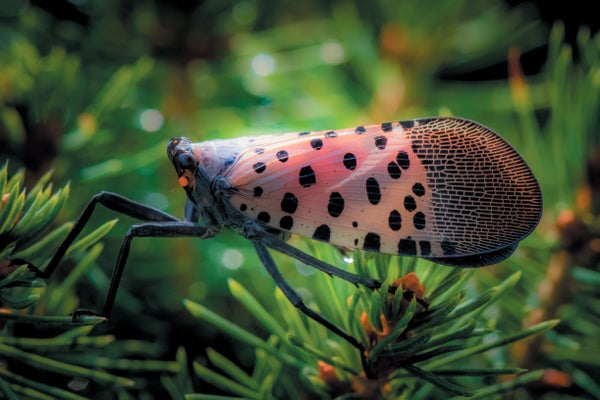
Ever since the seemingly indestructible spotted lanternfly began to infiltrate the U.S. East Coast in 2014, the hunt has been on for a way to stop it. The bug has devastated trees, grapevines, and other fruit crops, earning it a listing of potentially the most destructive invasive insect in 150 years by Pennsylvania State University. Its excrement, called “honeydew” by entomologists, feeds sooty mold and draws stinging insects. Managing the pest has proved difficult; it has no natural predator, and thus far there is no foreseeable end to its plaguing swarms.
USDA researchers have now found that lanternflies have an affinity for certain vibrations, they report in the Journal of Economic Entomology. “There was an anecdotal rumor that they were gathering near power lines,” says study co-author Richard Mankin, an entomologist with the USDA Agricultural Research Service. For the new study, the team members wanted to see whether vibrations influence the bugs’ movements on a surface. They found that in a laboratory setup, the bugs detected and moved toward 60-hertz vibrations (the common buzzlike frequency of power lines) generated with a speaker, says Miriam Cooperband, an entomologist with the USDA’s Animal and Plant Health Inspection Service, who designed the study.
This reaction suggested the creatures might communicate using surface-transmitted vibrations, so Cooperband and her colleagues are now examining the vibrations the lanternflies produce. Understanding such communication signals may be key to setting an effective trap, Cooperband says. Beyond frequencies that attract the lanternflies, “there might be other types of signals that, when applied a certain way, might jam their communication and disrupt mating or even drive them away,” she says.
On supporting science journalism
If you're enjoying this article, consider supporting our award-winning journalism by subscribing. By purchasing a subscription you are helping to ensure the future of impactful stories about the discoveries and ideas shaping our world today.
Many attempts have been made to vanquish the spotted lanternfly, but its behavior differs from that of other pests that entomologists are used to managing, Mankin says. For example, lanternfly females and nymphs gather in massive swarms, called aggregations, that are not clearly tied to mating—so the typical pest-control method of disrupting reproduction is difficult to apply.
“The lanternfly is a freak bug, and there’s a long way to go to unlock all its secrets,” says Brian Walsh, a horticulture educator at Penn State who has also been investigating how to effectively manage the pest. He says that although this new research is interesting, it needs more refinement before it might produce a broadly usable pest-management approach. “I hope that it does work out and that a scalable tool can be developed as a lure for the spotted lanternfly that produces more than a hyperlocalized impact,” he says. “That would be a massive game changer in our management efforts, as none currently exist.”