
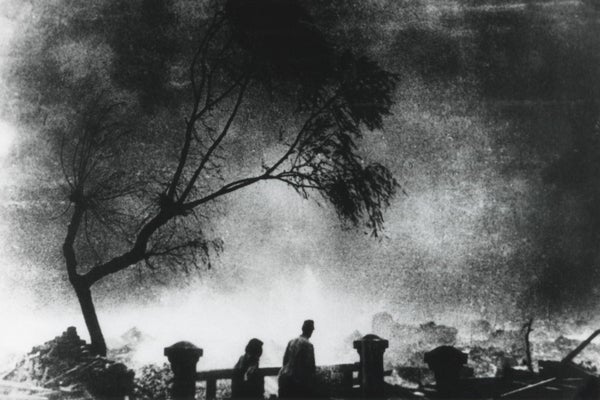
On August 6, 1945, the U.S. used an atomic bomb for the first time in history, against the city of Hiroshima. The U.S. dropped another atomic bomb on Nagasaki three days later. Experts estimate that the two bombs instantly killed more than 100,000 people.
The movie Oppenheimer has rightly received critical acclaim as a masterful recounting of the American effort to build those bombs and some scientists’ ethical anguish over their development and use. The movie presents the witch hunt and dismissal of the project’s scientific director, J. Robert Oppenheimer, in the vicious government war on science and culture during the Red Scare moral panic of the late 1940s and early 1950s.
But an equally disturbing and important story should not be forgotten—the fate of the more than 500,000 hibakusha, those Japanese civilians who survived the nuclear bombing of the cities of Hiroshimaand Nagasaki.
On supporting science journalism
If you're enjoying this article, consider supporting our award-winning journalism by subscribing. By purchasing a subscription you are helping to ensure the future of impactful stories about the discoveries and ideas shaping our world today.
American leaders wanted information about the human cost of fighting what many thought was an inevitable nuclear war against the Soviet Union. Japanese survivors of nuclear bomb attacks were drafted for study with no informed consent and no discussion of the risks of radiation. Within six weeks of the bombings, U.S. and Japanese expert teams were in both cities studying the biological impact of radiation while saying nothing about their suppositions of its dangers. The survivors’ enrollment began just as the victorious Allies concluded Nuremburg trials of Nazi doctors and scientists, which ended with convictions for atrocities including treating unwilling people as guinea pigs.
On November 26, 1946, President Harry Truman authorized the National Academy of Sciences/National Research Council to establish the Atomic Bomb Casualty Commission (ABCC) “to undertake long range, continuing study of the biological and medical effects of the atomic bomb on man.” The authorization noted that Japanese people who were exposed to radiation “[offered] a unique opportunity for the study of the medical and biological effects of radiation which is of utmost importance to the United States.” The ABCC was formed not out of concern for helping Japanese civilians who survived, but to manage future risks associated with atomic energy including a possible nuclear war involving Americans.
American researchers did not consider the physical damage caused by blowing up large Japanese cities to be of great importance. They were more interested in who survived, who died later and how badly hurt others were, post-detonation, in order to prepare a medical triage response for American cities. The longer-term effects of exposure to the radiation emitted by the bombs on fetuses in utero and future generations was also of deep concern.
The ABCC moved, in 1947, under the aegis of the newly established Atomic Energy Commission (AEC), which succeeded Oppenheimer’s Manhattan Project. The AEC, which was to develop and test bigger atomic bombs, wanted the ABCC to help ensure public support for possible nuclear war by showing that Hiroshima and Nagasaki had not created “a generation of genetic monsters.”
As M. Susan Lindee observed in her magisterial 1994 book on the survivors of these atomic attacks, Suffering Made Real, the Japanese deeply resented being studied following the bombings. Civilians felt both unjustly harmed by America and then exploited by us as research subjects. The ABCC offered them no help or benefits because to do so would be seen as an admission of American responsibility for the nightmare that the bombs had caused for so many Japanese survivors.
Help for the victims was slow to arrive. In 1954, the crew members of a Japanese fishing boat, the Daigo Fukuryu Maru (Lucky Dragon No.5), were exposed to radiation from an American hydrogen bomb test at Bikini Atoll in the Marshall Islands. In response to the attention created by this incident, more Japanese bomb survivors began requesting national support to cover the costs of their medical treatment, disabilities and living expenses.
It wasn’t until 1953 that the City of Hiroshima and the Hiroshima City Medical Association established the Hiroshima Atomic Bomb Survivors’ Treatment Council (ABSTC) to offer free medical treatment, health checkups and a new specialty hospital for survivors. Japan finally enacted the A-bomb Survivors Medical Care Law in 1957, more than a decade after the attacks, which enabled survivors to receive health examinations and medical care, although there were huge arguments over who would to be eligible.
Those who survived Oppenheimer’s bombs wound up providing, without real informed consent or treatment assistance, key data on blast injuries and radiation effects that proved useful for American military planning in the event of a nuclear war. Civilian casualties went many years with no systematic treatment since the research findings about radiation were kept secret. The fear of having to fight an all-out nuclear war against the USSR and the moral panic that ensued led to the maltreatment not just of one physicist, but of many in the U.S. and Japan.
This is an opinion and analysis article, and the views expressed by the author or authors are not necessarily those of Scientific American.