
On a recent morning, in Lower Manhattan, 20 scientists, including me, gathered for a private screening of the new film Don’t Look Up, followed by lunch with the film’s director, Adam McKay.
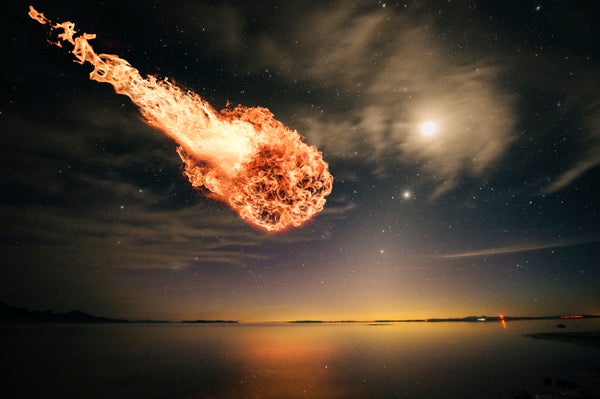
The film’s plot is simple. An astronomy graduate student, Kate Dibiasky (Jennifer Lawrence), and her professor, Randall Mindy (Leonardo DiCaprio), discover a new comet and realize that it will strike the Earth in six months. It is about nine kilometers across, like the one that wiped out the dinosaurs 66 million years ago. The astronomers try to alert the president, played by Meryl Streep, to their impending doom.
“Let’s just sit tight and assess,” she says, and an outrageous, but believable comedy ensues, in which the astronomers wrangle an article in a major newspaper and are mocked on morning TV, with one giddy host asking about aliens and hoping that the comet will kill his ex-spouse.
On supporting science journalism
If you're enjoying this article, consider supporting our award-winning journalism by subscribing. By purchasing a subscription you are helping to ensure the future of impactful stories about the discoveries and ideas shaping our world today.
At last, mainstream Hollywood is taking on the gargantuan task of combatting the rampant denial of scientific research and facts. Funny, yet dead serious, Don’t Look Up is one of the most important recent contributions to popularizing science. It has the appeal, through an all-star cast and wicked comedy, to reach audiences that have different or fewer experiences with science.
Many mainstream movies that include elements of science are ridiculous, but Don’t Look Up hits the right balance. My colleagues in astrophysics will surely nitpick a few scenes, and there are transgressions, but they have no effect on the film’s purpose and provenance, especially to anyone who understands the machinations of theater and the mechanisms of science. Any professional astrophysicist need suspend disbelief for only a few minutes out of the movie’s roughly 130. For science enthusiasts, easter eggs—the little hidden jokes —abound as well.
Those gems of science pervade the film because of McKay’s insistence that a practicing scientist, Amy Mainzer, be part of the production. Mainzer was the film’s “astrotech adviser” and is the principal investigator for NASA’s NEOWISE mission, which is tasked with finding and characterizing near-Earth objects (NEOs). Mainzer spent months with the cast and crew and helped write some scenes.
Astronomy might be one of the first areas in academia that wrestled with what, years later, became the Me Too movement. The student-advisor relationship, critical to the growth and development of scientists, has been shaken by the problem of harassment.
But one touching detail that she enabled was the relationship between the female graduate student and her male adviser. It is mutually caring, sometimes personal, but unquestionably professional. In the film, Mindy and Dibiasky have a warm relationship. They even hug and comfort each other. I suspect some of my colleagues might have a visceral reaction to this, but I found it refreshing. Research is vastly more productive and fun if students and advisers, who often spend a lot of time together professionally, get to know each other as people.
That aside, the promotion by the film’s crew of another issue is misguided: they want us all to believe that the film is about climate change. Indeed, the director said, when he talked to our group of scientists after the screening, that he wanted to make a film about global warming and that the comet is the dramatic vehicle. I certainly applaud the intention, but he doesn’t deliver.
Yes, there are vignettes and montages sprinkled throughout the movie showing hippos playing, a polar bear leaping, otters wriggling, bees buzzing and whales singing. These are typical tropes to appeal to nonscientists that global warming will kill everything we all ought to find beautiful. This is the most decidedly unscientific aspect of the movie, which makes no mention of climate change other than to say that the “climate” we know now might not exist after a massive collision with a comet.
Global warming is a different beast than a “planet-killer” comet. The timescale for a catastrophic comet impact is short, perhaps as short as six months, more likely a few years. Global warming does not provide a date six months or 600 years from now when the last human being on Earth will die. Indeed, it is unlikely to wipe out all life, given life’s 3.5-billion-year history spanning massive changes in temperature and atmospheric chemistry.
Don’t Look Up isn’t a movie about climate change, but one about planetary defense from errant rocks in space. It handles that real and serious issue effectively and accurately. The true power of this film, though, is in its ferocious, unrelenting lampooning of science deniers.
After the screening, in that basement theater in SoHo, McKay said: “This film is for you, the scientists. We want you to know that some of us do hear you and do want to help fight science denialism.”
A few days later, I met Mainzer again, finally, the first time since the pandemic began. While we gabbed and caught up, we laughed, and we toasted, in all seriousness, her success in putting real science into a big Hollywood movie. We also drank to the rainbow-feathered, dinosaurlike “bronterocs,” who appear in the film, the ones who might be custodians of the “climate” after us.