
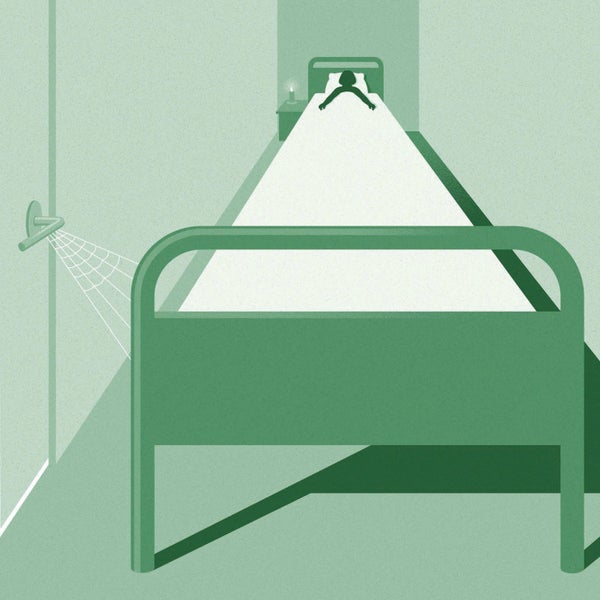
Everyone deserves a good death—a choice about how they spend their final days, a peaceful, pain-free exit. That is the mission of hospice care. But as corporate profiteers take over end-of-life care in the U.S., the system is failing many people in their moment of greatest need. Policymakers must better regulate this vital service.
The hospice movement got its start in England in 1967. The brainchild of Cicely Saunders, a physician and social worker, it aimed to ease the suffering of the dying by managing their pain and other symptoms and by affording social support to them and their caregivers. The culture around death has long been one of denial. The medical establishment tended to push aggressive treatment on ailing patients and then abandon them once they were deemed incurable. With its emphasis on accepting death and offering compassionate, holistic care to patients and their families, hospice revolutionized the way in which society tends to the terminally ill. By the 1970s the movement had spread to the U.S. Volunteer-led and supported by donations, hospices offered their services free of charge, mostly in the comfort of people's homes. Of the roughly three million Americans who die every year, around half now do so in hospice care.
The trouble began in the 1980s, when Medicare began paying certain hospice providers for care given to people with six months or less to live. Medicare pays a fixed amount to providers for each day that someone is enrolled in hospice, regardless of how much care they actually receive. With this turn of events, for-profit hospices began springing up to take advantage of the government contracts. Today nearly three quarters of hospice agencies operate on a for-profit basis. The sector has become so lucrative that in recent years private equity firms and publicly traded corporations have been snapping up previously nonprofit hospices at record rates.
On supporting science journalism
If you're enjoying this article, consider supporting our award-winning journalism by subscribing. By purchasing a subscription you are helping to ensure the future of impactful stories about the discoveries and ideas shaping our world today.
This takeover of what was once an almost exclusively nonprofit service by for-profit firms has had pernicious effects on hospice care in the U.S. When patients enter into hospice care covered by Medicare, they agree to forego further attempts to cure their terminal illness. In exchange, they are supposed to receive comprehensive comfort care from a team of doctors, nurses, social workers, spiritual advisers and trained volunteers who work together to provide patients and their loved ones with the medical, emotional and social support they need. Although hospice generally does not offer live-in care, agencies promise regular visits from members of the hospice team and 24/7 access to on-call doctors and nurses.
For-profit hospices do a significantly worse job of providing this care than nonprofit agencies do, according to a study by the RAND Corporation. Looking at quality measures such as management of pain and other symptoms, communication with the hospice team, and timeliness of care, the researchers found that nonprofits outperformed for-profits in every category.
In addition, it's easy for profit-seeking providers to use loopholes in the payment model to game the system—and worse. An investigation by ProPublica, co-published with the New Yorker in 2022, detailed example after harrowing example of hospice wrongdoing: agencies had bribed doctors to bring them new patients, enrolled patients without their knowledge and ditched patients when they approached the Medicare reimbursement limit.
Every so often perpetrators of hospice fraud get their comeuppance, as in the case of the owner, CEO, operations manager and medical director at the Merida Group, which runs a network of hospices across Texas. All four were found guilty of roles in a scheme to make false and fraudulent claims to Medicare totaling more than $150 million. Between 2020 and 2023 they were sentenced to more than 41 years in prison combined. But overall, there has been so little oversight of the hospice sector that the rot has spread largely unchecked.
Perhaps it should not come as a surprise, then, that according to a recent survey, the U.S. is a pretty lousy place to die. In an analysis of how well countries around the world deliver end-of-life care, the U.S. was ranked 43rd out of the 81 countries assessed, despite being one of the wealthiest nations. The U.K., whose hospices are generally not-for-profit, took first place.
We must fix hospice. It's an unquestionably daunting task, but last April, after reviewing the effects of private equity on the system, the nonprofit Center for Economic and Policy Research proposed a three-pronged approach that serves as a road map to reform. It advocates for strengthening and enforcing existing policies, such as screening hospice providers carefully for eligibility to receive government payments. It also recommends updating policies to account for the involvement of private equity firms in hospice by, for instance, better preventing anticompetitive mergers and acquisitions. And it argues for developing new policies to close loopholes that can be exploited by corrupt agencies, including moving away from the flat-fee payment model toward one based on patients' individual needs.
Death is big business. We can't let corporate greed dictate our endgame.