
In the 1930s Werner Burau, a German mathematician, introduced a twisted geometrical mystery that would stand for nearly a century.
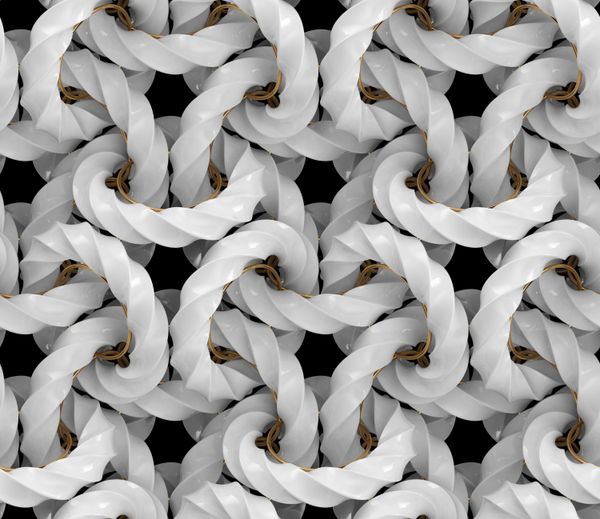
Previously, mathematicians had shown that knots could be reformulated into something more relatable: braids. A “braid” starts with a collection of strands. To make the braid, one dangles the strands vertically and weaves them downward however they like. Any type of knot, no matter how complicated, can be translated into a braid
As part of his investigation, Burau neatly translated braid structures into algebraic objects, making them much easier to manipulate mathematically. The objects, called matrices, are grids of numbers that function much like a spreadsheet. But mathematicians of the day worried that his elegant translation was losing information. Did some of these matrices represent more than one braid? If so, they were dubbed “unfaithful.” The problem was determining which, if any, of his braid representations were unfaithful.
On supporting science journalism
If you're enjoying this article, consider supporting our award-winning journalism by subscribing. By purchasing a subscription you are helping to ensure the future of impactful stories about the discoveries and ideas shaping our world today.
Columbia University mathematician Joan Birman helped to popularize the question about 60 years ago. And in 2026, nearly a century after the Burau representation was first proposed, the now 99-year-old Birman has closed the case with the help of two collaborators, University of Glasgow mathematician Tara Brendle and Princeton University mathematician Vasudha Bharathram. It has long been known that, for the first three strands of a braid, the matrices are always faithful, meaning there is a one-to-one relationship among them. It was also known that for five or more strands, the matrices all turn unfaithful. But in a new plot twist, the mathematicians showed how the four-strand braid complicates the relationship, but in the end, its matrices still remain faithful.
“It’s pretty crazy,” says London Institute for Mathematical Sciences mathematician Yang-Hui He, who has worked on the problem. “It’s one of the most interesting stories in recent years—not just that there’s this proof but that so many people have worked on it over the last 70 years. It’s one of the major advances in the field of group and knot theory.”
As a girl, Birman shared an interest with her grandmother: knitting. It wasn’t until she arrived at graduate school that she discovered the beautiful mathematical side to her pastime. Although she says that any of her mathematical work’s implications for the hobby are a stretch (Bharathram points to the major hurdle of translating a sweater into a matrix), the topic became Birman’s lifelong obsession.
In the 1970s Birman wrote a foundational book for mathematicians, Braids, Links, and Mapping Class Groups. In it, she showed that the Burau representation for the four-strand group could be transformed into a search for relationships between special three-by-three (3 × 3) matrices. The discovery reopened Burau’s cold case. “Braids had been a backwater of topology,” Birman says. “Suddenly braids became very popular.”
A single-stranded braid is trivially faithful. Similarly, the case for two strands, representing a repeating pattern of single crossovers, was quickly shown to be faithful. Around the same time that Birman’s book came out, a pair of mathematicians showed that the three-strand group was also faithful. But two decades later, a surprise awaited. A series of papers that used a geometric approach first pioneered by mathematician John Moody, showed that all braids with five or more strands were wholly unfaithful.
That left the case for four-strand braids as the sole holdout. Many researchers were convinced that the group must also be unfaithful and fished around to find the relationship in Birman’s approach or Moody’s method.
The race was on.
“I was introduced to the problem,” He says, “by Emmanuel Breuillard and Sasha [Oleksandr] Kosyak,” two well-known mathematicians who have worked on the quandary for more than 20 years. The group spent six futile months trying to prompt various artificial intelligence chatbots using Birman’s approach. “Then, boom, on a Wednesday morning, Joan Birman herself with her two talented collaborators claimed that they had solved the problem,” He says. “And they had.”
Ultimately, the 3 × 3 matrix approach had been a red herring. So was Moody’s unfaithfulness angle. Bharathram thought maybe the assumption of unfaithfulness was wrong, so the group adapted Moody’s method to instead try to prove faithfulness. Her hunch set the trio on the correct path.
Brendle offered an explanation of the group’s proof: Take a piece of paper and draw a bunch of points. Then draw loops around some of those points. The points correspond to strands, while loops capture all possible interactions of those strands. The disks, which are defined as the insides of the loops, tell you how to calculate the Burau matrices. “The more points you have, the more different loops you can draw,” Brendle says. “You can ask what different kinds of disks you can get.”
The trio found that as the disk variations ballooned, the ability to isolate a unique matrix weakened. “Disks that look very different end up having a similar effect on the matrices,” Bharathram says, “meaning information is being lost in the translation from braids to matrices.”
The method proved adept at testing faithfulness for all possible braids. For three-strand braids, the possibilities were so limited that the matrices had no option but faithfulness. The four-strand braids presented a few nasty scenarios, but the trio was able to handle them. When the braids had five or more strands, however, the disk possibilities proliferated, guaranteeing the matrices were all unfaithful. Just as water undergoes a phase transition before it freezes, Brendle says, the four-strand case represents an important flash point for braids.
"I’m very surprised that it’s gotten this much attention," Birman says. “There were many people who tried to prove this and it just didn't work because they were looking for a counter-example to faithfulness.”
Bharathram, Birman and Brendle, scattered across different cities and continents, didn’t celebrate after finishing their proof. Although braids wind their way into many different areas of science, from protein folding to string theory, simply cracking the century-old case was enough of a reward for the trio. “It’s intrinsically interesting,” Bharathram says.