
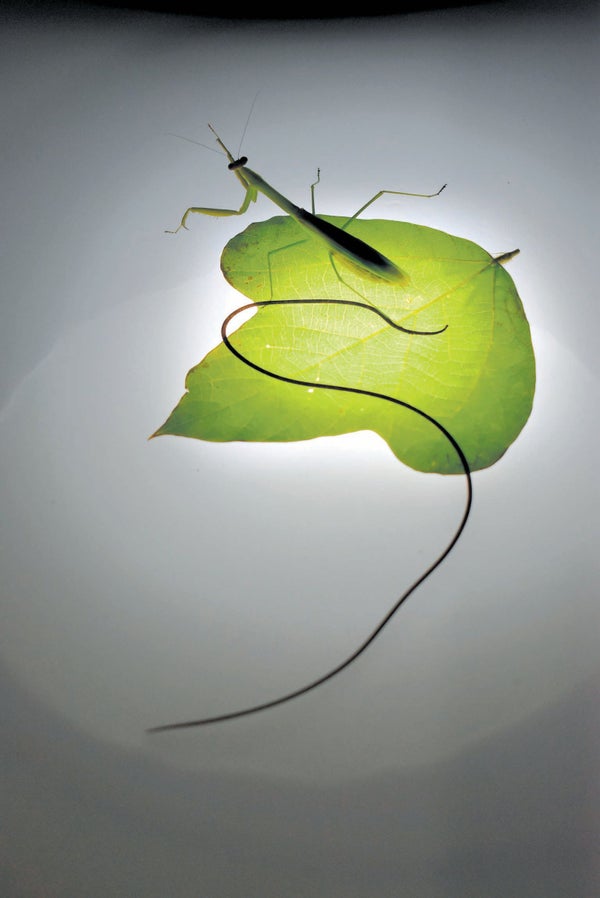
For a praying mantis, eating the wrong insect can be a one-way ticket to a watery grave. Some of its typical bug prey contain horsehair worms, Chordodes fukuii, which grow in a mantid's gut—and somehow manipulate the mantid into diving into the nearest body of water. The spaghettilike worms then wriggle free of their drowned host and reproduce. Aquatic insects eat the worms' offspring and are then consumed by other mantids, and the cycle repeats.
Now researchers may have discovered how the parasite pulls off its fatal trick: it seems to have evolved to use genes that its species once “stole” from the mantids themselves, enabling the worm to make proteins that affect the mantids' nervous system. If confirmed, these findings, published recently in Current Biology, would be the most extensive documented case of gene transfer between animal species.
Mantids infected with C. fukuii become attracted to light, like the shiny surface of water. This behavior is believed to arise from protein-level changes in both the parasite and the host's brain, says senior author Takuya Sato, a biologist at Japan's Kobe University. Because genes encode the instructions to build these proteins, Sato and his colleagues set out to examine how both species' gene activity changed during the course of a horsehair worm infection.
On supporting science journalism
If you're enjoying this article, consider supporting our award-winning journalism by subscribing. By purchasing a subscription you are helping to ensure the future of impactful stories about the discoveries and ideas shaping our world today.
The team found that a whopping 1,420 of the parasite's genes resembled those of their hosts and that these genes were most active when the parasite was pulling the host's strings.
Genes can move from one living organism to another in a process called horizontal gene transfer, which is common in bacteria but rare between animals. “That would be very amazing—to have thousands of genes acquired by horizontal gene transfer from the host to parasites,” says Etienne Danchin, a biologist at France's Sophia Agrobiotech Institute, who was not involved with the research. “But I think they need to confirm this claim,” he says, because the researchers haven't yet located these potentially stolen genes in the worm's genome. The new study confirmed only that they were present in the parasite's tissue samples, and it is still possible that some of these genes were just contamination from the mantid, Danchin says.
“We should reserve judgment on the role and extent of horizontal gene transfer until a whole genome sequence is available that confirms that the transcripts are correctly attributed to the mantid and the worm,” says Julie Dunning Hotopp, a microbiologist at the University of Maryland Baltimore, who was not involved with the study.
Sato plans to check the parasites' genome next. “The mechanism of horizontal gene transfer in C. fukuii is still a huge mystery,” he says. “By investigating genomes of C. fukuii and its mantid host,” he hopes to get closer to unraveling it.