
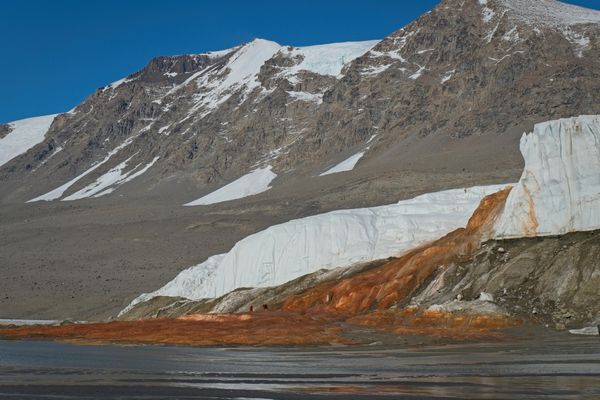
Antarctica’s Blood Falls looks exactly like what the feature’s name suggests. But despite appearing to bleed out for millions of years, its waters are actually home to an array of microscopic life. And those tiny beings offer clues as to how the mysterious formation came to be.
“The whole landscape is just a level of pristine that you’re not used to seeing,” says Andrew Allen, a marine biologist at the Scripps Institution of Oceanography. “When you look out at that landscape, life doesn’t come to mind right away. You know, it’s not like the Arctic, where there are vertebrates running around. And there’s no plant life, so it feels almost abiotic at times”—that is, until you look closer.
In a new paper published on Monday in Nature Geoscience, Allen and his colleagues describe an assortment of eukaryotic species—or those whose cells have organelles bound by membranes—found in the waters of the falls, which are located in an area known as the Taylor Glacier. The species are not believed to live in the underground, iron-rich saltwater lake that feeds Blood Falls (and that provides the feature’s signature color, thanks to the oxidation of the iron when it hits the air). But they do appear to be related to species that live in the ocean, whereas those from nearby sites are associated with fresh water. The only problem is that the closest ocean is more than 20 miles away.
On supporting science journalism
If you're enjoying this article, consider supporting our award-winning journalism by subscribing. By purchasing a subscription you are helping to ensure the future of impactful stories about the discoveries and ideas shaping our world today.

The organisms would have to have been either blown in by the wind or left over from a time when seawater was cut off from the ocean as water levels fell and the glacier moved into place over it at some point around two million years ago.
“We think that this periodic outflow of brine water creates a habitat where marine microbes could persist,” Allen says. “But the origin of these particular marine microbes is probably most consistent with the idea of ancient flooding than wind dispersal.”
That means these eukaryotic species have sustained their own isolated ecosystem since our ancestor Homo erectus was first emerging. Further study could help shed light on how the microscopic world has persisted through major periods of geological and climatic transformation.
There is at least one more mystery to solve, too: Allen notes that phytoplankton like those found in the expedition usually thrive in areas that are relatively poor in iron—the exact opposite of Blood Falls. “These lineages obviously have a lot of iron around,” he says. “We’d be interested to know more about what they’re doing with iron.”