
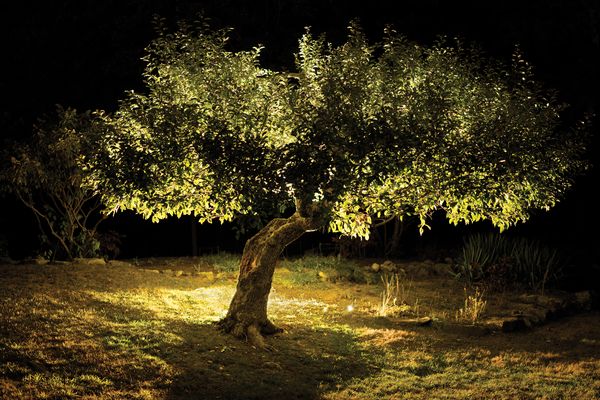
It was a routine day in the laboratory belonging to Cameron Peace on the campus of Washington State University, Pullman, in the high, dry hills close to the Idaho border. Peace is a tree-fruit geneticist, and on this warm September afternoon, as on most days, he was running programs that tease out the DNA profiles of apples. Apples are Peace’s passion and the focus of his professional expertise. He maintains a backyard collection of unusual varieties and runs a project called MyFruitTree, which lets members of the public send in leaves from unidentified apple trees and matches those trees’ genetic fingerprints to entries in a database of known types.
Washington State University is a land-grant university, founded to research and support agriculture, and Peace was honoring that mission. The samples he was examining had come from a team on the other side of the country at the Maine Organic Farmers and Gardeners Association (MOFGA), a long-standing agricultural nonprofit. The group wanted to identify trees it had found on old and abandoned farms, hoping to salvage valuable rarities before high winds or harsh winters killed them.
Peace does this work because every analysis he runs benefits his central project, a literal family tree of North American apples that traces the distribution of distinctive traits—flavor, color, hardiness, disease resistance—through siblings, parents and forebears. He plugged the data from a Maine sample coded AMHO-504 into a spreadsheet tool that would compare it against his collection. Then he sat back, agape. High up in the continental pedigree the entire DNA fingerprint matched a predicted empty space. The Maine team had found a living lost progenitor to hundreds of varieties—a tree that had been contributing its characteristics to American apples for hundreds of years.
On supporting science journalism
If you're enjoying this article, consider supporting our award-winning journalism by subscribing. By purchasing a subscription you are helping to ensure the future of impactful stories about the discoveries and ideas shaping our world today.
A lost piece of apples’ history had suddenly been discovered in North America.
That afternoon three years ago was the culmination of a detective story that spanned continents, collapsed centuries and linked the unlikeliest collaborators. Two quests drove their efforts. They wanted to identify a mystery tree on a property that dates back to the American Revolutionary War. But they also wanted to uncover what the possibly oldest living apple tree in the U.S. contributed to generations of apple varieties—and, equally, what traits it might still harbor that could be bred back into apples today to protect them against new threats in the future. “Maybe there are aspects that people didn’t value in the past and, 200, 300 years ago, selected against,” Peace says. “But these days, actually, we do need them.”
Scientists such as Peace, and detectives such as the team that brought the mystery apple to him, agree that retrieving those genetic resources is a vital task. For one thing, apples are valuable. They are the fruit Americans eat the most and one of the top commercial crops in the U.S., which grows more apples than any other country outside China. Apple harvests are rising in volume all the time, but in genetic terms, the base of that towering, crunchy mountain is narrowing. Although about 2,500 varieties exist in the U.S. and roughly 100 are raised commercially, most of the market depends on just 15 of them.
And apples are under threat. When small numbers of varieties are planted very widely, the crop becomes more vulnerable to diseases such as fire blight, powdery mildew and scab. Having near-monocultures in the field means disease organisms don’t have to rely on the evolution of new mechanisms to overcome the diverse genetic protections collectively carried by many apple varieties; once they settle genetically on a strategy, they can attack. And they do, very successfully. A U.S.-wide estimate made more than 20 years ago put the annual cost of fire blight, a bacterial disease, in excess of $100 million. Since then, outbreaks in various parts of the country have cost producers $16 million to $42 million at a time.
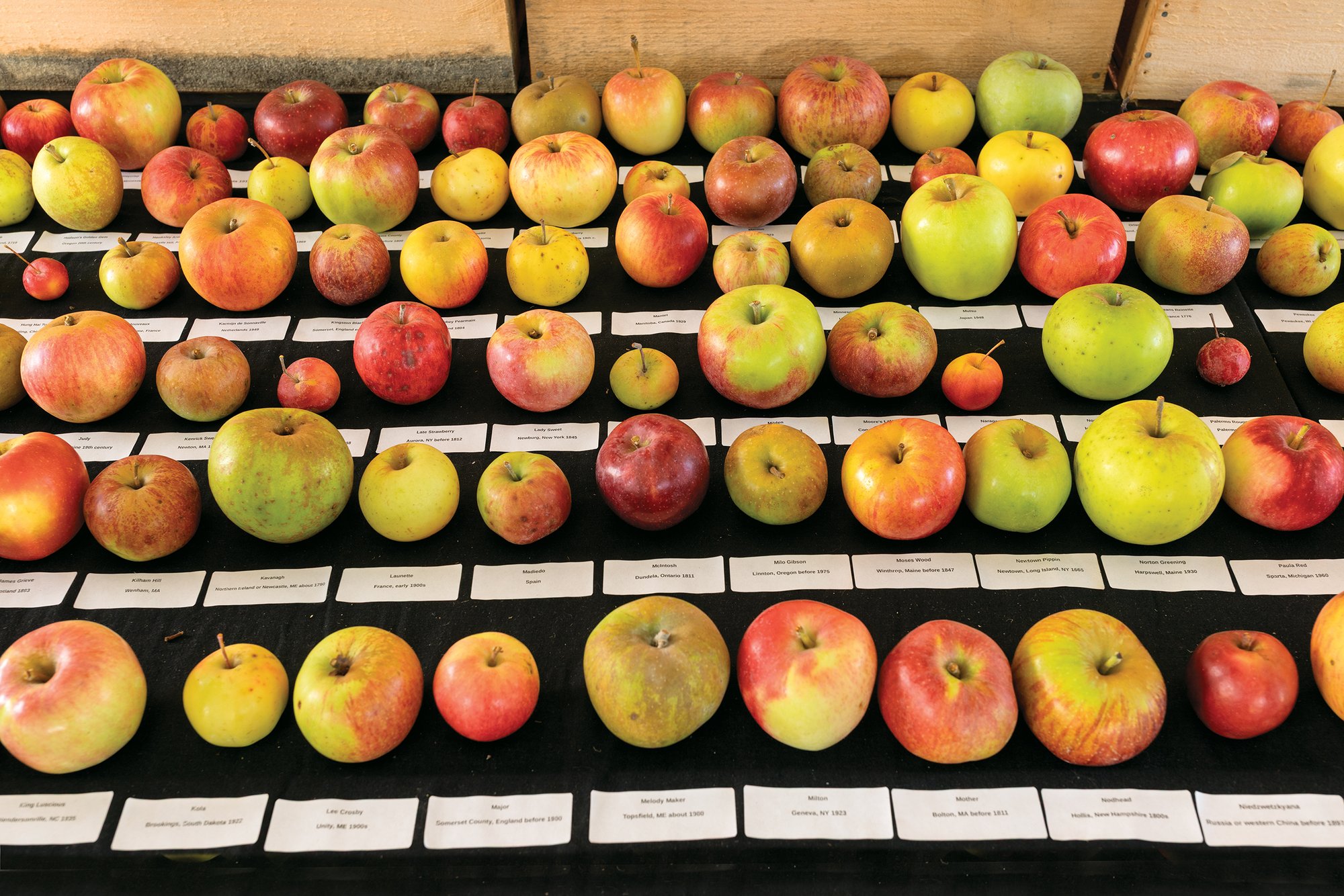
Apple varieties on display at the Maine Organic Farmers and Gardeners Association Common Ground Country Fair.
Grant Delin
Changing weather patterns are compounding these effects by creating conditions that encourage the growth of bacteria and fungi or by pulling the seasons out of sync with apples’ growing patterns, forcing trees to bud earlier and making flowers and fruit more vulnerable to temperature shifts. Washington State, the leading apple producer in the country, lost more than 2 percent of its crop to a heat wave in 2021.
Given these realities, retrieving genetics that have been lost to time and market contraction is crucial to apples’ survival. Worldwide, scientists are working to associate specific DNA segments with qualities that apples will need under future conditions so that those traits can be bred back into the fruit; the genetic markers can then be used to confirm that the breeding was a success. They are also looking for places where gene variants from long-surviving varieties have been retained in trees growing today; that persistence demonstrates how genetically useful those qualities have been.
Scientists carry out that work on apples grown by commercial breeders and held in agricultural-school collections—but they also rely on apple enthusiasts who bring them fruit for which names and provenance are unknown. Of course, those amateur detectives aren’t hunting rare varieties primarily to serve science. They are looking for lost trees for the charm of their names, the complexity of their histories and the love of apples themselves.
All these motivations were present in the self-assembled team—a historian, several apple hunters, two dedicated homeowners, and a crew of geneticists and breeders—that brought the Maine tree to Peace’s attention and hunted across continents and back through centuries to retrieve the lost apple’s name.
John Bunker was barely into his 20s when he realized apples might end up being his life’s work. During a preteen summer visit, he imprinted on Maine like a duckling on a zookeeper, vowing to get back to the state when he was old enough to chart his own path. He managed it by attending Colby College, a small school with a tradition of environmental programs. It was the early 1970s and the peak of the back-to-the-land movement. Bunker and some of his friends started driving around the middle of the state, looking for cheap property. They found a plot—more than 100 acres—in the tiny town of Palermo. “It was inexpensive, and I was young and wanted to live in the woods, and it seemed like the right thing,” Bunker says.
There were old apple trees nearby. Bunker remembers his first reaction was, “Free food!” (and maybe booze, too; he had tried making cider at Colby). But after a few years of homesteading, he became curious to know more. He started knocking on doors, asking about past owners and what they grew—and, increasingly, about apples, which became more fascinating to him the more he learned.
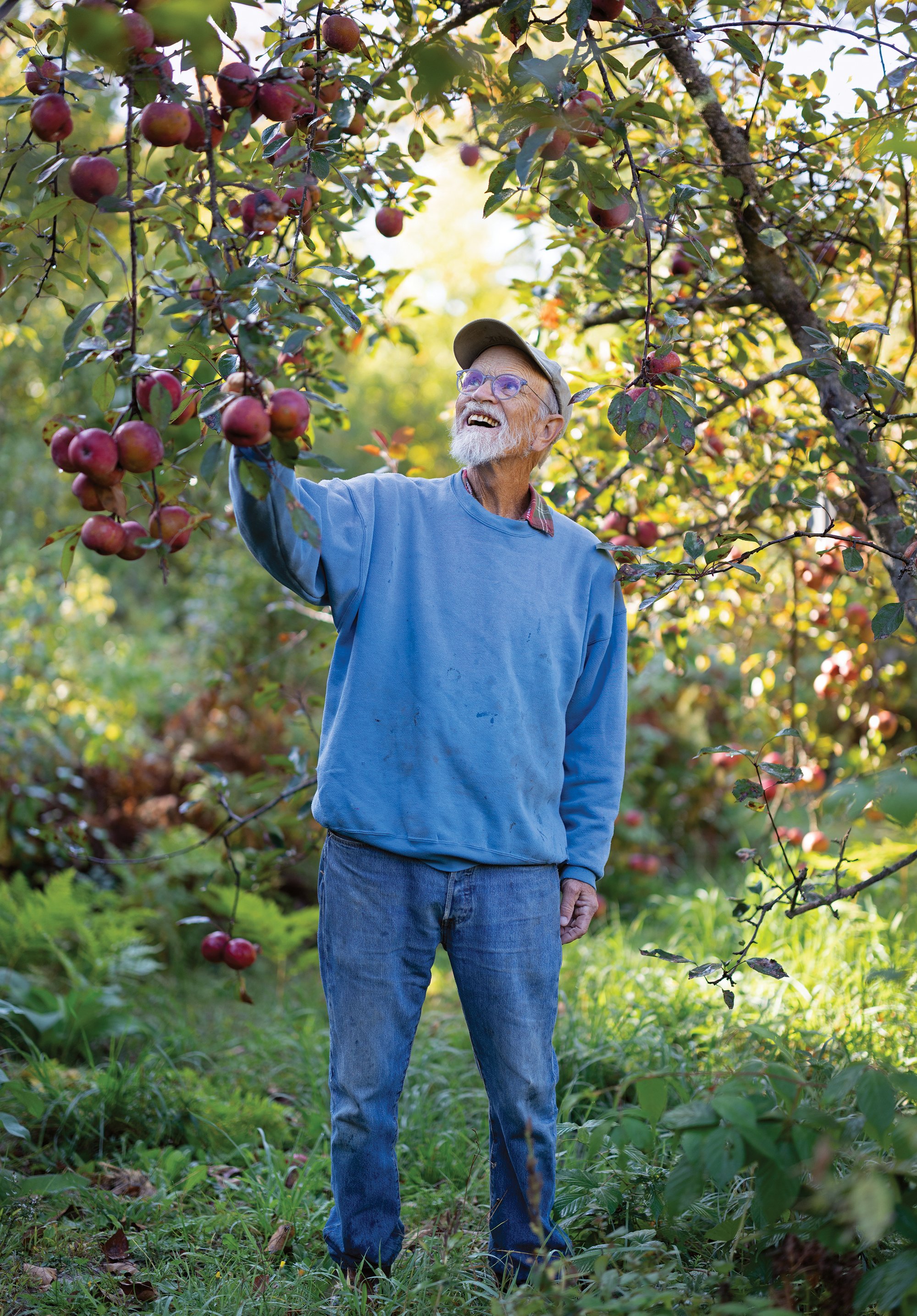
Apple detective John Bunker in his orchard.
Grant Delin
A quick pause for biology. Apples don’t self-pollinate the way that tomatoes and peppers do, fertilizing and germinating with no outside assistance. Instead they cross-pollinate: pollen from one tree travels to a blossom on a second, thanks to a helpful bee that carries it. This means each fruit has two parents, just like humans do—and, also as with humans, the parents don’t get reproduced identically. Instead their offspring possess unpredictable combinations of traits—which, just as in humans, often aren’t fully identifiable until some number of years pass. So if you want to precisely reproduce an apple variety you like, you don’t start it from a seed. You clone it by grafting, which means cutting a short piece of twig, inserting it into the trunk or branch of a different “rootstock” tree and letting it grow up. Generations of grafting can carry an apple variety unchanged into the future, and because trees are long-lived, grafted apple trees can survive after the people who valued and named them have died or moved away.
As Bunker learned about Maine apples, he began to understand how fragile that knowledge was, dependent on what people remembered about texture and taste and best use. He took on the task of saving it, talking to old-timers, studying neglected trees on old farm properties, and hauling fruit home to examine and document. “I had no knowledge at all,” Bunker says now, 50 years after he started. “At a certain point after I exhausted all the information that was out there, I realized I was going to have to develop a system for identifying things. Because I was getting into the ones that were more obscure, the local historic apples.”
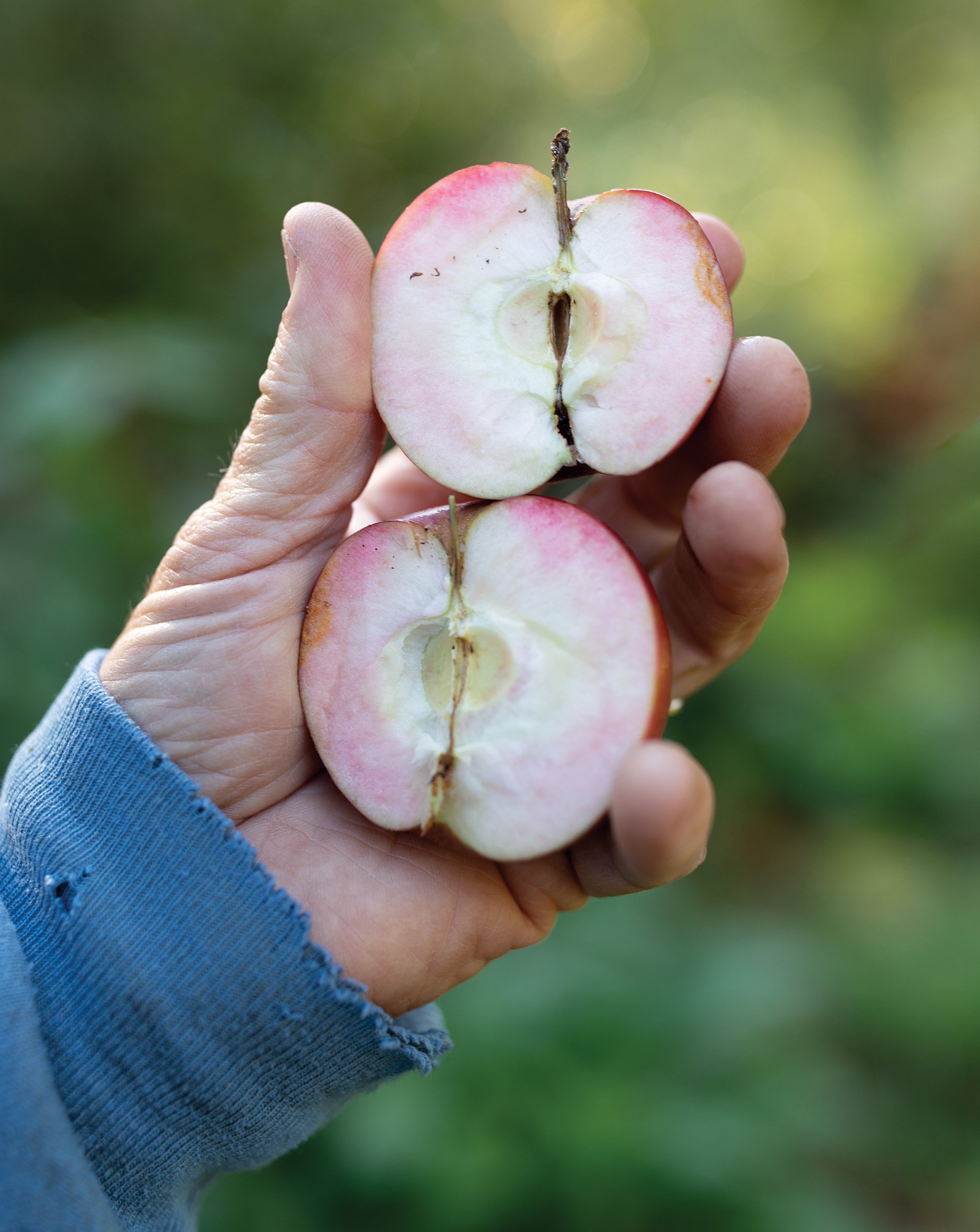
Over decades Bunker became the expert he had needed, teaching himself to classify apples by characteristics such as color, stem depth, bark appearance, and the pattern of seed cells in fruit sliced horizontally. He founded a fruit-tree nursery named Fedco Trees and sold grafted descendants of trees to ensure their ongoing survival and give himself an income while he kept apple hunting. And by excavating the history of abandoned apples, he created enthusiasm and demand for them.
When Bunker staged apple-identification events at agricultural fairs, people lined up to talk to him, clutching apples from family properties, and others asked him to come give talks. One of the latter was Jeanne Russell, who lives with her husband, Ron, on Verona Island, a narrow sliver of land where the Penobscot River begins to open to the Atlantic. In 2007 she invited Bunker to a gathering of the Bucksport, Me., garden club. It took place at the Russells’ property, where they have lived since 1979; they have traced its past ownership in local records as far back as George Washington’s first secretary of war. On its long sweep of lawn, which hangs above a river channel and below pines that house Bald Eagles, there are about two dozen apple trees, and some of them looked ancient.
Grant Delin
After his talk, Bunker strolled the property with the Russells. There were towering crabapples and thick-trunked trees that looked robust enough to bear fruit for years to come, as well as some tottering old specimens leaning sideways and barely hanging on to life. Bunker sketched a rough map on the back of the manila folder he had carried his notes in and marked the ones he thought he recognized: Ben Davis, Yellow Bellflower, Tolman Sweet. At one edge of the lawn, he recorded tree number 26 as “unknown”—a notable notation from someone as knowledgeable as him.
Later, Bunker would tuck the map away, promising himself to go back. In fact, he wouldn’t return to the Russells’ farm for many years.
Farther east from the Russells, in the tourist town of Bar Harbor, a historian was exploring a different question: where Maine apples came from. Todd Little-Siebold is a professor at the College of the Atlantic, a tiny school—it has 350 students and 33 faculty—that focuses on human ecology and hands-on learning. He landed there as a new Ph.D. specializing in colonial and 19th-century Guatemala and looked around for a project that would layer his knowledge of agriculture and economics onto the New England landscape. He settled on apples.
Little-Siebold began taking his students to properties where old trees could make history visible for them. “I introduce them to trees so that they ask the question, Who planted this tree? How could we find out?” he says. “There are agricultural census records and deeds and all these different ways that we can reconstruct what was probably grown here and who grew it.”
Trying to identify the apples on old homesteads was a natural next step. With his students, Little-Siebold started delving into nursery catalogs from previous centuries, along with diary accounts and monographs filed away by historical societies. It was satisfying work because it opened up the history of that part of Maine, which doesn’t share the English, Pilgrim heritage of southern New England. Much of Maine was once part of the New France of eastern Canada, a key transit point for fish and fur from the 1500s until Great Britain seized control in 1763. Little-Siebold could perceive the remains of that footprint in the apples his students were sleuthing: they were historic French varieties, not English, with names such as Calville Rouge and Reinette Franche. He started to develop a theory of French apples as an unknown backbone of early American agriculture, living evidence of the complex patterns of European settlement.
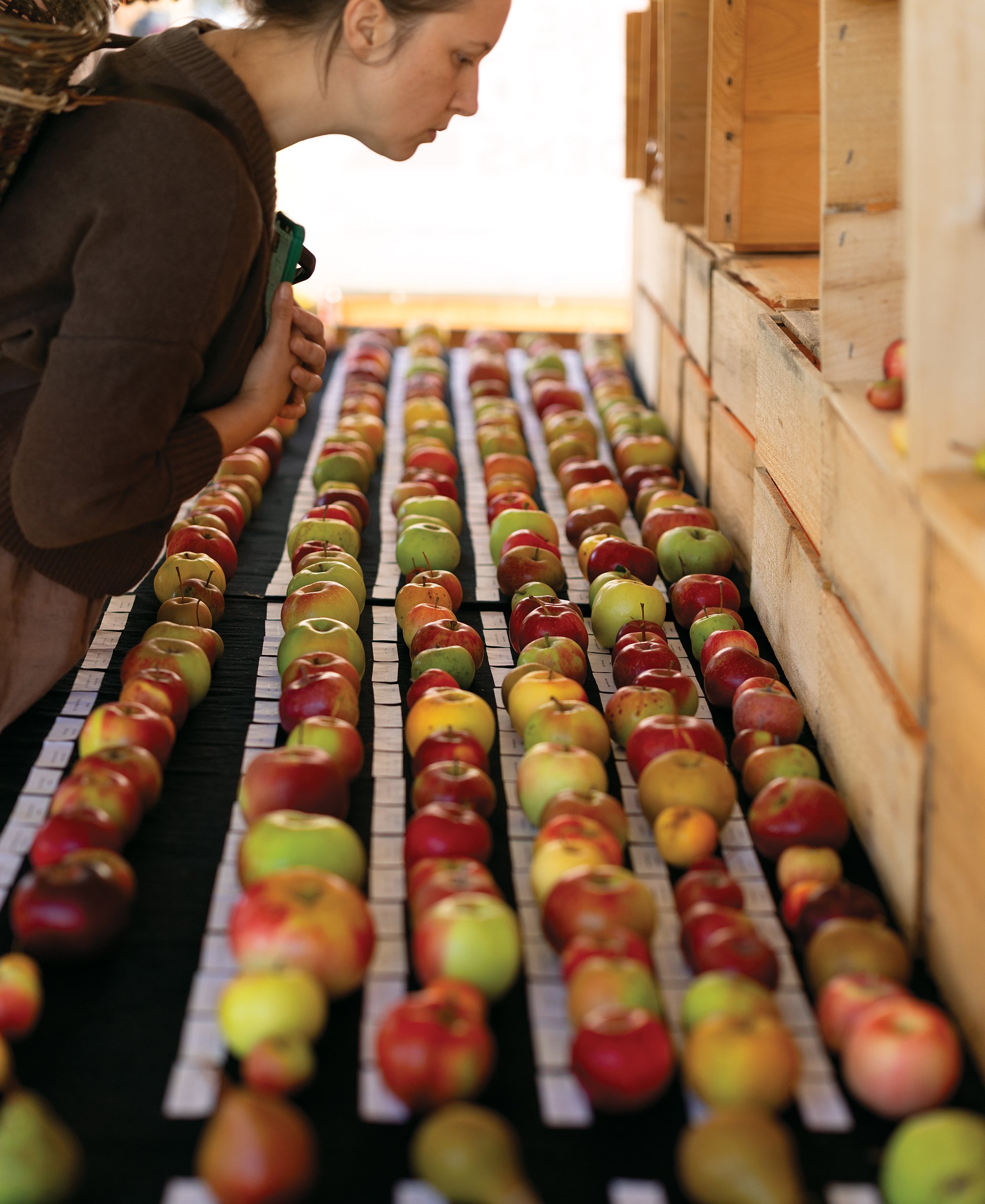
There are about 2,500 varieties of apples in the U.S.
Grant Delin
Maine is large but has a small population, so it was inevitable that Little-Siebold would meet other old-apple enthusiasts—not only Bunker but also Russell Libby and Laura Sieger, then the director and orchardist, respectively, at MOFGA. That group had spent years preserving knowledge useful to small-scale and organic farms and had turned to protecting farm products as well. With Bunker’s guidance, it established the Maine Heritage Orchard in 2012, seeking to regrow trees found in the state and to perpetuate them by offering scionwood—the twigs that become grafts—to farmers, collectors and historians. After meeting members at a 2018 conference, Peace joined the loose coalition. He offered the use of his DNA-fingerprinting techniques to identify the orchard’s more than 300 apple trees.
It was an extraordinary gift. Across centuries, apple growers had written down their personal observations of blossom tint and twig width and skin color but lacked tools for objective confirmation, such as photographs or Pantone codes. The apple hunters understood that the reidentification of a fruit based on an old name risked being an interpretation of an interpretation. DNA analysis could banish that uncertainty—if an apple had been analyzed before. “This supercharged this work,” Little-Siebold says. “The DNA has answers that no archive has, where no diary survives, no journal survives, none of the stuff that I normally work with exists. There’s a genetic archive that will tell us what an apple is.”
The tree was a grandmother, a hypothesized unknown founder of multiple American varieties.
The detectives redoubled their searches. At some point Bunker remembered his visit to the Russells’ property and the map he had drawn; he reminded Little-Siebold of the trees, and the professor volunteered some of his students for a new trip. Escorted by Sieger and by Peter and Kathleen Jenkins, apple enthusiasts who lived in a nearby town, the group found No. 26 at the edge of the lawn. It was gnarled and tilted sideways, and its trunk was almost hollow, a void surrounded by bark—but it was still bearing chartreuse-yellow apples overlaid with the rusty webbing known as russeting. They collected the sample Peace needed: a few leaves just budding at the end of a branch. They slid them into a sample tube Peace had sent, capped it and sent it off to Washington State.
At the university, Peace labeled the sample AMHO—to indicate an apple from the Maine Heritage Orchard—504. He held it in his lab until he had accumulated a big enough batch to justify delivery to the commercial lab that performs genotyping for him. In June 2023 he sent the leaves off. That September he received the results and plugged them into his database.
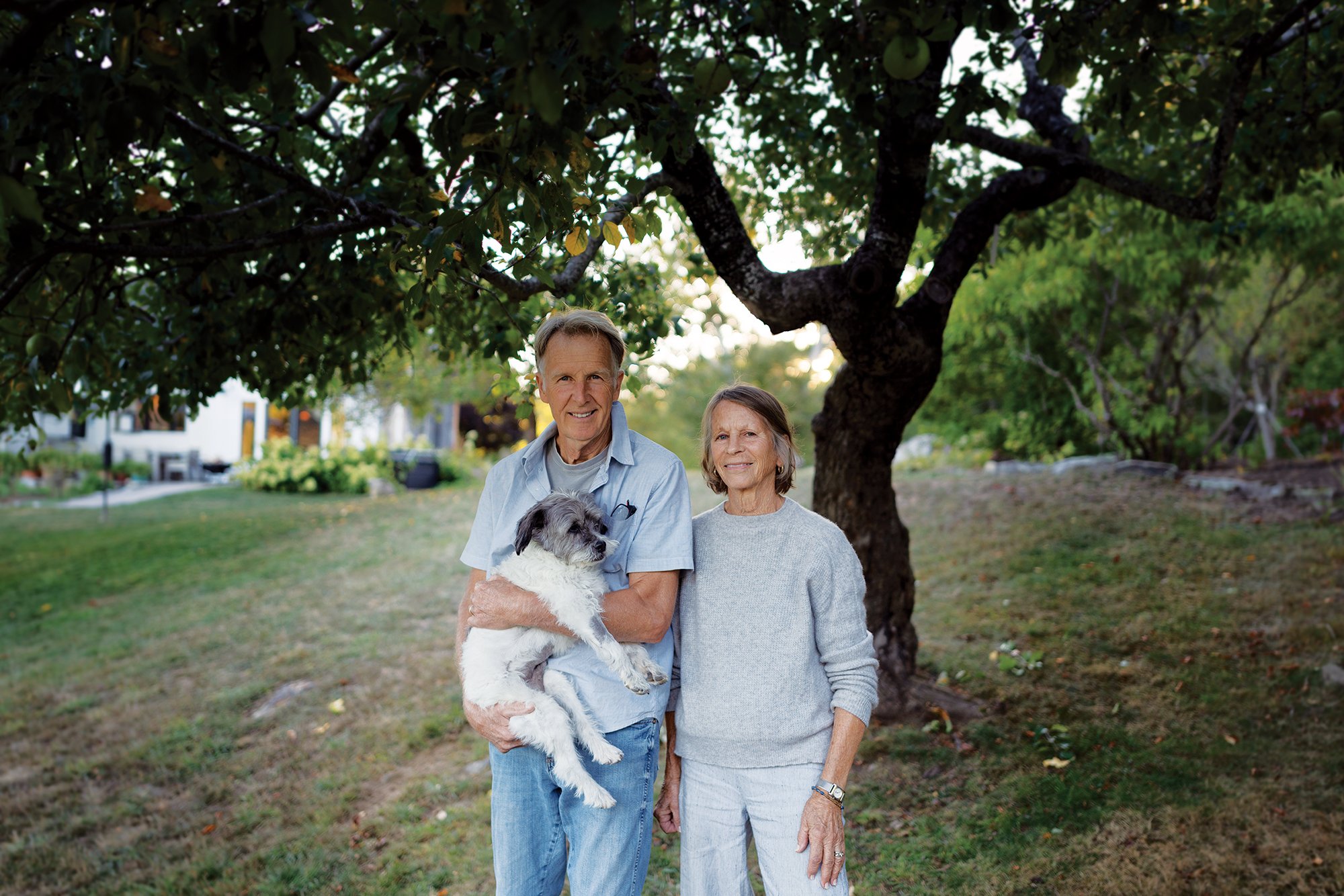
Ron and Jeanne Russell stand in their garden with the 300-year-old mystery tree.
Grant Delin
The Russells’ toppling little tree wasn’t just any unknown apple: it was a grandmother, a hypothesized unknown founder of multiple American varieties. Segments of its genetic traits were evident in apples now found throughout the country, the way an eyebrow shape or an eye color might recur across generations of a family. But the apple itself had no match anywhere in the database Peace had been building. The Russells’ tree was its first discovery in North America.
Peace couldn’t tell them—not yet, anyway—that he already knew its name.
The quest to parse apples genetically is an international pursuit because the knowledge the fruits contain is crucial to preserving such an economically important crop. Thus, apple detectives are distributed internationally as well. One of them is Nick Howard, a molecular geneticist who earned a Ph.D. at the University of Minnesota, home of the incredibly popular Honeycrisp. Howard collaborated with Peace and then continued the relationship when he moved to Europe to do a postdoc. He landed as an apple breeder in the Netherlands, one of the leading apple-exporting nations, performing a combination of academic research and practical application.
Howard, Peace, and some other scientists around the globe share the same method for fingerprinting apple varieties: they document each tree’s unique array of single-nucleotide polymorphisms, or SNPs (pronounced “snips”). At these genome locations, a pair of nucleotides, the rungs in the twisting ladder of DNA, includes a substitution that shows up like a spelling error. Using tiered tests—48 SNPs in a first round, thousands in a second—researchers can determine whether a tree has already been identified and then explore its details if it is unique. Peace uses the results to reassemble the genetic history of American apples. Howard’s goal was to document characteristics and connections across the world.
This work is not done just for archival purposes. “Genetic analysis opens up a new toolbox for the breeder,” Howard says. Studies are constantly associating genome segments with specific qualities: acidity, sweetness, texture, color, aroma, resistance to disease. Using such markers, geneticist breeders can select trees that harbor desirable qualities and then set up crosses, planning for the offspring to gain benefits without losing what made the parents worth growing. This approach isn’t genetic engineering, which would entail snipping DNA from a promising apple and inserting it into something that needed improvement. Instead it is the old-fashioned, unpredictable process of pollinating and growing, made more precise by genetic information. “Once you have your seedlings, you can take a leaf sample and look at the genetics and see, Does this have the disease resistance I wanted in this cross?” Howard explains. “If yes, you keep it. If no, throw it out.”
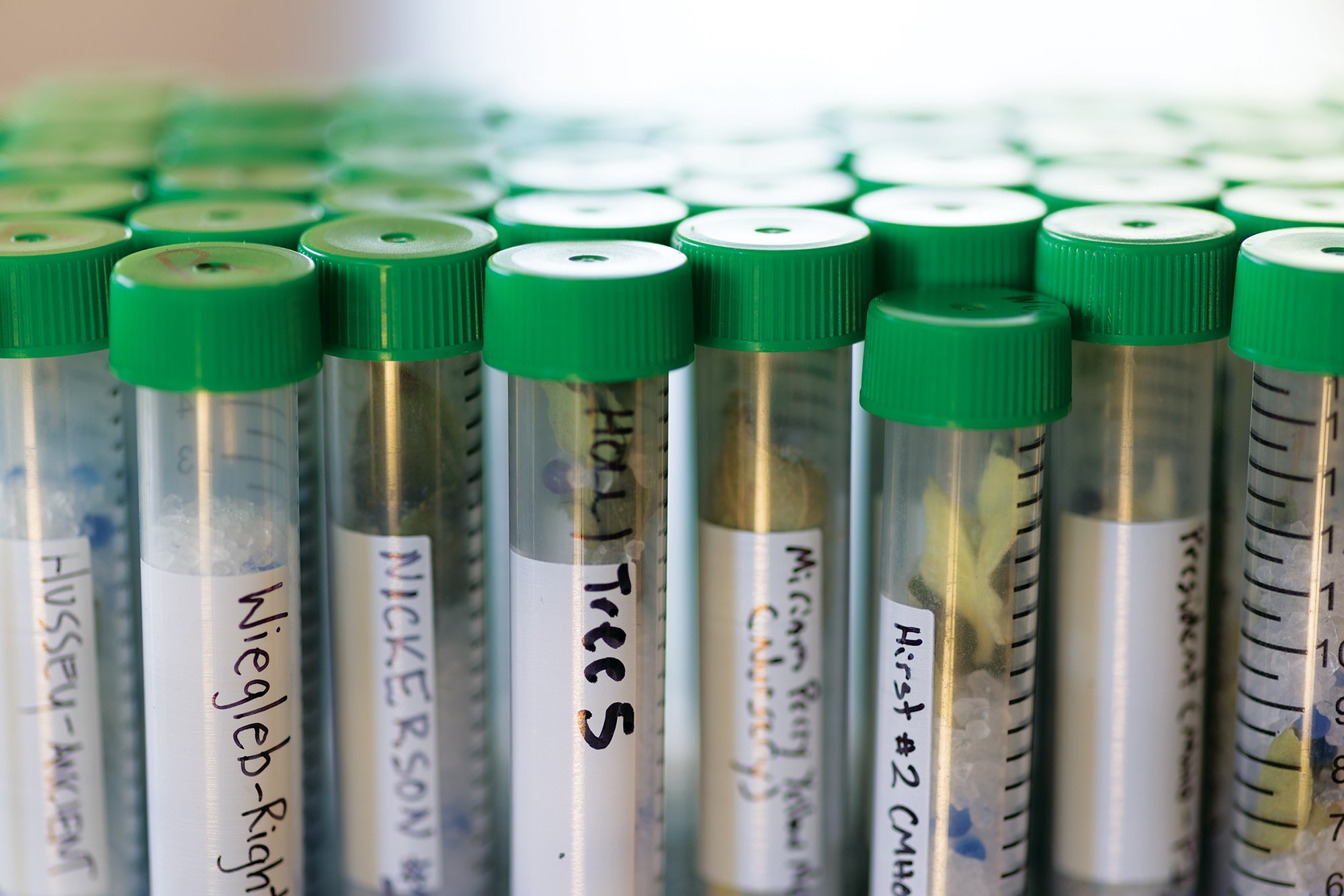
Tree DNA samples prepped for analysis.
Grant Delin
Howard’s survey of apples’ relatedness didn’t only show him how characteristics had moved through the cultivated varieties across generations. It also demonstrated places where intervening generations carrying those characteristics ought to exist. Using analytical techniques that already existed in the industry, he was able to infer what those parent and grandparent apples would look like genetically if they were ever recovered. He called them “unknown founders.”
Parts of Howard’s giant database have never been published anywhere because they contain SNP data that have been shared with him privately. People brought data to him because they wanted to know whether trees in university or personal collections had correct names and accurate histories or were misidentified duplicates that could be sacrificed to free up orchard space. He could draw conclusions from the shared data, but he wasn’t free to publish them until the owners agreed.
One collaborator, Bjarne Larsen, had given Howard access to a trove of apple genotypes from Denmark, the fingerprints of an orchard of historic cultivars maintained at the University of Copenhagen. Larsen had done his Ph.D. in plant breeding there, had written a book on old apple varieties and then had moved for a postdoc to the same Dutch university where Howard had settled. Because he had researched them for his book, Larsen could link the genetic proofs of apples’ identities to the historic evidence—where they had been grown, what they were good for, who had written about them.
One tree in the University of Copenhagen’s collection had an especially interesting story. Larsen believed it was a variety named and described in a French pomological text in 1628. A later account said it was so prized in French farming that trees had been hidden in a botanical garden to protect them when the French Revolution ravaged aristocratic estates. It had once been widely cultivated in Germany and Denmark but had fallen out of favor. It was called Drap d’Or de Bretagne—“Brittany’s cloth of gold.”
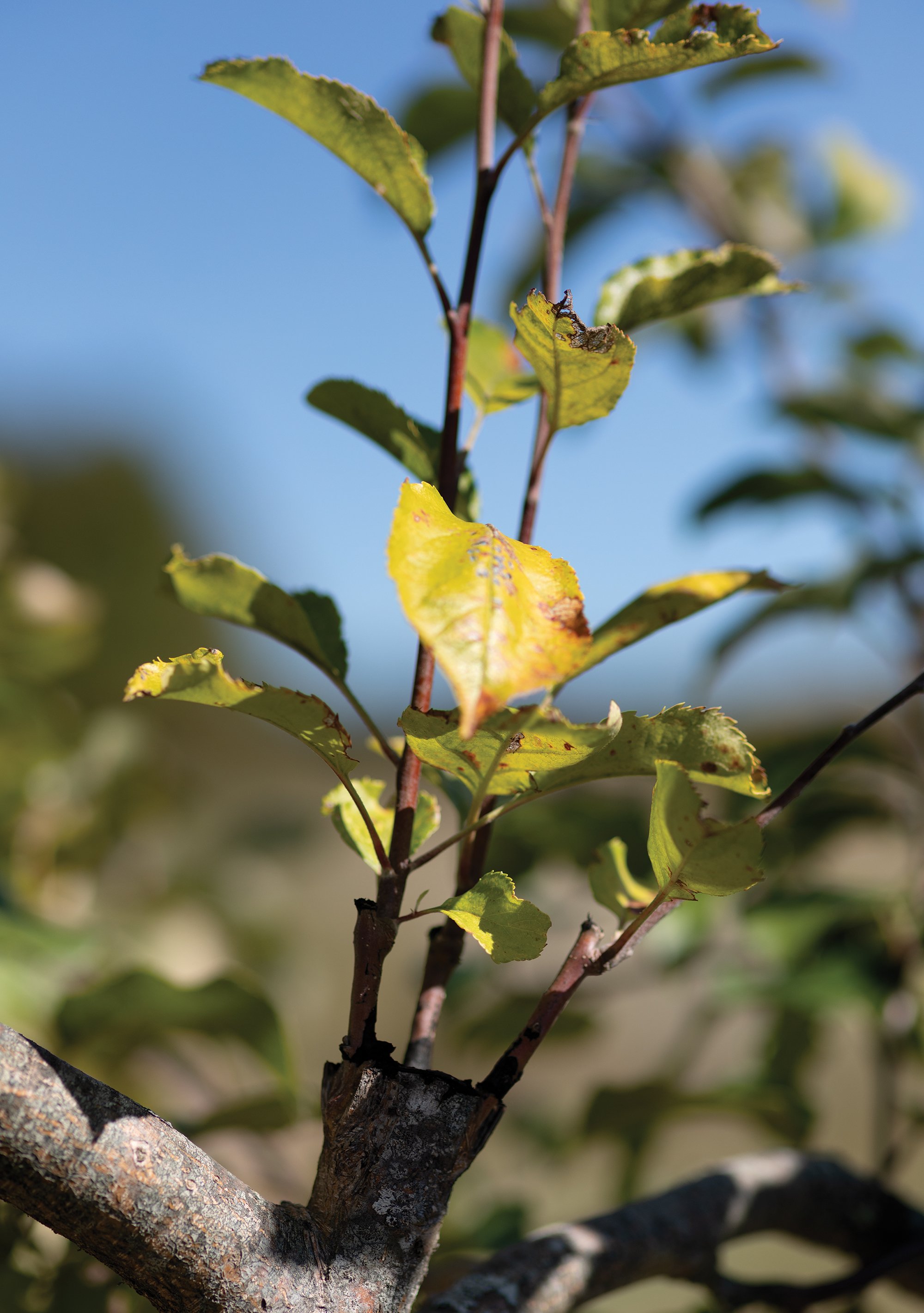
Drap d’Or cuttings grafted onto another variety of apple tree.
Grant Delin
When Howard added Larsen’s Danish data to his database, the Drap d’Or’s entry shone out. It matched his Unknown Founder 13. When the MOFGA sample matched it two years later, Howard and Peace understood immediately what the Maine mystery tree meant: a lost piece of apples’ history, grown in only one location in Europe, had suddenly been discovered in North America—the only known one on that continent, too. And because the Maine tree was an exact match, it could not have been a wild seedling accident. It represented a tree that someone had grafted and nurtured and carried into a new world. “It really tells you something about how people appreciated that cultivar historically,” Larsen says. “If immigrants brought that cultivar with them across the Atlantic and planted it in their gardens, it’s because it really had a value for them.”
The conventions governing who owns plant genetic data and who is entitled to disclose them—even if they have been submitted to a shared international database—are complex. They led to Howard, Larsen and Peace all being able to acknowledge among themselves that the name Drap d’Or de Bretagne, the University of Copenhagen’s tree, the characteristics expected in Unknown Founder 13, and the genotype data retrieved from Maine all added up to the same thing. But the rules also kept them from immediately announcing the name to the civilian apple detectives. That had to wait for almost another year, until publication of a scientific paper in August 2024 in which Howard and Larsen shared authorship with scientists from four other countries. One of the paper’s supplements associated the name Drap d’Or with the Danish genotype. With that information public, Peace felt free to take the next step.
The lost apple was just one among almost 1,000 in that paper’s spreadsheet. Yet to the Mainers, the announcement was momentous. For the Russells, learning their apple’s history validates their stewardship of a place they have invested almost 50 years in preserving. Bunker, who has probably rescued dozens of apple varieties, although he long ago lost count, says it represents “the importance of connecting with plants and with history and place.” For Little-Siebold, it means vindication for a chapter of history usually excluded from the American story—but also reinforcement for the way genetic detection can carry forward the work that apple hunters put in.
For the geneticists, though, the identification of the Drap d’Or isn’t only about illuminating the past. It also represents the promise that the apple’s characteristics, only partially preserved in its many descendants but now recovered intact, may improve fruit yet to come. “Thousands of cultivars were grown in the past, and only a small fraction of those are represented in the surviving trees that are out there,” Peace says. “The fact that they’ve survived through so much neglect, so many extra freezing winters and drought and all sorts of stuff over the decades—obviously they’ve got some resilience genetics in them. We should be tapping that as much as possible, understanding it, and incorporating that into development of new cultivars.”
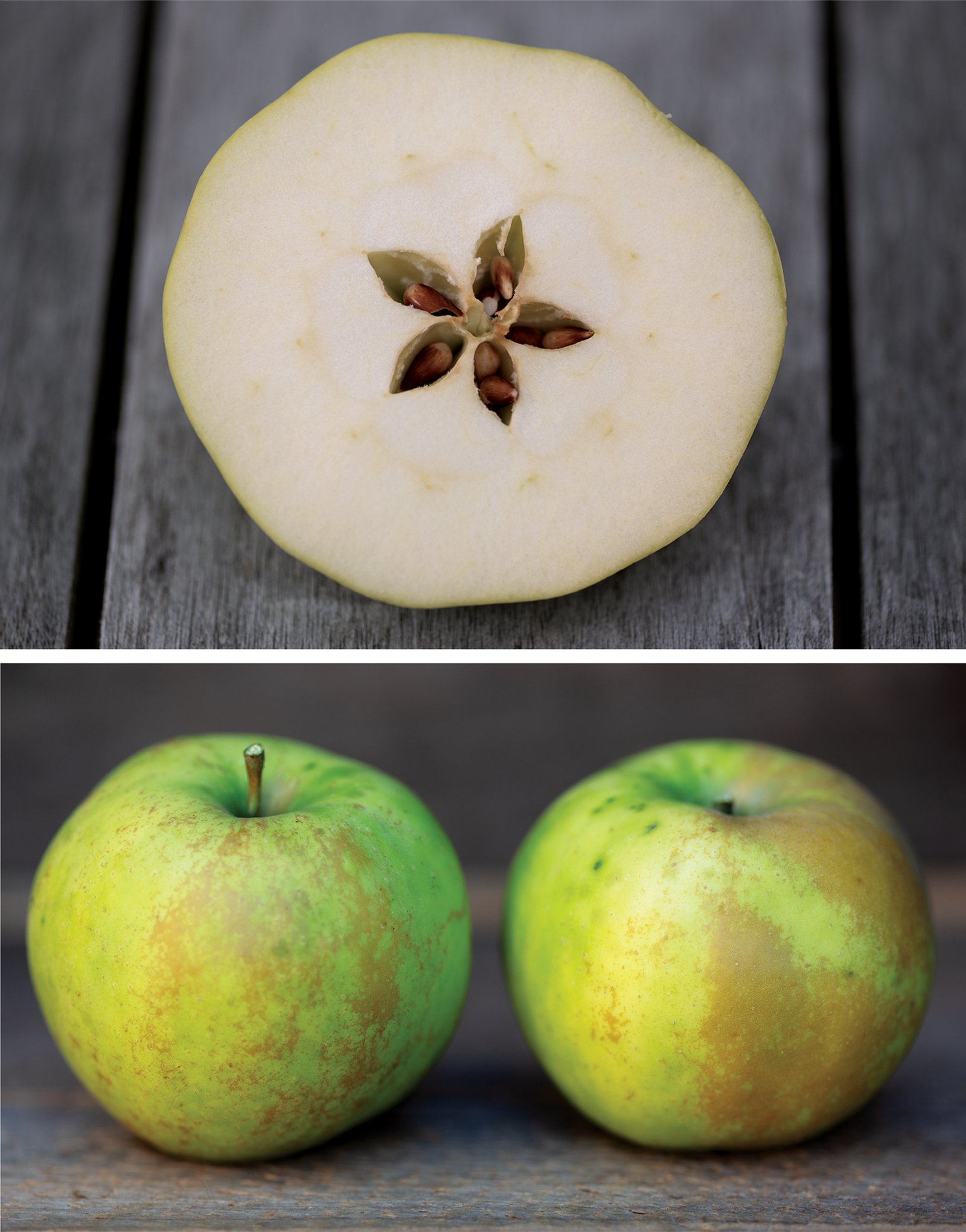
Drap d’Or apples.
Grant Delin
That work may soon be enhanced. It turns out the Russells’ tree isn’t the only Drap d’Or de Bretagne in the U.S. On September 21 of last year, a nonprofit housing counselor named Hannah Tays dashed up to a table in a tent at the Common Ground Country Fair, the hugely popular agricultural festival that MOFGA stages every year on its expansive grounds. It was a Sunday evening, the last hour of the fair’s last day, and Bunker and Little-Siebold were preparing to pack up the apple-ID table they had been running all weekend. Tays unrolled a brown paper bag and pulled out fruit from a scraggly, bifurcated tree that stands at the end of her property in Belfast, Me. The apple was yellow-green and fretted with russeting. Little-Siebold looked at it, looked at Bunker, looked back at Tays. “This is the apple we’ve been waiting for all weekend,” he said.
A few days later Bunker visited Tays’s tree to gather leaves for analysis. When the Maine team sent that sample for processing, it included some extras: leaves plucked from a roadside tree that Peter Jenkins had spotted in the town of Prospect. That tree’s owner said it had been grown from a graft of a family tree planted during the Civil War. One day this past April, Peace woke early, found an unexpected e-mail from the genotyping company and hurriedly downloaded the raw data. A few hours later he sent Bunker and Little-Siebold two e-mails bearing smiley faces: Both trees were identical to the Russells’ tree. They were all Drap d’Or de Bretagne.
Maybe the team should not have been surprised; the three locations lie within 20 miles of one another, and that entire area in Maine was settled early by the French colonists Little-Siebold has researched. The findings showed that the original identification hadn’t been a mistake scientifically or a mistaken assumption historically. That there were several additional trees demonstrated that early colonists had valued the Drap d’Or, shared it and grown it in different landscapes—fields and river cliffs and uplands—and that the trees had thrived and persisted and still remained.
“It helps to fill out the story of what happened,” Peace says. “The other thing it verifies for us is that we need to just keep testing lots more trees.”
This is not just true of Maine. Across the U.S., there may be hundreds of spots where early colonists and their Indigenous allies planted trees they loved—and then, over centuries, we forgot their origins, their uses and even their names. Already, in other fruit-growing areas, there are other researchers and enthusiasts looking for lost apples, hoping to recover their genetic resources and reassemble their histories. Somewhere there is another tree that harbors a piece of the American past or a protection for apples’ future. We cannot know, until we look, what treasures remain to be found.