
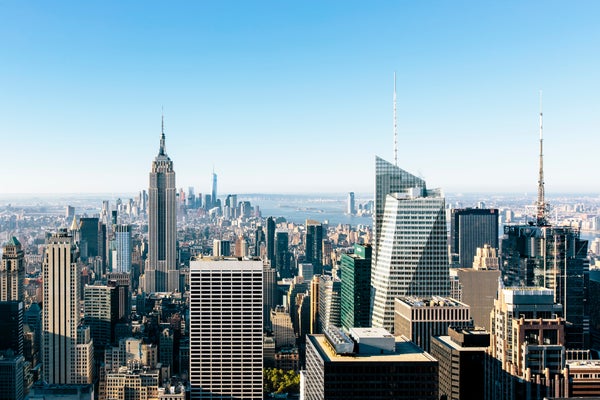
If global greenhouse gas emissions don’t decline soon, the climate in Washington, D.C., could more closely resemble that of today’s Greenwood, Miss. Summers may be slightly drier and more than 6 degrees Fahrenheit warmer than they are today.
That’s according to a new climate mapping project by researchers Matthew Fitzpatrick of the University of Maryland Center for Environmental Science and Robert Dunn of North Carolina State University. The project is designed to illustrate how U.S. cities will change over the next 60 years and determine which present-day climates serve as the best representations, or “analogs,” for what they will become.
It’s a way to show the public how familiar places—including their home cities—might change as the climate continues to warm, in a manner “we hope resonates better with people” than less personal forms of climate communication, Fitzpatrick said.
On supporting science journalism
If you're enjoying this article, consider supporting our award-winning journalism by subscribing. By purchasing a subscription you are helping to ensure the future of impactful stories about the discoveries and ideas shaping our world today.
“I was thinking about the stuff that we hear from scientists a lot and in the news a lot about climate change, and it’s often couched in terms of things like a 5-degree-Fahrenheit increase in the annual temperature—or if you’re talking about the Paris climate accord, you might hear something like, ‘We’re trying to limit global temperature change to 1.5 degrees Celsius,” he told E&E News. “And those sorts of descriptions never really resonated for me, even as a scientist that works with these data a lot.

Climate change is expected to alter seasonal norms for American cities. Credit: Matthew Fitzpatrick University of Maryland Center for Environmental Science
“I didn’t know, what does that mean for the place where I live, how will that place change?”
Fitzpatrick and Dunn have created a mapping tool that shows the closest climate analogs for cities across the United States, looking anywhere in the Western Hemisphere north of the equator. The comparisons are based on minimum and maximum temperatures and seasonal precipitation in each city.
Under a business-as-usual warming scenario, for instance, New York City may most closely resemble present-day Jonesboro, Ark.—a town that’s about 8 F warmer and more than 10 percent wetter in the winter than New York. Chicago may most closely resemble present-day Lansing, Kan., as it becomes both warmer and drier.
In general, the study finds that cities in the Northeast will tend to become warmer and wetter, while cities in the West will become hotter and often drier. Across the board, U.S. cities will start to resemble cities hundreds of miles to the south: Under a business-as-usual climate trajectory, the average climate analog is located about 500 miles away.
But there’s some caution warranted when making these comparisons. The closest analog for each city isn’t necessarily a perfect, or even a particularly close, match. It’s just the closest comparison available.
Under a more moderate climate scenario, for instance, in which there’s some mitigation of global greenhouse gas emissions and global temperatures warm by about 3 C, D.C. will most closely resemble present-day Paragould, Ark. And statistically speaking, it’s a pretty close match.
Under the business-as-usual trajectory, Greenwood is the closest match of anywhere on the map—but the similarities are much less close. In other words, it’s the closest match available, but it’s by no means identical to what future D.C. will be like.
And for many cities, the scientists say there’s really no good analog at all. In these cases, it would be fair to say the future will bring a “novel climate”—something that doesn’t currently exist in this corner of the world.
As many as 42 percent of studied cities may develop a novel climate by 2080 under a business-as-usual climate scenario. And 17 percent would have an analog considered a very good match. That’s particularly true for Western and Gulf Coast cities.
The climate comparisons made in this study are also relatively simple, relying only on basic measurements of temperature and precipitation. There are many other complex factors that may affect the human experience in a given city—average humidity, wind speeds, the frequency of extreme weather events or natural disasters and so on—and those could all change with the warming climate.
“We’re definitely working with a simplification here, and we’re ignoring a lot of the important variability and complexity in the climate system,” Fitzpatrick said. “But I think it’s a necessary simplification.”
For one thing, long-term records of these kinds of fine data aren’t always available at the city scale, he pointed out. But for another, the study’s purpose was mainly to avoid complexities and instead find a simple and personal way to demonstrate the effects of climate change on a local scale.
The map should demonstrate to people that limiting emissions can have a major effect on how dramatically their cities will change in the future—but also that they should likely be prepared for a different future no matter what.
“Overall, even when we limit emissions we’re in store for a dramatic transformation of climate that’s already started,” Fitzpatrick said. “And cutting emissions will help for sure, but at the same time the next 60 years are going to be a big change.”
Reprinted from Climatewire with permission from E&E News. E&E provides daily coverage of essential energy and environmental news at www.eenews.net.