
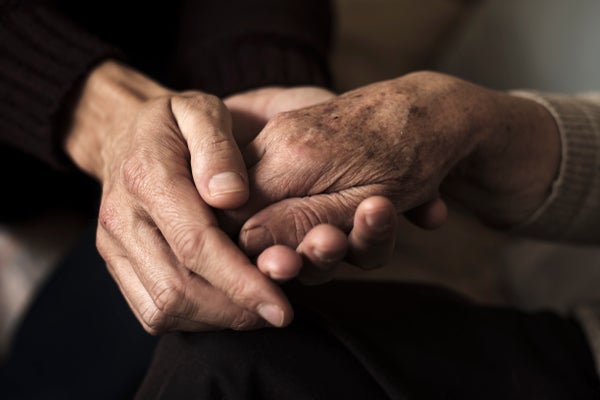
Birth and death are the bookends of life, yet we welcome one and dread the other. Why is it that birth is celebrated, but death is taboo?
When a friend was expecting her first child, she needed additional support through her pregnancy, so she hired a birth doula. The idea of women helping other women during childbirth is not new. Since the beginning of time, women have labored and birthed at home, attended by a midwife and their female friends and kin. This camaraderie of women, once universal, was a way to provide birth support and also to pass on knowledge about pregnancy, childbirth and parenting.
The natural birth movement of the 1960s begged a return to this approach with women demanding unmedicated, less interventional births. Hence, the inception of the birth doula—a nonmedical caregiver who assisted pregnant women in the transition to motherhood.
On supporting science journalism
If you're enjoying this article, consider supporting our award-winning journalism by subscribing. By purchasing a subscription you are helping to ensure the future of impactful stories about the discoveries and ideas shaping our world today.
Can the same idea apply to death? The evolution of death care has followed a similar trajectory to that of childbirth care. For most of human history, people were cared for and died at home, with corpses even displayed on the dining room table for mourning. This began to change in the mid-20th century as society saw great advancements in medical technology for diagnosis and treatment of illnesses. These developments moved health care away from the local doctor, who made house calls, to inpatient stays at hospitals. When people fell ill, they went to the hospital and eventually died there. In 1980, 60.5 percent of people died in hospitals. This number peaked in the mid-1980’s, but has since steadily decreased in response to a growing movement for death to be less medicalized, less institutionalized, and more natural. By 2016, half as many people (29.4 percent) were dying in hospitals, roughly equaling the number of people dying at home (30.5 percent). While this trend is encouraging, these numbers still do not reflect the fact that 71 percent of people would prefer to die at home.
I am a death doula, or what is now more commonly termed an end-of-life doula. This role grew out of the increasing awareness of and desire for more humane and compassionate ways to die. Similar to birth doulas, end-of-life doulas are nonmedical professionals offering emotional, spiritual, informational and physical support—not at birth, but at the other end of the spectrum of life—at death.
An elderly man with a terminal illness is afraid to die. He fears for the family he will leave behind—his wife, children and grandchildren—and how they will cope after he is gone. He has not expressed this fear to his doctors or to his wife, who is already handling so much. I listen. I hold space for his despair and angst. He realizes the fear is based on his immense love for his family. He drinks champagne with them on his deathbed. Reconciliation with the things that are important can allow one the peace to let go.
End-of-life doulas work with those with serious illnesses who are facing death—and also for those who are healthy and just want to prepare for death. On practical matters, doulas can advise on advance care directives, vigil planning and postdeath options, and assist with life review and legacy. On more emotional matters, doulas can facilitate conversations about unresolved issues or complex family dynamics and offer space for the fears and uncertainties around death and dying. When we are prepared for death, we are better able to face it when the time comes.
Despite her wish to die at home, an elderly woman is taken to the hospital by her son, who can no longer bear to watch his mother die in excruciating pain. The hospital wants to discharge her, finding nothing wrong, and, at her age, what can be done anyhow? The family is distressed by the hospital’s response and calls me. I suggest that they ask for a palliative care consultation. Eventually, the mother is placed on a proper pain management plan and discharged to hospice care. How do you know what to ask for, if you don’t know the choices?
Palliative and hospice care are philosophies of care that focus on comfort and symptom management to alleviate pain and suffering. Both are available to persons with serious illnesses. While palliative care can be given concurrently with curative care, hospice is typically for those who no longer seek curative treatments.
End-of-life doulas advocate for the wishes and needs of the dying person. We work with the health care team in ongoing care and coordinate with the support network of family and friends in place or help to establish a needed support system. We fill gaps in care and tackle tasks that are difficult to do or face. All the while, we can be a calming presence for loved ones and the dying person, especially for those who are facing death all alone.
A middle-aged man lies actively dying, completely nonresponsive, in his bed. He displays “death rattle” breathing, and his body has occasional violent spasms. At his bedside, a petite woman sits, his aunt, pained to watch her nephew die this way. After creating rapport with the aunt, I seek to allay her distress and encourage her to speak to him. The aunt responds gratefully, awakened to the possibility of making a difference for her nephew. He dies peacefully, immersed in soft light, music and love. Sometimes all a loved one needs is permission to be an active participant in the process, to turn helplessness into empowerment.
While death brings sadness and loss, there can also be positive emotions of love, honor and pride. It is possible to feel seemingly contradictory emotions all at the same time—because death is loss, and grief is the natural expression of love.
On the end-of-life journey, we doulas are your personal advocate, cheerleader, companion, guide, ear, rock—whatever you need us to be to face a difficult, intense and emotional time, because no one who wants support at the end of life should have to go without.
This is an opinion and analysis article.