
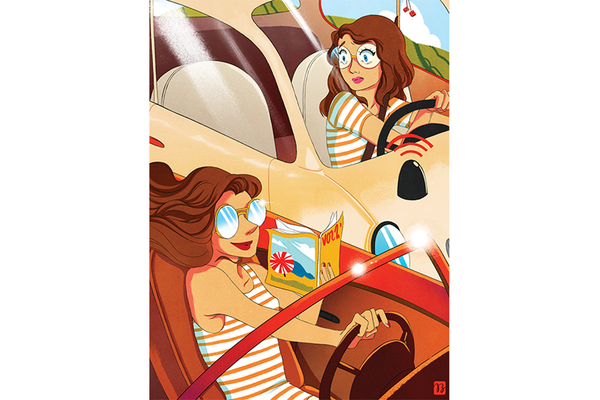
Car companies predict that self-driving cars will save millions of lives. They talk about a future without personal auto ownership, drivers' licenses, car insurance or the search for parking. When you need a ride, simply use an app to call an autonomous taxi.
But not everyone is sold on the dream. In fact, 73 percent of respondents told the American Automobile Association in a recent survey that they wouldn't want to ride in a self-driving car. They don't want to give up control to a machine. They don't trust it, don't think it's safe.
After two years of waiting, I'm finally the proud owner of a Model 3, the latest and least expensive Tesla—and among the most autonomous cars on the road. I've used its Enhanced Autopilot a lot. It's had some near misses and required some adjustments, but I can now say whether it's really safer than my own driving.
On supporting science journalism
If you're enjoying this article, consider supporting our award-winning journalism by subscribing. By purchasing a subscription you are helping to ensure the future of impactful stories about the discoveries and ideas shaping our world today.
To be clear, no car is fully autonomous yet, meaning that you can't just enter a destination and then go to sleep. That's considered level 5 autonomy, the high end of the scale determined by the Society of Automotive Engineers.
Today's smartest cars are mostly level 2, meaning that they can drive themselves on the highway. They stay in their lane automatically and adjust their speed to traffic as necessary (you specify a maximum speed and a minimum distance between you and the car ahead of you). But they can't turn onto new roads, read stop signs or traffic lights, or make lane decisions.
With its eight video cameras, 12 ultrasonic sensors and a front radar, the Tesla Model 3 goes a bit further—I'd call it level 2.3.
For example, if you put on your turn signal, the Tesla watches for an opportunity, accelerates if necessary and then smoothly changes lanes, all by itself. If you're exiting, it eases onto the ramp and slows down. (Ingeniously, it knows how much to slow down based on the behavior of Tesla owners who have taken that ramp before you.) Enhanced Autopilot also knows to slow down on a curve, can recognize pedestrians and bicycles, and can slam on the brakes to avoid a collision.
The manual teems with warnings, especially this one: you still have to pay attention. In my Tesla, if it notices your hands have been off the wheel for too long (three minutes in most situations), the screen shows increasingly frantic warnings. If you ignore them, Autopilot shuts off for the rest of your trip, punishing you for your carelessness. If there's still no response from you, Autopilot activates the hazard blinkers and slowly stops. If you've fallen asleep or taken ill, that's a much better outcome than crashing.
Autopilot has saved me from some near misses. Once it noticed before I did that highway traffic had suddenly slowed, and it braked automatically. It's also given me a couple of scares: it didn't see a parked utility truck jutting into my lane. Another time it didn't hug a curve when the outside painted line was missing. (The manual does warn about both these situations.) Its self-driving maneuvers are generally graceful, but I've experienced a few bafflingly jolty ones. On balance, though, I'm convinced that Autopilot makes me safer. It takes care of fussy, mechanical operations, leaving you to focus on larger-level issues, like what's around you or what your next turn should be. By off-loading the second-by-second, fight-or-flight decisions, you're free to destress a little, making driving less fatiguing and more pleasant.
Now, self-driving skeptics note that two people are confirmed to have died in Autopilot crashes. But software updates continuously improve these cars; many of the behaviors described here are new since those tragedies. And Tesla points out that, statistically, Autopilot is already much safer than humans. Tesla crashes average one death per 320 million miles; for U.S. human drivers, it's one every 86 million. If everyone used Autopilot, the company calculates, we'd save 900,000 lives a year worldwide.
Operating a partly automated car really is a different kind of driving. It involves different muscles—mental and physical—and some adaptation. If you resist change, you may not ever want a self-driving car, and that's okay. But if you're willing to try something new, I predict you'll enjoy driving more—and crash less.