
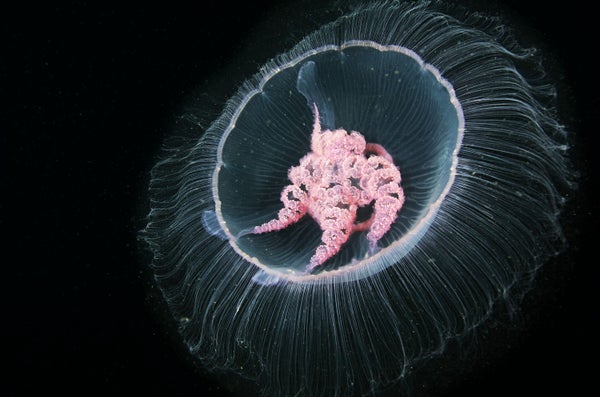
Jellyfish never stop. Twenty-four hours a day, seven days a week, they move through the water in search of food such as shrimp and fish larvae, on journeys that can cover several kilometers a day. They are more efficient than any other swimmer, using less energy for their size than do graceful dolphins or cruising sharks. “Their cost of transport—the oxygen they use to move—is 48 percent lower than any other swimming animal,” says Bradford J. Gemmell, a marine biologist at the University of South Florida. By studying moon jellies, the species Aurelia aurita, Gemmell and other researchers have recently found that jellyfish pull off this feat by creating zones of high and low pressure around their body that alternately suck and push them forward.
Scientists once believed that jellies traveled so easily because they were light, mostly water. But water has mass, and mass still has to be moved. So Gemmell, with engineer John Dabiri of Stanford University and their colleagues, took a close-up look. They put a jellyfish in a tank and dropped tiny glass beads into the water. By illuminating the beads with lasers, they could track their movements with a high-speed camera, essentially making the water velocity and pressure visible around the animal.
When the animal contracted its bell—the dome that forms much of the jellyfish body—it created lower pressure outside the bell and higher pressure within. Because objects move from high to low pressure, the moon jelly got pulled forward, the scientists noted in November 2015 in Nature Communications.
On supporting science journalism
If you're enjoying this article, consider supporting our award-winning journalism by subscribing. By purchasing a subscription you are helping to ensure the future of impactful stories about the discoveries and ideas shaping our world today.
Then the researchers got a surprise. When the jelly relaxed the bell margin, letting it flare out, the high-pressure water below the animal rose up into the bell. “It gave the moon jelly a secondary bump forward, even while it relaxed,” Gemmell says. To make these moves, the jelly needs to flex the bell margin up and down. Jellyfish have muscles, but most go around the bell like a stack of rubber bands. That arrangement is good mainly for squeezing. Recently, though, Richard Satterlie, a biologist at the University of North Carolina Wilmington, discovered other muscles at the margin that stick out at angles. Those fibers let the jelly bend its edge, moving water around it, and make for a very effective swimmer.
The Jellyfish Swim Stroke
Jellyfish create zones of high and low pressure around themselves, then move from one to the other. By dropping tiny glass beads in a water tank with a jellyfish, a team of scientists was able to see that a vortex—a relatively low-pressure spinning doughnut of water—rolls down the jelly. Seen below as a cross-sectional slice, the vortex (blue) appears as two wheels of water (1). As the jelly contracts, it creates higher pressure within its bell, and the animal is pulled ahead to lower pressure (2). By flexing the edge of its bell, the jelly moves the vortex down and underneath (3). There the vortex pushes water up as it spins, giving the jelly an extra shove (4).

Credit: Eleanor Lutz