
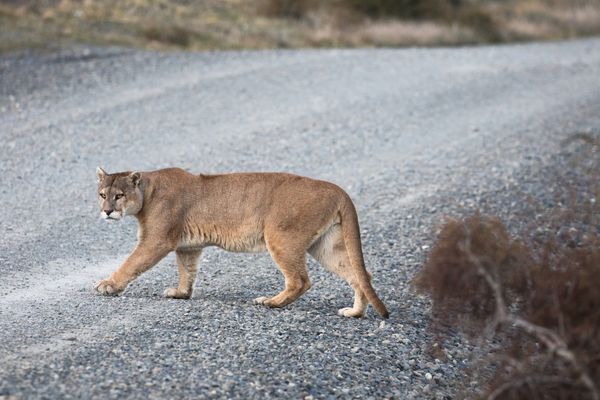
Hearing the roar of a mountain lion in the distance while you’re just outside your house might sound scary. Yet living in an area inhabited by these large predators might actually make you safer.
New large-scale research shows that the presence of mountain lions, also known as pumas or cougars, can drastically decrease the number of potentially deadly collisions between deer and vehicles by changing the behavior of their prey.
“It’s not easy to live alongside large carnivores, and they are often implicated in conflicts with people,” says Kaitlyn Gaynor, a wildlife ecologist at the University of British Columbia, who wasn’t involved in the new research. “But this study shows that carnivores can actually reduce conflicts with their prey species, often through complex ecological pathways.”
On supporting science journalism
If you're enjoying this article, consider supporting our award-winning journalism by subscribing. By purchasing a subscription you are helping to ensure the future of impactful stories about the discoveries and ideas shaping our world today.
Every year in the U.S., deer are involved in more than 1.5 million collisions with vehicles, resulting in the death of more than 200 people, tens of thousands of injuries and billions of dollars in damages.
The team of scientists behind the new study, published on Wednesday in Current Biology, wanted to see whether pumas could play a role in decreasing those numbers.
The researchers analyzed data from 503 camera traps and 59 GPS collars tracking pumas’ presence in Washington State’s Olympic Peninsula between 2020 and 2025. They also looked at data on the distribution and behavior of black-tailed deer and elk in the landscape and on collisions between vehicles and the animals. In those five years, the deer and elk were involved in more than 950 collisions with vehicles on the peninsula, which resulted in two human’s deaths and more than 80 injuries.
The analysis showed that a high presence of pumas led to a 76 percent reduction in deer-vehicle collisions compared with areas where pumas’ presence was lower.
The reduction wasn’t because pumas were preying on the deer and reducing their overall numbers. Rather it resulted from the mountain lions instilling fear in the deer, which shaped how the prey animals moved in the landscape.
The presence of pumas pushed deer into more remote areas, making them 15 percent less likely to be in areas with many roads. That might be because they can find cover from predators in the more abundant vegetation in those remote areas, says study co-author Mark Elbroch, a mountain lion biologist and director of the Puma Program at Panthera, a conservation organization. Pumas also led deer to stay more active during the day rather than at night, which is when the predators are most active. Drivers might also be better able to see the deer and avoid collisions during daylight, Elbroch says.
Though coexistence between pumas and humans can be challenging, Elbroch hopes this kind of research can highlight how large predators can bring benefits to human communities that live alongside them, especially in light of the predators’ natural expansion and possible reintroductions. “I hope that it helps people be more tolerant of living alongside these animals when they realize that there is tremendous value in having them live alongside us,” he says. “They're saving lives. They’re reducing damage to infrastructure. They’re saving millions of dollars just in our place.”