
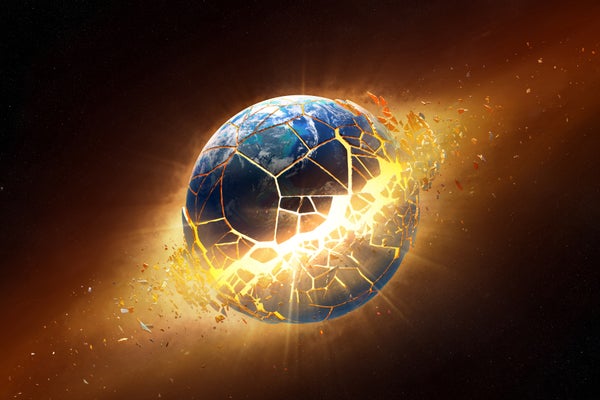
An apocalypse needs a lot or just a little energy—depending on what you compare it with. But what's really exciting is the math behind this ultimate destructive event.
If you want to destroy Earth, you have many options—at least when it comes to the extinction of humanity. Nuclear war, climate crisis or species extinction: over the course of human history, we have unfortunately found plenty of ways to destroy ourselves. But the planet doesn’t really care.
To actually destroy the planet, you would have to work a little harder. A collision with a large asteroid, for example, could make it uninhabitable and melt Earth’s crust, but even that wouldn’t destroy the Earth. If you wanted to pulverize it completely so that nothing remained, you would have to use the following formula:
On supporting science journalism
If you're enjoying this article, consider supporting our award-winning journalism by subscribing. By purchasing a subscription you are helping to ensure the future of impactful stories about the discoveries and ideas shaping our world today.
EG = 3GM2⁄5R
This equation describes gravitational binding energy. It corresponds to the energy required if the components of a body held together by gravitational force are to be moved infinitely far apart. The formula applies to a homogeneous sphere. Although Earth is not a perfect homogeneous sphere, the equation suffices to at least calculate the correct order of magnitude of its binding energy. If you do this, you get a result of around 200 nonillion joules (two followed by 32 zeros). This corresponds roughly to the energy that would be obtained if the mass of the entire asteroid Eros (which has an average diameter of almost 17 kilometers) could be converted directly into energy. On the other hand, it corresponds to only one sixtieth of the energy that the sun produces in a year.
If you’re not intrigued by the complete destruction of a planet, the gravitational binding energy is still interesting from a different perspective. This is because it doesn’t just correspond to the energy required to dissolve the cohesion of matter induced by gravity. The same amount of energy is also released when, for example, a star forms. If one of the large gas clouds in interstellar space begins to collapse because of external forces, it becomes increasingly compact. It collapses, and the matter comes closer and closer and becomes more and more bound together. The collapse releases the amount of energy given by the formula for binding energy.
This energy ensures that the gas cloud from which a star is later formed continues to heat up. In the past, before we knew how old stars were (and before nuclear fusion was understood), it was even thought that all of the sun’s energy came from its original collapse. This turned out to be wrong, but this energy should still not be overlooked. Jupiter, for example, radiates more energy into space than it absorbs from the sun. Part of this additional energy comes from the slow contraction of the gaseous planet, which shrinks a few centimeters a year under its own gravitational pull.
Knowing how much energy is needed for binding has a broader importance in astronomy. In the 1930s astronomer Fritz Zwicky calculated the maximum speed at which galaxies in a cluster could move and not break free from their mutual gravitational bonds. The result was significantly lower than the movement actually observed. The gravitational binding must therefore be greater than expected. Zwicky concluded from this that a “dark matter” exerts the additional gravitational force that is necessary to hold galaxy clusters together.
We have now observed traces of this gravitational binding everywhere in the universe. And even if its source has not yet been identified, we definitely know that such a discovery lies ahead at some point. In any case, it is a more enticing topic than the prospect of total planetary destruction.
This article originally appeared in Spektrum der Wissenschaft and was reproduced with permission.