
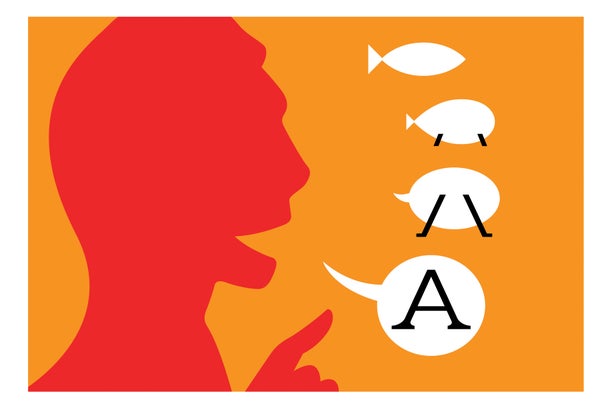
Charles Darwin found inspiration for his theory of evolution in birds’ beaks, giant tortoise shells—and language. “The survival or preservation of certain favored words in the struggle for existence is natural selection,” he wrote in The Descent of Man in 1871.
Language gradually shifts over time. Much research examines how social and environmental factors influence language change, but very little grapples with the forces of human cognitive selection that fix certain words into the lexicon. For an extensive new study, published in the Proceedings of the National Academy of Sciences USA, scientists investigated just that.
In an experiment much like a game of telephone, thousands of participants read English-language stories and rewrote them to be read by other participants, who then rewrote them for others. Only certain words from the first stories survived in the final versions. Researchers analyzed the word types speakers consistently favored, theorizing that such preferences drive language change over time. The scientists also separately analyzed two large collections of English historical texts from the past two centuries, containing more than 40 billion words—again seeing only certain types survive.
On supporting science journalism
If you're enjoying this article, consider supporting our award-winning journalism by subscribing. By purchasing a subscription you are helping to ensure the future of impactful stories about the discoveries and ideas shaping our world today.
The results converged to show three properties that give words an “evolutionary advantage” by helping them stick in the brain: First, words typically acquired at an early age (such as “hand,” “uncle” or “today”) are stabler. Next, concrete words linger better than abstract ones: “dog” persists longer than “animal,” which persists longer than “organism.” Lastly, emotionally exciting words—whether negative or positive—tend to endure.
Early language-evolution models assumed that language becomes increasingly complex over time. But Indiana University Bloomington cognitive scientist and study co-author Fritz Breithaupt says the new study supports a more recent theory that language ultimately gets more efficient and easier to understand. Still, as the study notes, “the English language is not baby talk.” Breithaupt explains: “Yes, we shift toward simple language, but then we also grab complex language that we need.” New words that address the intricacies of modern life may somewhat balance out this shift.
The proposed trend toward “simpler” language is controversial. Columbia University linguist John McWhorter more or less agrees with the study’s results about evolutionary advantages within language. He questions, however, implications regarding the overall efficiency of English—a language he says contains things like “needlessly complex” grammatical vestiges. “There are about five ways to indicate the future in English,” he says. “I pity anybody who doesn’t grow up with it natively” and wants to learn it.
Study lead author Ying Li, a psychologist at the Chinese Academy of Sciences and a non-native English speaker, notes that English had even more perplexing grammar in the past. McWhorter, Li supposes, “would complain more if he traveled back 800 years ago.”