New Issue: Orbital Catastrophe Ahead? Read Now

How Skin Cancer Rates Vary across the Globe

This leading cancer affects some populations and regions much more than others

Graphics highlight most common body locations and activities associated with sunburn in the U.S.

MSJONESNYC

Join Our Community of Science Lovers!

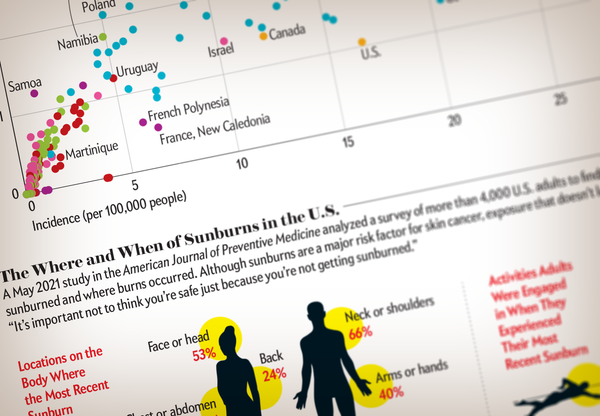
Skin cancer is the most common form of cancer, and because older people make up a greater share of the population in many places, including the U.S., it is on the rise. The main cause of skin cancer is exposure to the sun's ultraviolet rays, but the risk varies greatly across the globe because of differences in skin pigmentation—which protects against skin cancer—and the amount of direct sunlight that regions receive. “Skin melanoma is nearly 30 times higher in whites than in Blacks,” says Ahmedin Jemal, a cancer epidemiologist at the American Cancer Society. “And even in white populations there is a difference in susceptibility—those with fairer skin, blue eyes and blond hair are more susceptible.”

Yet there are reasons for optimism. New treatments for skin cancer, including immunotherapy, have helped raise survival rates, which are now around 93 percent after five years for people diagnosed with melanoma relative to the general population.

Credit: MSJONESNYC; Source: GLOBOCAN 2020; Global Cancer Observatory; International Agency for Research on Cancer 2022


On supporting science journalism

If you're enjoying this article, consider supporting our award-winning journalism by subscribing. By purchasing a subscription you are helping to ensure the future of impactful stories about the discoveries and ideas shaping our world today.


The Where and When of Sunburns in the U.S.

A May 2021 study in the American Journal of Preventive Medicine analyzed a survey of more than 4,000 U.S. adults to find out what people were doing when they got sunburned and where burns occurred. Although sunburns are a major risk factor for skin cancer, exposure that doesn’t lead to a burn can still be harmful, Jemal says. “It’s important not to think you’re safe just because you’re not getting sunburned.”
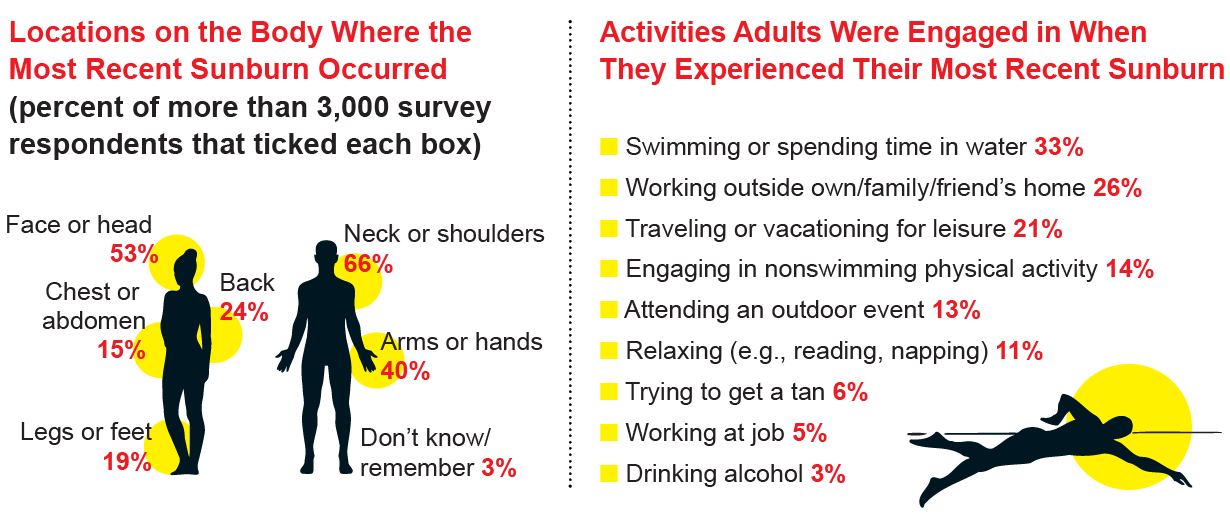
Graphics highlight most common body locations and activities associated with sunburn in the U.S.

Credit: MSJONESNYC; Source: “The Context of Sunburn among U.S. Adults: Common Activities and Sun Protection Behaviors,” by Dawn M. Holman et al., in American Journal of Preventive Medicine, Vol. 60; May 2021

Editor’s Note (7/29/22): The first graphic in this article was edited after posting to correct the description of why New Zealand’s ultraviolet radiation is stronger that it is in corresponding latitudes in the Northern Hemisphere and why the Southern Hemisphere is closer to the sun during its summer than the north is during its summer.

Clara Moskowitz is chief of reporters at Scientific American, where she covers astronomy, space, physics and mathematics. She has been at Scientific American for more than a decade; previously she worked at Space.com. Moskowitz has reported live from rocket launches, space shuttle liftoffs and landings, suborbital spaceflight training, mountaintop observatories, and more. She has a bachelor’s degree in astronomy and physics from Wesleyan University and a graduate degree in science communication from the University of California, Santa Cruz.

More by Clara Moskowitz
Scientific American Magazine Vol 326 Issue 6This article was published with the title “Skin Cancer around the World” in Scientific American Magazine Vol. 326 No. 6 (), p. 62
doi:10.1038/scientificamerican0622-62

Subscribe to Support Independent Journalism

Great science journalism requires human expertise, time, effort and creativity. And it costs money. That’s why I and the journalists here at Scientific American hope you’ll join our community.

When you subscribe, you are supporting staff and freelance journalists who are passionate about telling science stories that are true, important and compelling. Our editors and reporters are often experts in their fields, which means they understand the nuances of big discoveries and can untangle the breakthroughs from the hype. With a subscription, you are also supporting rigorous fact-checking to ensure the words we publish are precise and accurate. And you’re supporting original illustrations, graphics and photos that bring you closer to an advanced laboratory, an ice sheet in Antarctica or a space mission in orbit. You’re helping us craft other types of high-quality journalism as well: Our newsletters are carefully written, edited and curated by staffers you have or will come to know and love. Our Science Quickly podcast is based on original reporting, collaboration with editors and scientists and exacting production.

Subscriptions keep this engine running so we can continue to deliver thoughtful, rigorous and independent science journalism to you. In an era of viral misinformation, this work is crucial. If you value what we do, I hope you’ll consider joining us as a subscriber

Thank you,

Jeanna Bryner, Editor in Chief, Scientific American

Subscribe