
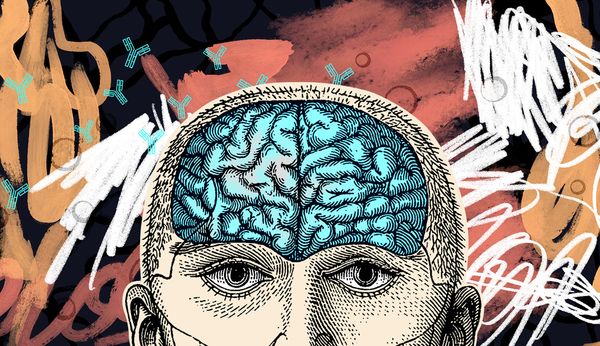
Peter Jones once treated a patient with strikingly vivid hallucinations of animals. During ward visits, the patient would stroke and interact with the critters “in as real a way as he was with me,” says Jones, an academic psychiatrist at the University of Cambridge in England.
Antipsychotic drugs did nothing to dissolve these Snow White-esque visions. But when the patient receivedplasma exchange –– a treatment normally reserved for a misbehaving immune system –– his hallucinations dissipated.
Clearly, this was not a textbook case of schizophrenia. Rather, the patient’s symptoms stemmed from autoimmune encephalitis, a rare form of brain inflammation that can, in some cases, cause hallucinations and other symptoms of psychosis. When these patients are treated with drugs that tamp down the immune system, the psychotic symptoms often disappear.
On supporting science journalism
If you're enjoying this article, consider supporting our award-winning journalism by subscribing. By purchasing a subscription you are helping to ensure the future of impactful stories about the discoveries and ideas shaping our world today.
Autoimmune encephalitis is usually first identified through testing blood or spinal fluid for certain types of antibodies. If patients test positive for these antibodies, it’s a sign that their immune system may be attacking the brain. Other signs can help to solidify diagnosis: bright patches of inflammation on MRI scans, quickly worsening psychotic symptoms and — importantly — clear neurological symptoms such as seizures.
But Jones’ patient didn’t have those obvious neurological symptoms. If Jones hadn’t suspected an autoimmune cause, the case likely would have been missed.
Some experts suspect that the field of psychiatry is overlooking a small number of patients like this, and they are working to find more of them. They’re considering screening a broader array of psychiatric patients and seeking out new antibodies that may be involved in autoimmune encephalitis.
At the same time, many worry that there’s a risk of planting false hopes and diverting patients from the psychiatric treatments the vast majority will actually need, should autoimmune encephalitis become overdiagnosed.
Landmark research paper
The “artificial divide” between the body and the mind that separates the fields of psychiatry and neurology is starting to break down, says Michael Zandi, a neurologist at University College London. Psychosis, for example, can be caused by a mix of mental and biological factors, from psychological trauma to drug abuse to physical diseases or infections (such as syphilis) that alter brain activity. Around 3 percent of people will experience a psychotic episode in their lifetime.
Brain inflammation caused by the body assaulting itself, as in autoimmune encephalitis, has been recognized for the past couple of decades. In the early stages of this condition, many patients develop the core features of psychosis –– hallucinations, delusions and agitation –– and so are initially sent to psychiatric services.
A landmark paper about this condition came in 2007, when researchers described the cases of 12 women with autoimmune encephalitis. Nine of the patients initially presented with a number of psychosis-like symptoms, while the others mainly had memory loss. All but one devolved into seizures. The researchers found that the women’s conditions were caused by antibodies that bind to the brain’s NMDA receptors, proteins that are involved in many processes in the brain, such as learning and the formation of memories.
The trigger for autoimmune encephalitis, in this case, seemed to be tumors in these patients, 90 percent of which were ovarian. All five tumors the researchers examined contained nerve tissue complete with NMDA receptors. This confused the immune system, which came to recognize the NMDA receptor as foreign and ramped up the manufacture of antibodies that bind to it.
But those antibodies also bound to NMDA receptors in healthy brain tissue, interfering with brain function. Other cells of the immune system gathered to the area, sparking inflammation that, in many of these cases, caused psychosis.

In autoimmune encephalitis, an immune chain reaction may be triggered by tumors, previous infections or unclear causes. Most cases of the condition are linked to a brain-targeting autoantibody, which leads to inflammation that may result in neurological or psychiatric symptoms.
Beyond tumors, experts also think that classic autoimmune encephalitis may be triggered by previous infections such as herpes simplex virus in the brain. But root causes are often mysterious. Only a tiny sliver of psychosis cases are due to autoimmune causes — most experts cap it at 1 to 2 percent of patients. If untreated, these patients may decline into a coma and even die, so to avoid missing them, savvy psychiatrists look for other neurological symptoms, most notably seizures, but also features like catatonia or mouth-twitching.
If these telltale signs of brain inflammation emerge, blood or spinal fluid may be tested for autoantibodies (antibodies that attack the patient’s own tissues). If these tests, often coupled with signs on MRI or EEG brain scans, point to autoimmune encephalitis, patients are rushed into immunotherapy: treatments with drugs to tamp down the overreactive immune system. Many fully recover: “We can get them completely better,” says Zandi.
Autoimmune encephalitis is commonly caused by antibodies that bind to the NMDA receptor, known as NMDAR antibodies. But researchers have uncovered dozens more antibody types that are associated with encephalitis, some of which also appear to produce psychiatric symptoms.
One leading example is LGI1 antibodies, which were discovered in 2010. These antibodies latch onto LGI1 proteins in the brain, preventing them from passing signals between nerve cells. This form of autoimmune encephalitis often causes dementia-like symptoms, leading to initial misdiagnosis. Zandi says he’s had patients whose apparent dementia has disappeared after immunotherapy, leaving them “fully independent, back to driving, normal.”
University of Oxford psychiatrist Belinda Lennox has observed similarly striking transformations. Around the time of the 2007 paper, she began conducting antibody tests on psychiatric patients whose symptoms seemed to overlap with signs of autoimmune encephalitis,such as quickly shifting psychotic symptoms or neurological features like seizures.

One of Lennox’s first patients to test positive for NMDAR antibodies was a young female librarian who had rapidly descended into paranoia, stopped sleeping and then went mute. Antipsychotic drugs made her condition worse. After the antibodies were detected, the patient was given treatment to remove them from her blood. Within about a week, she was completely better. “That was the sort of mind-blowing moment,” Lennox says.
Today, Lennox is fascinated by the possibility of a larger population of psychosis patients whose illness is owed to autoimmune issues that are missed. This might explain why some patients don’t respond well to psychiatric treatments. “It’s an unexplored tip of the iceberg,” she says.
In search of missed patients, for the last decade Lennox has been running a clinical trial called SINAPPS2 to probe whether antibodies can be causing psychosis even in patients who don’t have other obvious neurological symptoms such as seizures and comas. Jones of the University of Cambridge is another investigator on the trial.
The researchers have been screening patients who have been experiencing psychotic episodes for less than two years, for four types of antibodies, including NMDAR and LGI1. At testing, none of the participants had severe neurological issues. Lennox says the team has detected the antibodies in the blood or spinal fluid of around 5 percent of around 5,000 psychiatric patients who have been screened.
Blood tests aren’t always reliable, however. Some of these detections may be false positives — meaning that despite the positive score, the body doesn’t truly have those autoantibodies in it. Others may have some antibodies floating around but they’re harmless and not driving their illness. A third population, though, may be in the same camp as Jones’ memorable patient.
One outstanding — and contested — question is whether a wider swath of early psychosis patients should be tested for these antibodies.
So far, 70 participants have been recruited to receive either immunotherapy or a placebo treatment. After treatment, researchers track their progress for up to 1½ years. (Jones stresses that if any patients start having seizures or other clear neurological symptoms, they will be treated with immunotherapy even if they were in the placebo group.)
The results, which are expected in 2027, will hopefully help map out the risks and benefits of immunotherapy treatment for psychosis patients with detected autoantibodies, guiding future care, says Jones. One outstanding –– and contested –– question is whether a wider swath of early psychosis patients should be tested for these antibodies, already a norm in Germany and Australia.
New antibody clues
Researchers are also continuing to search for new brain-targeting antibodies. Their hope is to understand patients who don’t have known antibodies but do have symptoms that look like autoimmune encephalitis. Detecting such new antibodies doesn’t prove they are driving the symptoms — cause and effect takes time to disentangle. But it gives researchers clues.
“Every year, there are a handful of new antibodies that are discovered, and some are more relevant to psychosis than others,” says Jonathan Rogers, a neuropsychiatry researcher at University College London. For example, in 2024, researchersdiscovered an antibody that binds to a protein in the brain called CAMKV. They detected this rare antibody in five patients with cancer, three of whom had psychosis or other psychiatric changes.
A variety of scientists also are turning to methods used in basic research to test patients who they suspect may have an autoimmune condition. The method involves sweeping a patient’s blood across a slice of rodent brain, incubating it for an hour and then washing off the blood. Then researchers check if any antibodies in the patient’s blood have stuck to the rodent brain tissue.
If they have, that implies there’s something in the blood that reacts against something in the brain. And even if the antibody type isn’t identifiable, it suggests potential immune activity in the patient’s brain.
Given the differences between rat and human brains, this detection technique isn’t perfect. But these rat brain tests can help build evidence for encephalitis in unclear clinical cases, says Eoin Flanagan, a neurologist at the Mayo Clinic in Rochester, Minnesota. When his clinic uses this method, around 5 to 10 percent of antibody activity detected is “unclassified,” meaning it’s not certain what the antibodies bind to. That suggests there may be more autoantibodies still to be found that are involved with autoimmune encephalitis.
To determine whether antibodies are present in a patient’s blood or spinal fluid, the fluid may be washed over a slice of rodent or primate brain. Different antibodies will stain this tissue in distinct patterns, making this a useful method for antibody discovery. In this image, staining patterns in rat brains are shown for three of the most common antibodies in autoimmune encephalitis: NMDAR, LGI1 and Caspr2.
As antibody discovery work continues, others in the field are pushing for improved treatments for autoimmune encephalitis. “If we’re going to do the work to discover the antibodies, we have to use that data to actually improve patients’ lives,” says Tammy Smith, a neurologist at the University of Utah. She argues for more targeted therapies, rather than a “kitchen sink approach, where everyone gets everything thrown at them.”
Smith is working on an ongoing clinical trial called ExTINGUISH that is testing a treatment for encephalitis caused by NMDAR antibodies. Even this, the poster child of autoimmune encephalitis, still isn’t fully understood, she says.
An important early step in treatment is to find and treat any tumors triggering the brain inflammation, if necessary. There’s generally a round of anti-inflammatory steroids, combined with a treatment such as plasma exchange, which flushes out antibodies, or intravenous immunoglobulin therapy, which neutralizes them.
Next, patients often receive treatment with groups of identical antibodies — called monoclonal antibodies — that target and eradicate the immune cells that birth antibodies.
But Smith says there isn’t strong evidence that the monoclonal antibody treatment step improves all patient outcomes, even though it’s common to give the treatment right away, without waiting to see if the previous steps were enough. ExTINGUISH aims to rigorously test this: All of the trial’s 116 participants diagnosed with autoimmune encephalitis receive the earlier treatment rounds, but only half receive monoclonal antibody treatment. The other half get a placebo. The researchers won’t know who’s in each group, but if patients don’t notably improve, they’ll receive a different kind of intense immune-suppressing therapy.
Comparing all of these outcomes will help to clarify whether early monoclonal antibody treatment is necessary. This will ensure that patients aren’t burdened with unnecessary side effects, Smith says.
Smith has another concern. She is worried that, rather than missing patients, the field is tilting toward overdiagnosis — “treating something that’s not clearly autoimmune as autoimmune,” she says. If so, patients who actually need standard psychiatric care or other kinds of treatment won’t receive the help they require.
Patients are also getting tested in labs that may not be reputable. One patient came to Smith with test results indicating she had tested positive for 12 different autoantibody types –– a result Smith says is impossible. When the patient was tested at a lab Smith trusts, only one kind of antibody was detected.
Other experts are similarly concerned about potential overdiagnosis. Some cite high-profile cases of autoimmune encephalitis, such as that of former New York Post journalist Susannah Cahalan, as the cause, as well as continued stigma around mental illness. “If people think it might be an autoimmune cause, that’s more of a biological explanation,” says the Mayo Clinic’s Flanagan.
“If people think it might be an autoimmune cause, that’s more of a biological explanation.” — EOIN FLANAGAN
And then there are physicians themselves, Flanagan says: Initially, patients were missed, but now that practitioners are aware of the disease, they are more likely to overdiagnose.
Noticing more patients with incorrect autoimmune encephalitis diagnoses showing up in his clinic, Flanagan, with his colleagues, examined misdiagnosis across six specialty clinics. Reporting in 2022, the team found that just over a quarter of patients diagnosed with autoimmune encephalitis didn’t have it, and most of that one-quarter didn’t meet established criteria for the disease.
Immunotherapy isn’t risk-free, says Flanagan. The treatments lower the immune system’s defenses, increasing the possibility of infection, and steroids in particular can worsen psychosis. (This is one reason Jones and Lennox’s trial isn’t giving patients steroids.) In his study, 20 percent of the 84 patients who had received immunotherapy had some kind of negative reaction.
In addition to burdening patients with unnecessary risks, treatment for their “real disease” was also skipped over or delayed, Flanagan adds.
Refining levels of diagnosis
Tom Pollak, a psychiatrist at King’s College London, has led the charge to establish criteria for diagnosing less clear-cut cases of autoimmune encephalitis –– a wider category some researchers have dubbed “autoimmune psychosis.” But beyond identifying missed patients, he says, these criteria are also meant to clarify who shouldn’t be diagnosed.
When the autoimmune antibodies were first being discovered, he recalls, many in the scientific community believed the antibody blood test would revolutionize treatment for schizophrenic patients.
“It turned out to be not at all as simple as that,” he says. “I still see patients from that era who I think have been misdiagnosed and who have been given a diagnosis of autoimmune encephalitis that they’ve lived with for 10 years, even though it’s inaccurate.”
But though the significance of these rare cases shouldn’t be overinflated, it also shouldn’t be reduced to a “nothingburger,” Pollak says. “There doesn’t seem to be one easy kind of story.”
Today, Pollak is skeptical that another antibody as prevalent as NMDAR will be discovered and illuminate an enormous hidden community of patients. But he has grown increasingly interested in something different but related: a broader link between immune system function and mental illness.
“I still see patients from that era who I think have been misdiagnosed and who have been given a diagnosis of autoimmune encephalitis that they’ve lived with for 10 years, even though it’s inaccurate.” — TOM POLLAK
He recently published a study that found an association between poor mental health and more static immune responses. When faced with stressful situations (such as a car accident or a more chronic psychosocial stressor), patients whose white blood cell counts jumped in response to the stressor, then leveled out afterwards, were less likely to develop depression and anxiety than those whose immune responses were more stagnant. Pollak is hoping to investigate the phenomenon in people at high risk for psychotic disorders.
As the research on autoimmune encephalitis inches along, a group of psychiatrists in New York is searching for, then trying to treat, an even less-studied population: patients diagnosed with long-term, severe schizophrenia that may have a hidden autoimmune cause.
Steven Kushner, a psychiatrist and codirector of Columbia University’s Stavros Niarchos Foundation Center for Precision Psychiatry and Mental Health, believes that such people exist in small numbers and is determined to find and help them. Since last fall, he has been leading an initiative to screen severe psychiatric patients across 15 New York state-run hospitals for signs of autoimmune-related illness, including lupus and autoimmune encephalitis, as well as a handful of other disorders.
The initiative, Kushner says, is starting to identify a few cases and to treat them with immune-suppressing drugs, after multiple rounds of testing. He says that so far, they’ve screened a few hundred people.
At some point in the future, Kushner says his team will share how many patients they’re finding with autoimmune conditions, and how those patients are faring after treatment. But he says that the primary goal of the project isn’t science; it’s patient care. “We’re trying to help people,” he says.
Jones, for one, doesn’t believe this work should be done outside of a research setting. But he’s sympathetic to the idea of helping the most severely affected patients, for whom no other treatment has worked.
“Trying some heroic treatments may well be worthwhile in that group, but I’d still say you should do it within the context of a trial, so that you can learn from it,” he says.
After all, despite the dramatic recovery of his patient with animal hallucinations, Jones also remembers similar cases that didn’t end up being autoimmune encephalitis.
While he believes in this wider unrecognized population, anecdotes can only go so far in science, he adds. “We don’t have that gold standard evidence from a trial. So the whole thing remains an unanswered question at the moment.”
This article originally appeared in Knowable Magazine, an independent journalistic endeavor from Annual Reviews. Sign up for the newsletter.