
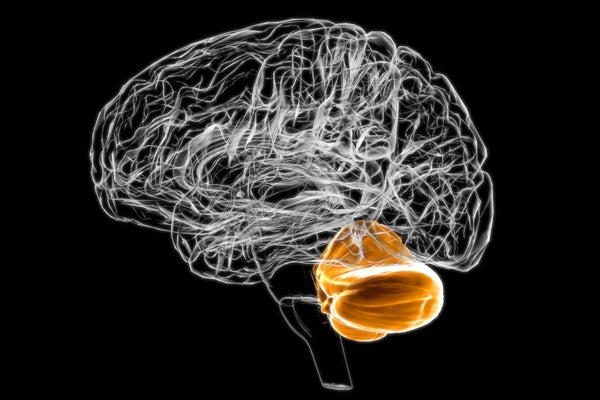
People with a rare genetic disorder known as Prader-Willi syndrome never feel full, and this insatiable hunger can lead to life-threatening obesity. Scientists studying the problem have now found that the fist-shaped structure known as the cerebellum—which had not previously been linked to hunger—is key to regulating satiation in those with this condition.
This finding is the latest in a series of discoveries revealing that the cerebellum, long thought to be primarily involved in motor coordination, also plays a broad role in cognition, emotion and behavior. “We’ve opened up a whole field of cerebellar control of food intake,” says Albert Chen, a neuroscientist at the Scintillon Institute in California.
The project began with a serendipitous observation: Chen and his team noticed they could make mice stop eating by activating small pockets of neurons in regions known as the anterior deep cerebellar nuclei (aDCN), within the cerebellum. Intrigued, the researchers contacted collaborators at Harvard Medical School. Scientists there had gathered data using functional MRI to compare brain activity in 14 people who had Prader-Willi syndrome with activity in 14 unaffected people while each subject viewed images of food—either immediately following a meal or after fasting for at least four hours.
On supporting science journalism
If you're enjoying this article, consider supporting our award-winning journalism by subscribing. By purchasing a subscription you are helping to ensure the future of impactful stories about the discoveries and ideas shaping our world today.
New analysis of these scans revealed that activity in the same regions Chen’s group had pinpointed in mice, the aDCN, appeared to be significantly disrupted in humans with Prader-Willi syndrome. In healthy individuals, the aDCN were more active in response to food images while fasting than just after a meal, but no such difference was identifiable in participants with the disorder. The result suggested that the aDCN were involved in controlling hunger. Further experiments on mice, conducted by researchers from several different institutions, demonstrated that activating the animals’ aDCN neurons dramatically reduced food intake by blunting how the brain’s pleasure center responds to food. The findings were recently detailed in Nature.
For years neuroscientists studying appetite focused mainly either on the hypothalamus, a brain area involved in regulating energy balance, or on reward-processing centers such as the nucleus accumbens. But this group has identified a novel feeding center in the brain, says Elanor Hinton, a neuroscientist at the University of Bristol in England who was not involved with the study. “I’ve been working in appetite research for the past 15 years or so, and the cerebellum has just not been a target,” Hinton says. “I think this is going to be important both for Prader-Willi syndrome and, much more widely, to address obesity in the general population.”
Multiple colleagues of Chen’s are now planning to test whether they can manipulate this circuit in healthy people by using a noninvasive intervention known as transcranial magnetic stimulation. If that is successful, Chen says, the researchers hope to eventually conduct a clinical trial.