NONFICTION
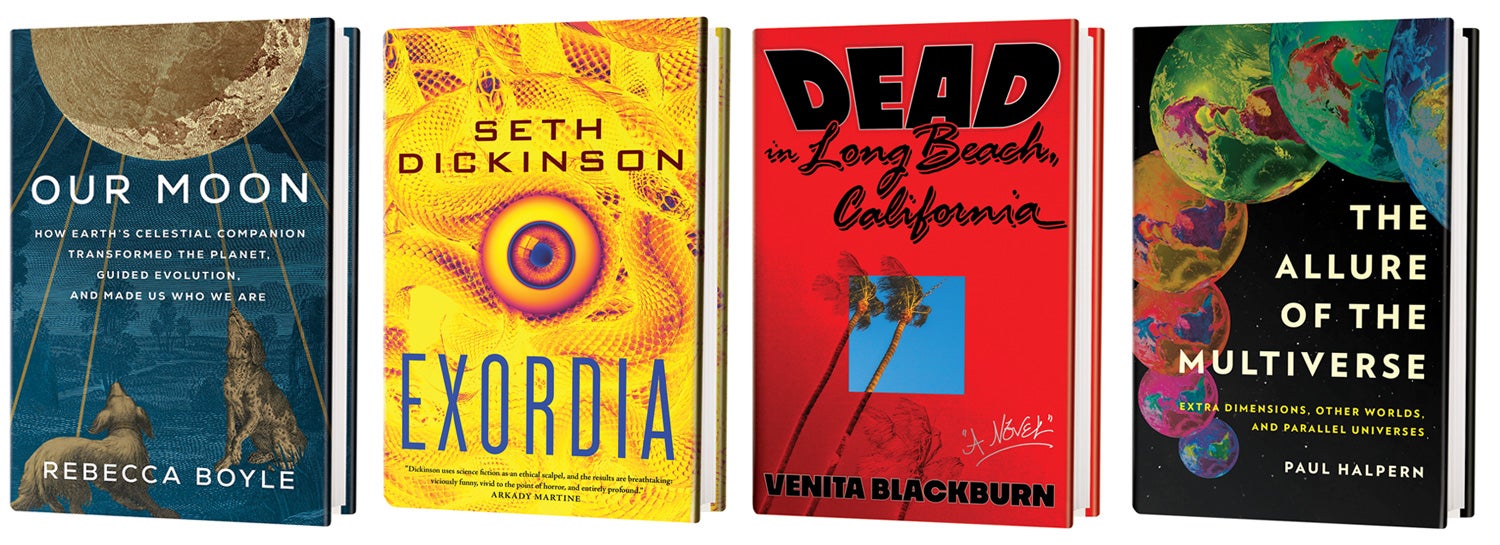
Our Moon: How Earth’s Celestial Companion Transformed the Planet, Guided Evolution, and Made Us Who We Are
by Rebecca Boyle
Random House, 2024 ($28.99)
A few days a month the moon rises as a fat pearl above us. “If you're lucky,” Rebecca Boyle (a contributor to Scientific American) writes in her new book, “you will see a few hundred of these in your life.” It's a quick sentence whose sentiment—like the silvery orb it conjures—might pass you by: our lives are finite; our lives are marked in moons. This is a poetic revelation in itself, but Boyle's project is far more ambitious. Not only does she show how the moon scaffolds our years, but she reveals its sway over just about every facet of our history, including scientific discovery, religion, climate, physiology, psychology and evolution, with gravitational tides nudging our distant fish relations to walk. Its cycles of departure and return helped early humans grasp concepts such as “becoming, birth, vanishing, death, resurrection, renewal, and eternity.” Shared lunar knowledge was our ancestors' Google calendar, helping them to coordinate the hunts, harvests and ceremonies that allowed societies to coagulate. Our moon, Boyle writes, has done nothing less than enable “the beginning of history.”
On supporting science journalism
If you're enjoying this article, consider supporting our award-winning journalism by subscribing. By purchasing a subscription you are helping to ensure the future of impactful stories about the discoveries and ideas shaping our world today.
In the hands of a less deft writer, sentences like that one might raise red flags of hyperbole. But Boyle's command of her subject is so clear, her journalistic instincts and interdisciplinary research so impressive, that readers will have no qualms about learning to see their world through a moon-colored lens. Boyle structures the book in three sections: how the moon was made, how the moon made us and how we made the moon in our image. “There is no story about the Moon that does not tell us something about Earth,” Boyle writes. From Mesopotamian priests to the Apollo program's “white Protestant men who ... drank whiskey from highball glasses,” she surveys those who have defined our lunar view, guiding us to the precipice of its uncertain future. As governments and billionaires scheme for a moon-based economy, Boyle considers who gets to determine the future of this “limited, special, spectral, spiritual thing.”
The moon cannot be reduced to a resource or a divine symbol. It is its own place—all of ours, Boyle writes, which means it's also none of ours. Even now it's spiraling away from Earth at roughly the rate of fingernail growth. Six hundred million years from now it will be too far away to eclipse the sun. —Erica Berry
IN BRIEF
Exordia
by Seth Dickinson
Tor, 2024 ($29.99)
In Seth Dickinson's 2015 debut novel, The Traitor Baru Cormorant, a fiercely willful woman from a colonized island plots her revenge against a brutal empire. This fascination with weighing the value of specific lives against a greater good also powers his new book, a mind-shredding first-contact epic. A spaceship or weapon or something has appeared in Kurdistan, where its mysteries get puzzled over by a sprawling cast. There are nukes, alien brain locks, intergalactic warfare and a scope that keeps expanding long after the stakes seem clear. This thrilling novel grips hardest when Dickinson's characters must reason through the science of seemingly impossible phenomena. —Alan Scherstuhl
Dead in Long Beach, California: A Novel
by Venita Blackburn
MCD, 2024 ($27)
After discovering her brother Jay's suicide, Coral, a Black, gay graphic novelist with biting wit, assumes his identity. She texts Jay's friends and daughter from his phone and creates social media accounts in his name, all while burying herself in the banality of daily life. Coral's escapades are interwoven with snippets from her own novel, Wildfire, a tale of a dystopian, alien world that gradually infiltrates Coral's actual reality. Those excerpts occasionally meander, but author Venita Blackburn's prose is stunning, sensitive and that-made-me-snort funny. Richly layered and ambitiously structured, this unconventional novel about death and denial is bizarre in the best way. —Lucy Tu
The Allure of the Multiverse: Extra Dimensions, Other Worlds, and Parallel Universes
by Paul Halpern
Basic Books, 2024 ($30)
Physicist Paul Halpern has noticed the public's fixation with the multiverse—take Everything Everywhere All at Once winning seven Oscars in 2023, for instance. Such popular science fiction serves as a launchpad for Halpern's crash course on the strange physics behind multiple-universe theories. His lively synthesis of millennia of scientific debate humanizes prominent theorists such as Theodor Kaluza and Brandon Carter, and his analogies—such as a bickering couple to illustrate renormalization—simplify heady concepts. It's still a dense read, but it's worth the exertion: more of an Interstellar blockbuster than a Rick and Morty episode. —Maddie Bender