
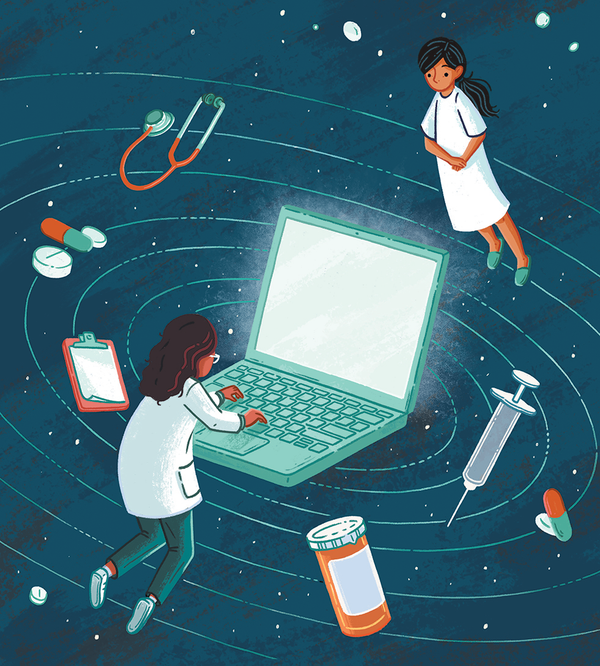
I don’t know if you’ve noticed this, but something has come between you and your doctor. It’s there at every office visit, stealing the doc’s attention and punctuating conversations with awkward silences and the light clicking of a keyboard. Yes, it’s the computer, an omnipresent participant in the modern medical exam.
Electronic health records (EHRs)—and the computers that support them—crept onto the scene about 25 years ago, but they took off after getting a $19-billion boost in 2009 as part of the federal economic stimulus package. Several other countries, especially those with national health care systems, had already adopted EHRs, reaping the benefits of instant access to a patient’s history, prescriptions, and much more. The U.S. was playing catch-up.
Alas, the rollout was excruciating. University of Chicago pediatrician Lolita Alkureishi vividly remembers the 2010 arrival of EHRs at the clinic where she sees patients. “It was like seeing the five stages of grief,” says Alkureishi, who had volunteered to orient colleagues to the system. “People were angry and cursing at the computer. They were sad, lamenting the loss of paper charts. People were trying to bargain with me—saying, ‘Could you just put in the orders for me?’ Some finally accepted it, and some never got to that stage.” Sadly, a number of veteran physicians took the arrival of EHRs as a cue that it was time to retire, recalls Neda Ratanawongsa, associate professor of internal medicine at the University of California, San Francisco.
On supporting science journalism
If you're enjoying this article, consider supporting our award-winning journalism by subscribing. By purchasing a subscription you are helping to ensure the future of impactful stories about the discoveries and ideas shaping our world today.
The shift reshaped the doctor-patient relationship, says Elizabeth Toll, a pediatrician and internist at Brown University: “Prior to that I would have told you I had a job that revolved around people. Immediately thereafter I had a job that revolved around the computer. If you didn’t pay 100 percent attention to the machine, you’d start making mistakes: you’d pick the wrong medicine or the wrong dose or send orders for the wrong test. I would often feel that the patient was slipping into second place.” In fact, a 2017 study showed doctors spent twice as much time on clerical work—much of it after hours—as seeing patients.
Alkureishi decided to investigate the phenomenon, working with internist Wei Wei Lee, assistant dean of students at Chicago’s Pritzker School of Medicine. They led a 2016 meta-analysis of 53 studies examining the impact of EHRs on patient-physician interactions. Six of the studies quantified EHR use and found it consumed, on average, 32 percent of a doctor visit. A 2017 study by Ratanawongsa found that health care providers spent 30.5 percent of a visit dividing their attention between patient and computer, another 4.6 percent silently tapping away and 33.1 percent in focused discussion with the patient.
The meta-analysis identified both good and worrisome behaviors. Conversation was too often synchronized to typing pauses and subject to abrupt shifts, as the doctor worked through screens of required questions. Only about 10 percent of doctors shared the screen with patients, but when they did, patients liked it. One study found that when trauma patients were shown scans of their injuries on a tablet, they felt more involved in their care.
Based on their research, Lee and Alkureishi developed a set of “patient-centered” best practices for EHRs that are now taught to all Pritzker students and included in EHR training for medical staff. Among the tips: review patient records before the visit so you can begin the first “golden minute” with eye contact and conversation; position the computer in a “triangle of trust” where the patient can also see it; narrate data entry aloud so the patient can listen and comment; and disengage with technology when discussing sensitive matters. The authors also encourage using online videos and graphics as what Lee calls “a communication-enhancing tool” for patients. They have shared their ideas widely, including via a brief Doctor’s Channel video.
One reason EHR systems were so disruptive in the U.S. is that they were designed with billing in mind, as opposed to simply patient care, as is the case in countries such as Sweden and the U.K. Newer systems are better, Ratanawongsa says, and integrated with tools for patients. At the same time, some practices are employing “medical scribes” as notetakers or employing a “team care” approach in which a nurse or assistant shares the record-keeping role. Making patients aware of ways to avoid letting technology hijack their visit also helps. If that starts to happen, speak up!