
Edited by Amy Brady
FICTION
A Quantum Love Story
by Mike Chen
MIRA, 2024 ($30)
On supporting science journalism
If you're enjoying this article, consider supporting our award-winning journalism by subscribing. By purchasing a subscription you are helping to ensure the future of impactful stories about the discoveries and ideas shaping our world today.
Time and grief are two inexorable companions in life, even when we are falling in love. It is truths like this one that set the scene for A Quantum Love Story. Tragedy has already struck when the novel begins, as neuroscientist Mariana Pineda has just lost her best friend, Shay. Carrying Shay's framed portrait, Mariana is headed to marvel at the new Hawke Accelerator with the team from ReLive, an experimental program that allows people to reenter their memories and live those moments once again. Mariana has given up her old life to start working at ReLive just before disaster hits.
One morning she runs into Carter Cho, a mysterious man bearing doughnuts and a surprising amount of knowledge about who she is and what she's after. Carter tries to explain something to her about how they've been there before and how he needs her to remember. Carter, who has an eidetic memory, can do nothing but remember. He knows what's about to happen: there's going to be an explosion at Hawke, and time is going to bend around them in a time loop that restarts every four days.
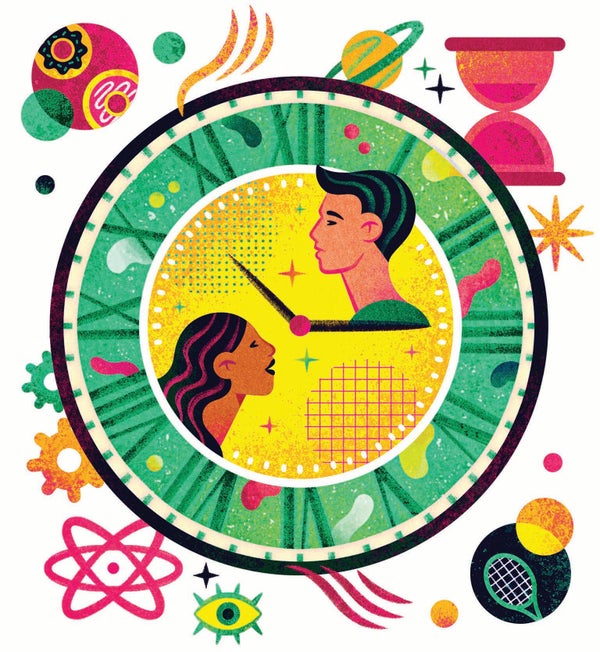
This emotional new novel from Mike Chen combines what is best about science fiction, mystery and romance. The concept at the heart of A Quantum Love Story is that time, memory and consciousness are all similar substances, both stubborn and fluid. The mystery to be solved is at once simple (how did we get here?) and deeply complicated (how far back do we have to go to change the conditions in which we live now?). The romance is built on the smallest daily intimacies: cooking and going out to eat, meeting one another's pets, playing tennis, and trying to hold these pleasures even as time works against the lovers to take everything from them over and over again.
Chen's body of work—including his previous books Here and Now and Then and Star Wars: Brotherhood—is growing in distinction largely thanks to his ability to spin human frailty into a golden webwork between the concepts of space and time. His prose choices create a friendly, highly accessible understanding of character and setting. The result is a world rendered in Technicolor, every corner lit, every scene set so that the reader can walk right in. Chen's charming characterizations are at their best in cooperative relation to one another: Carter and Mariana give off that slow-burn ozone long before they ignite, and even the story's AI presence (a helpful yet coy assistant patterned after the late David Bowie) is endearingly tender.
People who enjoyed reading The 7 1/2 Deaths of Evelyn Hardcastle, by Stuart Turton, or who watched the Netflix series Russian Doll will anticipate the bittersweetness of this time-loop romance. It both resembles real life and distorts it, giving us the chance to contemplate both the mundane sameness and the numinous qualities of our daily lives. Fans of Audrey Niffenegger's The Time Traveler's Wife will foresee the frustration and peril ahead; although Mariana and Carter can accept and enjoy the loop they're in, nothing lasts forever, even when time stands still.
Carter, despite his visual memory, is the first to break. Keeper of the watch, he's been the one to track all the things they've done within the confines of their repetition to avert the disaster that landed them here. When he starts to forget their previous loops, Mariana realizes they can't keep looping indefinitely. The stakes go beyond the two of them: The entire time line is at risk as they uncover the dangers of ReLive's design flaws and memory medicine. One of them is going to have to make a considerable sacrifice. But if that means losing each other, Mariana isn't sure she can do it. Add to that the possibility that she might be able to save Shay, and the dilemma of the novel's final act is set.
Readers who crave hard-shell explanations of time travel or who need to know exactly what mechanism causes the continuum to loop and create an eddy will have to look elsewhere. Chen is not that kind of writer. Although the science of memory and the brain comes across as well researched and intriguing, the realm of quantum mechanics remains a cosmological question mark. Readers who enjoy the difficult questions about how we move through time with a great deal of love (and very little control), however, will appreciate how Chen builds a skiff made of paper to sail through the storm. The twin companions of time and grief are not the adversaries they seem, and Carter and Mariana have more fodder for reconciliation than for fighting. We arrive at the end of the book with our hearts bruised but intact.
