
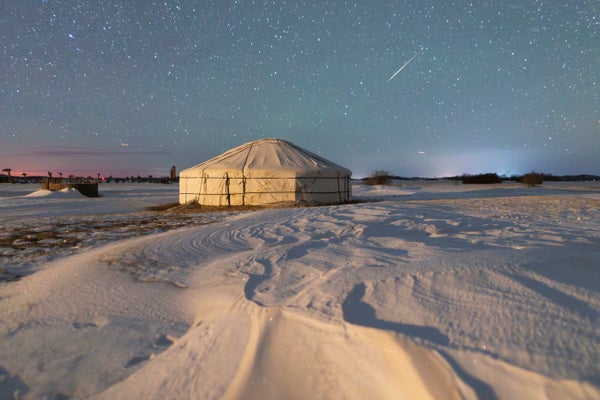
The new year has arrived, and so have the Quadrantids. The first meteor shower of 2026 is known for its bright fireballs and bolides—large meteors that explode in the atmosphere in dramatic fashion, sometimes raining meteorites onto Earth below.
The Quadrantids are an annual shower running from November through early January. This year the Quadrantids will peak on the night of January 3 through the early hours of January 4. Best viewed from the Northern Hemisphere, the ideal time to get outside and try to spot some of these luminous fireballs is in the predawn hours on January 4, according to NASA. Unfortunately, a full moon rises the night before, so the moon’s light may interfere with your ability to see these shooting stars.
To have the best chance of spotting a meteor, look for the Quadrantids’ radiant—the point of the sky where they appear to originate. First observed in 1825, the meteor shower radiates from an obsolete constellation called Quadrans Muralis—named by a French astronomer in 1795, it was left out of the International Astronomical Union’s list of official constellations in 1922. Instead look for Ursa Major, or the Big Dipper, and gaze toward the end of its handle.
On supporting science journalism
If you're enjoying this article, consider supporting our award-winning journalism by subscribing. By purchasing a subscription you are helping to ensure the future of impactful stories about the discoveries and ideas shaping our world today.
The Quadrantids don’t come from the stars, however. Unlike other meteor showers, which tend to be caused by debris falling from comets, the Quadrantids are produced by an asteroid, 2003 EH1. Discovered in 2003, the asteroid may actually be a dead comet, NASA notes. Some astronomers think there may also be a second object that contributes to the meteor shower, a comet called 96P/Machholz.
If you can get outside in the early hours of January 4, move as far as you safely can from bright light sources, such as street lamps and buildings. Give your eyes 30 minutes to adjust to the dark, and look toward the northern sky. Then just be patient!