New Issue: Science’s Impossible Questions. Read Now

Your Name Could Orbit the Moon with NASA’s Artemis II

The public can submit names to travel along with four astronauts on an orbital journey to the moon next year

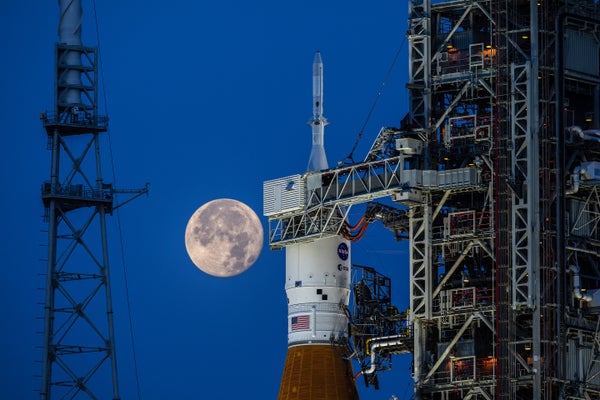
A full Moon in view behind the The Artemis I Space Launch System (SLS) and Orion spacecraft atop the mobile launcher during dress rehearsals at NASA’s Kennedy Space Center

The Artemis I Space Launch System (SLS) rocket and Orion spacecraft sit at the launch pad for dress rehearsals at NASA’s Kennedy Space Center in Florida on June 14, 2022.

NASA/Ben Smegelsky

Join Our Community of Science Lovers!

Your name could make it to the moon along with NASA’s Artemis II mission next year—the first time a crew will travel to Earth’s natural satellite in more than 50 years.

Anyone can submit their name in English here or Spanish here. The collected names will be included on an SD digital memory card that will be carried onboard the Orion capsule as it ferries four astronauts into orbit around the moon. The deadline to register is before January 21, 2026.

“This is one way for the public to feel like they’re a little closer to the mission than just being spectators,” says space collectibles expert Robert Pearlman, editor of the space memorabilia website collectSPACE. Everyone who enters their name can download a collectable “boarding pass” to commemorate the mission.


On supporting science journalism

If you're enjoying this article, consider supporting our award-winning journalism by subscribing. By purchasing a subscription you are helping to ensure the future of impactful stories about the discoveries and ideas shaping our world today.


NASA routinely offers similar opportunities on its space exploration missions. “Right now there are names aboard the Perseverance rover on Mars, the Parker Solar Probe at the sun and the Europa Clipper mission on its way to Jupiter’s moon Europa,” Pearlman says.
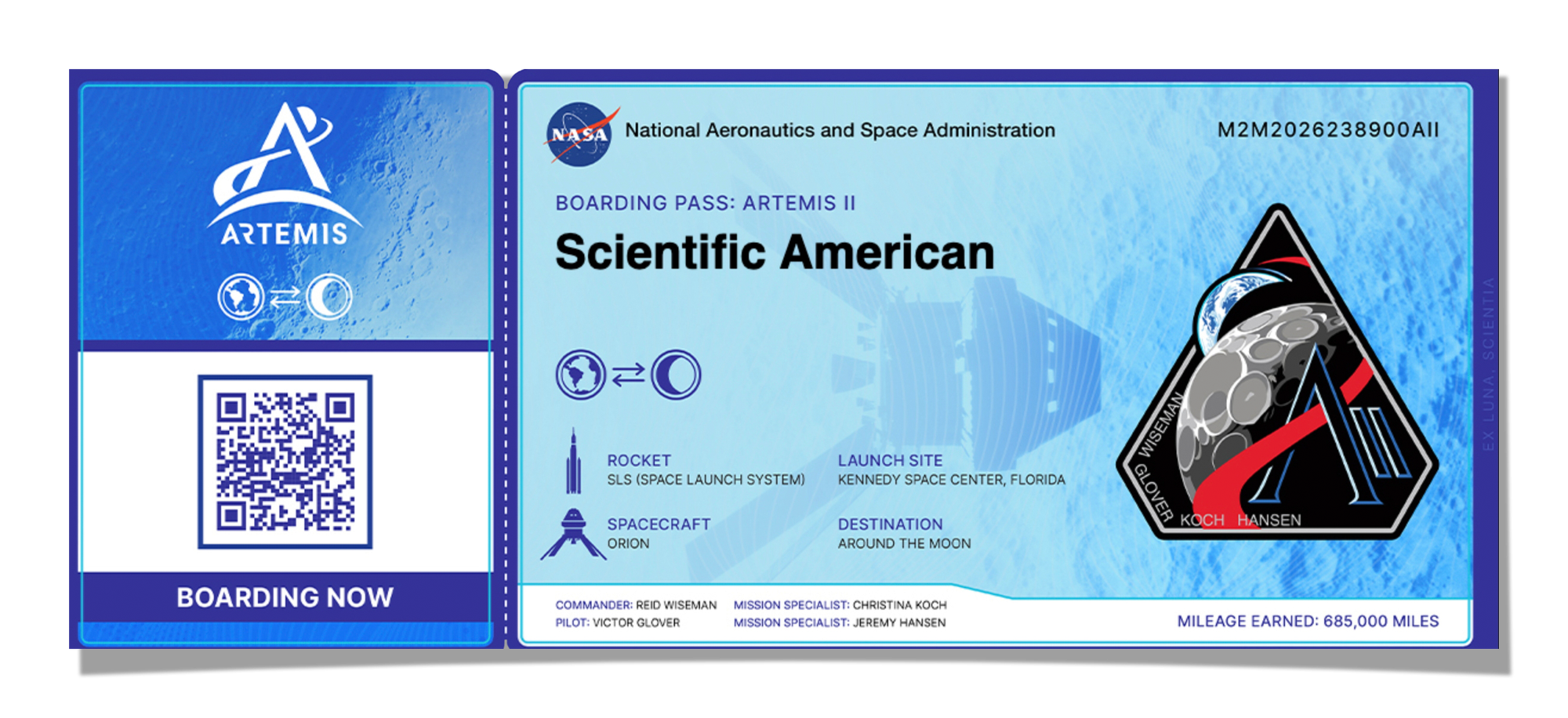
A digital boarding pass for NASA's Artemis II mission

A commemorative virtual Artemis II boarding pass issued by NASA. Participants' submitted names will fly around the Moon on an SD card inside the Orion spacecraft when the mission launches in 2026.

NASA

Artemis II is slated to lift off from NASA’s Kennedy Space Center in Florida sometime by April 2026. It will launch onboard the agency’s Space Launch System (SLS) rocket—a heavy-lift vehicle that makes use of some recycled components from NASA’s space shuttle and that has been in development for more than a decade. The rocket, which hasn’t carried humans before, has come under fire for its gigantic $23-billion budget, outdated technology and delayed timeline. The nonreusable lifter will reportedly cost $5.7 billion for just this launch.

The Artemis II mission is part of NASA’s plan to resume deep-space exploration. In the Artemis I flight in 2022, an SLS rocket sent an uncrewed Orion spacecraft to the moon and back. If all goes well—and NASA receives enough funding—Artemis III will send astronauts to the moon’s surface for a stay of roughly a month, perhaps as soon as 2027.

Yet moon exploration is in some ways more difficult now than it was during the 1960s era of Apollo, even though we all have more computing power in our pockets these days than NASA had in entire buildings back then. The agency is struggling under threats of budget cuts and the possibility of losing out to China in the latest race to the moon.

Clara Moskowitz is chief of reporters at Scientific American, where she covers astronomy, space, physics and mathematics. She has been at Scientific American for more than a decade; previously she worked at Space.com. Moskowitz has reported live from rocket launches, space shuttle liftoffs and landings, suborbital spaceflight training, mountaintop observatories, and more. She has a bachelor’s degree in astronomy and physics from Wesleyan University and a graduate degree in science communication from the University of California, Santa Cruz.

More by Clara Moskowitz

Subscribe to Support Independent Journalism

Great science journalism requires human expertise, time, effort and creativity. And it costs money. That’s why I and the journalists here at Scientific American hope you’ll join our community.

When you subscribe, you are supporting staff and freelance journalists who are passionate about telling science stories that are true, important and compelling. Our editors and reporters are often experts in their fields, which means they understand the nuances of big discoveries and can untangle the breakthroughs from the hype. With a subscription, you are also supporting rigorous fact-checking to ensure the words we publish are precise and accurate. And you’re supporting original illustrations, graphics and photos that bring you closer to an advanced laboratory, an ice sheet in Antarctica or a space mission in orbit. You’re helping us craft other types of high-quality journalism as well: Our newsletters are carefully written, edited and curated by staffers you have or will come to know and love. Our Science Quickly podcast is based on original reporting, collaboration with editors and scientists and exacting production.

Subscriptions keep this engine running so we can continue to deliver thoughtful, rigorous and independent science journalism to you. In an era of viral misinformation, this work is crucial. If you value what we do, I hope you’ll consider joining us as a subscriber

Thank you,

Jeanna Bryner, Editor in Chief, Scientific American

Subscribe