New Issue: Orbital Catastrophe Ahead? Read Now

To safely navigate icy sidewalks, walk like a penguin

Icy weather brings a serious risk of falls. Here’s how to stay safe

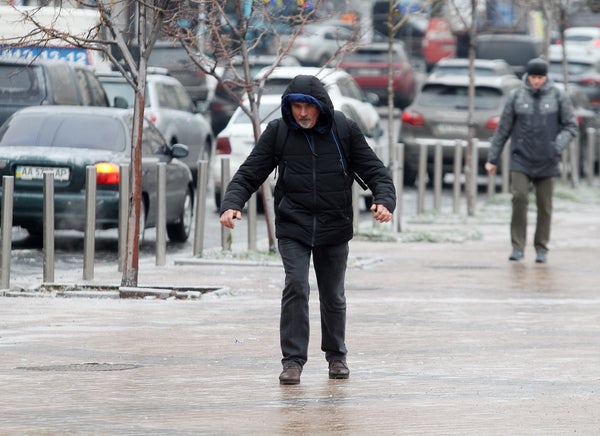
A man walking carefully on an icy sidewalk.

Pavlo Gonchar/SOPA Images/LightRocket via Getty Images

Join Our Community of Science Lovers!

The recent snow and ice storm turned much of the nation into a winter wonderland—from the safety of a nice, cozy sofa indoors. If you step outside in such conditions, however, you’ll find a dangerous obstacle course that can turn walking the dog or checking the mailbox into an emergency room visit with just one false step.

There’s no good clearinghouse for data about injuries related to winter weather, but studies do suggest that fall rates increase with snow and ice, especially among older adults. That said, anyone can slip and tumble when sidewalks get icy. Alas, you can’t always hunker down until the thaw, so what’s to be done? Walk like a penguin, says Gabriela Murza, a health and wellness extension associate professor at Utah State University.

“You’re not really waddling literally,” she notes, but there’s enough similarity between the movements to channel everyone’s favorite Antarctic birds. “When you walk like a penguin, you keep your feet flat the entire time, and you take shorter steps,” Murza says. “You’re less likely to slip and fall.” Flat feet have more surface area in contact with the ground each time you take a step than our typical heel-to-toe gate, and smaller steps keep your weight more centered, she explains.


On supporting science journalism

If you're enjoying this article, consider supporting our award-winning journalism by subscribing. By purchasing a subscription you are helping to ensure the future of impactful stories about the discoveries and ideas shaping our world today.


In addition to the small, flat-footed steps, Murza recommends keeping your knees slightly bent to reduce pressure on your lower back and increase stability.

Icy days aren’t the time to multitask while walking, either, so tuck your phone away and keep your hands free. Murza also recommends bending your arms and keeping your hands out of your pockets. If you do end up slipping, that position will leave your forearms ready to catch you, protecting your more vulnerable wrists and face.

Overnight and early morning, when temperatures are at their lowest and the sun isn’t helping to melt ice, are the most dangerous. Keep your eyes peeled for ice hiding under snow or meltwater and for transparent “black ice” in general, Murza recommends.

Meghan Bartels is a science journalist based in New York City. She was previously a senior reporter at Scientific American. Before that she spent more than four years as a writer and editor at Space.com, as well as nearly a year as a science reporter at Newsweek, where she focused on space and Earth science. Her writing has also appeared in Audubon, Nautilus, Astronomy and Smithsonian, among other publications. She attended Georgetown University and earned a master’s degree in journalism at New York University’s Science, Health and Environmental Reporting Program.

More by Meghan Bartels

Subscribe to Support Independent Journalism

Great science journalism requires human expertise, time, effort and creativity. And it costs money. That’s why I and the journalists here at Scientific American hope you’ll join our community.

When you subscribe, you are supporting staff and freelance journalists who are passionate about telling science stories that are true, important and compelling. Our editors and reporters are often experts in their fields, which means they understand the nuances of big discoveries and can untangle the breakthroughs from the hype. With a subscription, you are also supporting rigorous fact-checking to ensure the words we publish are precise and accurate. And you’re supporting original illustrations, graphics and photos that bring you closer to an advanced laboratory, an ice sheet in Antarctica or a space mission in orbit. You’re helping us craft other types of high-quality journalism as well: Our newsletters are carefully written, edited and curated by staffers you have or will come to know and love. Our Science Quickly podcast is based on original reporting, collaboration with editors and scientists and exacting production.

Subscriptions keep this engine running so we can continue to deliver thoughtful, rigorous and independent science journalism to you. In an era of viral misinformation, this work is crucial. If you value what we do, I hope you’ll consider joining us as a subscriber

Thank you,

Jeanna Bryner, Editor in Chief, Scientific American

Subscribe