
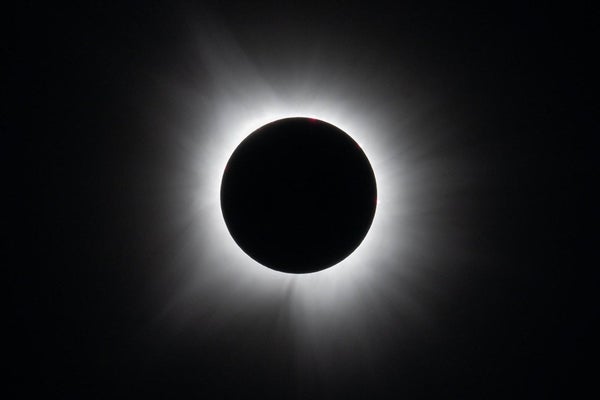
Solar eclipses have captivated human imaginations for millennia, and they still fuel scientific discovery today. On August 12, the moon will pass directly between Earth and the sun, blocking its light over a swath of Western Europe and the Arctic.
A total solar eclipse occurs about once every 18 months; the last one, on April 8, 2024, was visible across North America. But although they’re relatively common, it is rare for any given spot on Earth to see a total solar eclipse—one estimate suggests a specific place will experience a total solar eclipse about once every 373 years. The upcoming total eclipse on August 12 will be most visible from northern Spain and Portugal, eastern Greenland, western Iceland, and the Russian and Canadian Arctic, although much of Europe will see at least a partial eclipse.
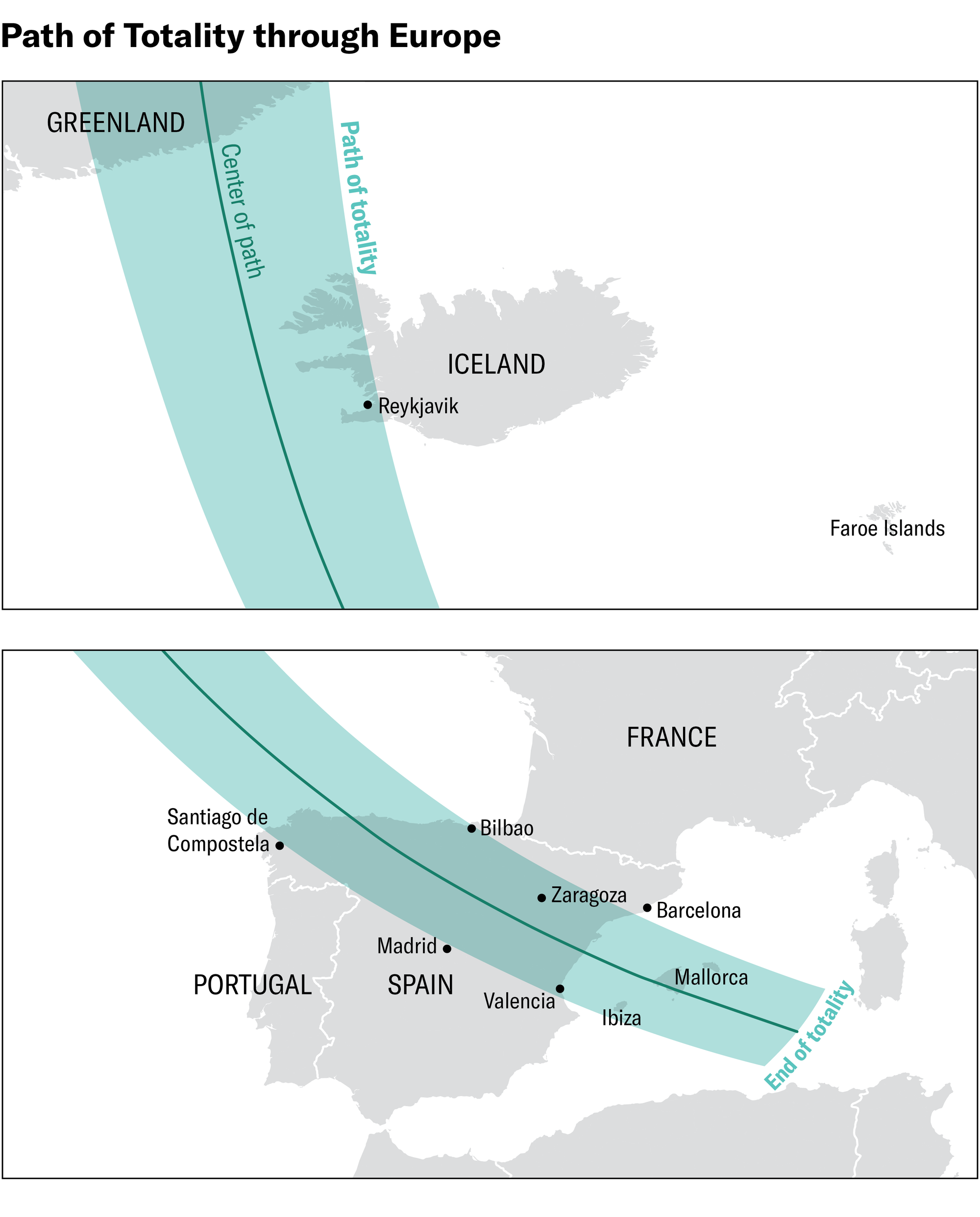
Amanda Montañez; Source: National Solar Observatory (reference)
On supporting science journalism
If you're enjoying this article, consider supporting our award-winning journalism by subscribing. By purchasing a subscription you are helping to ensure the future of impactful stories about the discoveries and ideas shaping our world today.
When you can see the eclipse and how long it will last will depend on where you view it. On August 12 totality will start at approximately 5:48 P.M. local time in Reykjavík, Iceland, and will last for around two minutes. In Valencia, Spain, it will start at approximately 8:32 P.M. local time and endure for around one minute. Other particularly good spots to see this eclipse are Zaragoza, Spain, and Segovia, a Spanish city that’s just an hour from Madrid, and Sant Elm on the Balearic island of Mallorca. If you want to travel to catch this one in person, reserve your transportation and accommodations as soon as possible: popular sites are booking up fast.
Because the eclipse will occur right at sunset in Spain, viewers will need to look toward the horizon. Although the best viewing will definitely be over Europe, even some people in Canada and the U.S. may be able to catch a glimpse of a partial eclipse. (The contiguous U.S. will see its next total solar eclipse in 2044.)
Whether you are hoping to catch the total eclipse or a partial eclipse, always wear eye protection, such as solar eclipse viewing glasses or other solar filters, to protect your eyes from the sun’s light. Even a moment of direct sunlight can damage your eyesight, including when looking through a camera lens. You can also use a pinhole projector to indirectly view the eclipse.
And if you won’t be in Europe this summer, don’t fret. For those of us who won’t be able to see the total solar eclipse up close, Scientific American will be on the ground and livestreaming the event from Ibiza, Spain. Subscribe to our YouTube channel so you don’t miss it, and check back on our homepage on August 12—on that day, the eclipse will begin over Ibiza at approximately 7:30 P.M. local time, or 1:30 P.M. EDT, with totality occurring an hour later.