
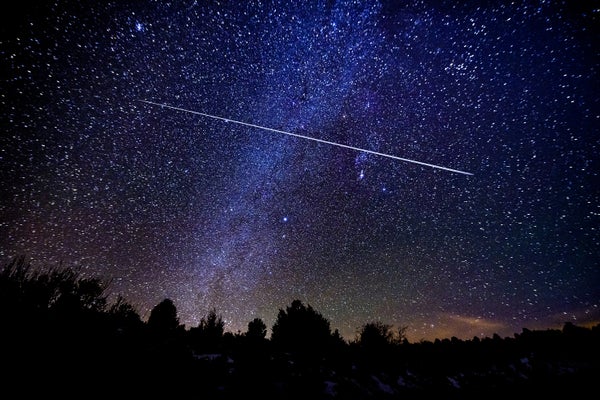
Keep your eyes on the skies from Tuesday night into Wednesday morning, and you might see an unusual cosmic convergence: two meteor showers, the Southern Delta Aquariids and the Alpha Capricornids, peaking in intensity on the same night.
On their own, each meteor shower can be a little difficult to spot. The Aquariids appear relatively faint in the sky and often lack long trails, and the Capricornids tend to produce only about five visible meteors an hour. But tonight a waxing crescent moon will set early, leaving the skies dark, and two showers at once should increase the chances of spotting a shooting star.
The Southern Delta Aquariids come from a dust cloud left by Comet P/2008 Y12. This shower has been active since July 18 and appears to originate in the southwestern part of the constellation Aquarius. They’re easiest to see if you live in the Southern Hemisphere. But if you live north of the equator, they should be most visible low in the southern sky. This shower will be easiest to see after 10 P.M. local daylight time (LDT) on Tuesday and peak around 3 A.M. LDT on Wednesday morning.
On supporting science journalism
If you're enjoying this article, consider supporting our award-winning journalism by subscribing. By purchasing a subscription you are helping to ensure the future of impactful stories about the discoveries and ideas shaping our world today.
The Alpha Capricornids come from Comet 169P/NEAT, and they became active on July 12. Although they are relatively low in volume, they’re more likely to produce dramatic fireballs that trail across the sky. They appear to originate in the constellation Capricorn and should be visible on both sides of the equator. The best time for viewing should be in the hour after midnight.
With a little bit of luck, you might even see a third shower. The annual Perseid meteor shower peaks in mid-August, when the Earth passes through the dusty trail left behind in the passage of Comet Swift-Tuttle. We crossed into that debris cloud on July 14. And while it’s still very early, a few shooting stars from this shower could appear.
Meteors come from particles left behind by comets or from broken bits of asteroids as they orbit the sun. When Earth passes through these trails of debris, the bits of rock and dust ignite in our planet’s atmosphere to produce a fiery show.
The American Meteor Society has more details on how and when to see the two meteor showers in tonight’s sky.