
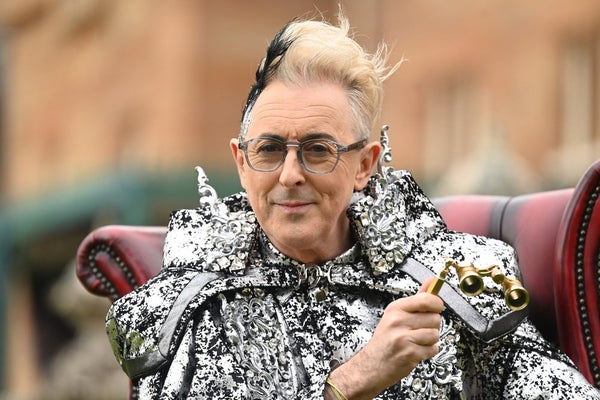
Alan Cumming, host of the hit U.S. version of the reality competition The Traitors, has a theory about what makes the show so captivating: “We watch people lying, and we know they’re lying,” he said in a recent interview on NBC’s Today. “And also, you watch people dealing with lying not very well and not enjoying it.”
The Traitors brings a group of celebrity competitors—actors, comedians, reality TV stars and Olympic athletes, for example—to a mansion in the bucolic Scottish Highlands to play a high-stakes version of the party game Mafia. The prize is a jackpot worth up to $250,000. The object of the game is for the “faithfuls” to identify and banish the “traitors,” while the traitors attempt to trick everyone else into believing they’re one of the good guys.
The lying, backstabbing and manipulation the game inspires does indeed make for delightful TV viewing. But the show’s formula also raises a question: How do you win? The answer may lie in what science tells us about how and why we lie and how to know when someone is playing false with us.
On supporting science journalism
If you're enjoying this article, consider supporting our award-winning journalism by subscribing. By purchasing a subscription you are helping to ensure the future of impactful stories about the discoveries and ideas shaping our world today.
Playing as a Faithful
For those who play The Traitors as a faithful, a winning strategy lies in being able to tell who is lying and who is not. Unfortunately, humans are exceptionally bad at detecting lies. One 2006 meta-analysis involving more than 24,000 people, for example, found that participants correctly identified lies just 47 percent of the time—about the same as they might by just flipping a coin—and correctly identified truths just 61 percent of the time.
To catch a traitor in the act, players need to consider their own innate biases, says Geoffrey Beattie, a professor of psychology at Edge Hill University in England and author of the book Lies, Lying and Liars: A Psychological Analysis. “And there are lots of them,” Beattie adds.
One such bias is that many of us are taught from a young age that if someone’s lying, they won’t look you in the eyes. “That’s simply not true,” Beattie says. On the contrary, when people are planning what to say next, they tend to look away, while liars often known to maintain eye contact to avoid detection. "So forget about eye gaze,” Beattie says.
Other body language may be more telling. When they smile, how abruptly do they stop grinning? An extremely abrupt stop to a smile signals that it may be fake, Beattie says. Research also shows that people who lie often suppress their hand gestures and may even blink differently compared with when they speak the truth.
Part of the reason why liars try to control their body language may be because playing false requires more cognitive effort, says Sharon Leal, a senior research fellow at the University of Portsmouth in England, who studies deception detection. “It takes up more mental resources to lie than it does to tell the truth,” she says. A similar situation arises when we unconsciously stop dead in the street in order to answer a text message, for example, Leal adds.
There is a way to exploit this tendency called “cognitive interviewing.” For faithful Traitors players, Beattie recommends asking other contestants about their experiences out of chronological order. That makes it harder to lie convincingly and consistently compared with telling a single, rehearsed story. Research that Leal and her colleagues published in 2008 found that police officers were better at detecting lies about an incident when mock “suspects” told false details in reverse chronological order.
Confirmation bias can also muddy the waters. “If you like someone and they share your views,” Beattie says, “you’re less likely to be skeptical when they start talking, because they’re saying things that you want to hear.” Similarly, people who are thought of as good-looking may take advantage of a so-called halo effect: some research suggests that defendants in criminal cases are more likely to get a lighter sentence if they are perceived as physically attractive, Beattie says.
Leal recommends focusing on verbal information—contradictory storytelling or word choice, for instance. In a 2025 study, she and her colleagues found that people tend to be better at detecting lies when they hear someone giving a statement rather than see it.
“I would totally ignore nonverbal behavior,” Leal says, “unless it was something really obvious.”
Playing as a Traitor
For the traitors in the game, science has a few tricks they can try to be more convincing. Appearing open, friendly and approachable all come off as more trustworthy, Leal says. “You might throw something in about your personal life” in a conversation, for example, to give the impression of openness.
Another strategy is to “reframe stories emotionally,” Beattie says. “The secret of being a really good liar is to change the emotional response to [lying].” If you can remind yourself that you are playing a game with your fellow contestants that you want to win, you can avoid triggering more emotive—and thus telling—responses to questions, he says.
Ultimately, lying can be taxing. In this season, one traitor, Love Island’s Rob Rausch, revealed in the episode before the finale that his deception had been “taking a toll.”
“It’s a bit like if you hold a glass of water: At first, it doesn’t bother you,” Leal says. “But keep holding that for hours and hours and hours, and you’ll start to feel the stress of it.”
Viewers will need to wait until the show’s finale airs on Thursday to know if Rausch’s efforts will pay off—or if he will leave with nothing. But his strategy of keeping his emotions at bay, leaning in to alliances and wearing overalls without a shirt appears to be going well so far. As host Cumming shared on a recent episode of Watch What Happens Live with Andy Cohen, “the game is called The Traitors, and he’s really good at it.”