
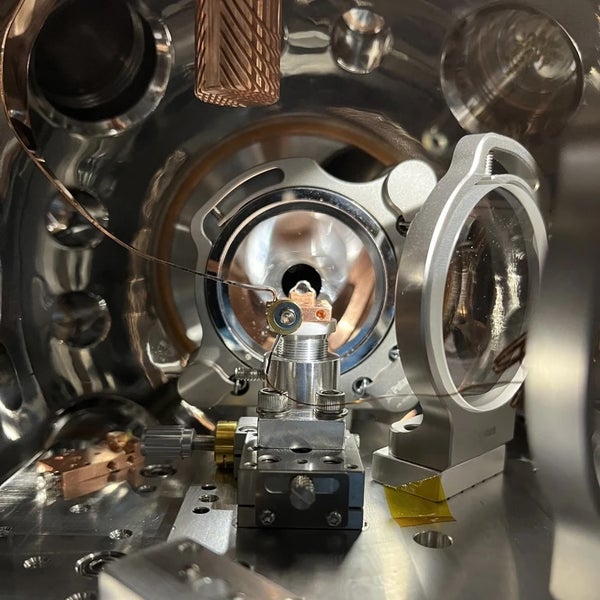
Denver, Colorado | Physicists are getting closer to creating a long-sought ‘nuclear clock’. This device would keep time by measuring energy transitions in the nuclei of atoms and could become the most precise clock on the planet.
Decades ago, scientists predicted that the isotope thorium-229 could be used in such a clock, but they couldn’t pin down its unusual nuclear energy transition. That feat, achieved with a laser in 2024, started the countdown to a nuclear clock.
Now, such a clock is “way closer than people think,” says Eric Hudson, a physicist at the University of California, Los Angeles, who is working on one. “You’ll see nuclear-clock measurements in 2026, I’m sure.”
On supporting science journalism
If you're enjoying this article, consider supporting our award-winning journalism by subscribing. By purchasing a subscription you are helping to ensure the future of impactful stories about the discoveries and ideas shaping our world today.
Nearly a dozen research teams, spread across China, Europe, Japan and the United States, are closing in on assembling the components of such a clock, including a source of 229Th — which is radioactive — and a powerful continuous-wave ultraviolet laser to excite the energy transition. At the American Physical Society (APS) Global Physics Summit in Denver, Colorado, this week, researchers provided updates on their progress, including details of laser development.
Claire Cramer, the executive director of quantum science at the University of California, Berkeley, who was in attendance, expressed optimism about the potential of solid-state nuclear clocks: “This is a really, really promising technology for commercial applications.”
That’s because nuclear clocks could be resilient to noise and have a compact design for use outside the laboratory. They might also surpass the precision of optical atomic clocks, the field’s current top timekeepers, which lose only one second every 40 billion years.
Laser jockeying
Timekeeping, whether in a pocket watch or a physics lab, boils down to counting rapid, regular events — the ‘ticks’ in any clock. In optical atomic clocks, these events are the hopping of electrons in an atom between a ground and an excited energy state. A laser with a wavelength in the 350- to 750-nanometre range (the visible, or optical, part of the electromagnetic spectrum) excites this transition, which can ‘tick’ trillions of times per second.
By contrast, a nuclear clock would count transitions between nuclear states of 229Th. These have the same number of protons and neutrons, but different energies depending on how the particles are squeezed together in the nucleus.
For half a century, the precise energy of the 229Th transition remained uncertain. Several independent research groups began to close in on an answer a few years ago. The search culminated in a 2024 experiment led by Chuankun Zhang, a physicist now at the California Institute of Technology in Pasadena, and Jun Ye, a physicist at the JILA research institute in Boulder, Colorado. Using a frequency comb — a laser with about 30 million frequencies that can hit a crystal simultaneously — Zhang, Ye and their colleagues pinpointed the transition with ultra-high precision. To access it in a functioning nuclear clock, however, scientists now need a powerful and stable continuous-wave laser with an ultraviolet wavelength of around 148 nanometres. And no such laser has been made.
A group based at Tsinghua University in Beijing, China, has taken some of the most promising strides towards constructing one. Last month, the team reported in Nature that it had delivered 100 nanowatts of power at 148.4 nm. Although researchers have praised the advance, some at the APS meeting expressed hesitation about the laser’s long-term prospects, because it requires heating toxic cadmium vapour to 550 ºC.
Another approach converts an optical laser’s wavelength to 148 nm with a specialized crystal. Ye said that preliminary tests with a particular crystal have provided a nearly stable 40 microwatts of power. He did not disclose the material’s identity, instead saying that it is “tremendously promising”. But his group collaborates with IPG Photonics, a laser manufacturer based in Marlborough, Massachusetts, which has filed a patent for a method of growing specialized strontium tetraborate crystals.
The community hasn’t nailed a solution yet, Hudson said. “But my opinion is, this is a technical problem that no one needed to solve before, and now we will solve it.”
Searching for stability
The other component of a nuclear clock that researchers are chasing is a stable source of 229Th. Two general solutions have emerged: using trillions of 229Th ions in a solid crystal, or just a handful in an ion trap.
The crystal approach offers a much stronger clock signal because of the sheer number of 229Th ions used, but it is limited by stability. A stable nuclear clock requires a narrow linewidth for the nuclear transition — that is, its signal must have a narrow range of frequencies. Using a calcium fluoride crystal infused with 229Th ions, Ye’s group has so far achieved a signal with a linewidth of around 30 kilohertz — too big for a stable clock.
It’s not yet clear what’s causing the large linewidth, but researchers at the meeting suspect impurities in the calcium fluoride. Some are exploring other types of crystal, and even thin crystalline films, which are easier to make and have fewer impurities. Hudson is particularly optimistic about thorium tetrafluoride — a radioactive coating that used to be popular for camera lenses — and thorium oxide.
Even so, using crystals as a source of 229Th might not offer enough accuracy for a nuclear clock, because they naturally broaden the clock signal’s linewidth. This is why researchers are pursuing ion traps, in which ions of 229Th are cooled and suspended at ultra-low temperatures, down to microkelvin. “If you want to be really accurate, then you will do a trapped ion” experiment, Ye says. So far, no one has managed that with 229Th, but researchers at the meeting said that it is only a matter of time.
This article is reproduced with permission and was first published on March 20, 2026.