
In late 2025 we asked the world’s top researchers a simple question: Who are the best, most promising early-career scientists working in the U.S.? We then read through nominations, mined scientific journals and performed a rigorous data analysis to choose the inaugural class of Scientific American’s Young American Scientists.
While we used multiple methods to identify our honorees, the final selections are based on the qualitative judgment of outside experts and our editorial staff.
To begin the process, we decided to limit the award to early-career professionals of any nationality and of any age who were based in the U.S. We determined they could work in an academic, nonprofit or industry/corporate setting but had to be actively engaged in research. We required that they had completed an undergraduate degree and that their current position should be roughly equivalent to the early-career academic title of postdoctoral fellow or assistant professor.
On supporting science journalism
If you're enjoying this article, consider supporting our award-winning journalism by subscribing. By purchasing a subscription you are helping to ensure the future of impactful stories about the discoveries and ideas shaping our world today.
To gather nominations, we reached out to leading researchers and experts representing a wide array of disciplines, as well as to select industry associations, and asked them to fill out a form to nominate the best and brightest in their field. Each nominator was required to explain why candidates deserved recognition, how they were changing their field and how their work could affect the world.
Simultaneously, we created a computational system that used the application programming interface from OpenAlex, which contains information on more than 474 million scholarly works, to identify the 1,000 most highly cited peer-reviewed research papers published from 2015 until early 2026. We attempted to exclude all papers that did not demonstrate a novel scientific method or result (such as meta-analyses or literature reviews) using a combination of programmed key phrases and manual review. We focused on first authors in the hope of identifying the researcher who were most responsible for the paper’s findings and, when possible, fetched their biographical information or Open Researcher and Contributor (ORCID) IDs to determine their educational and employment history. When that information was not available, we used the date of the authors’ first publication as a proxy for their career length, excluding all authors whose estimated career length was longer than 13 years.

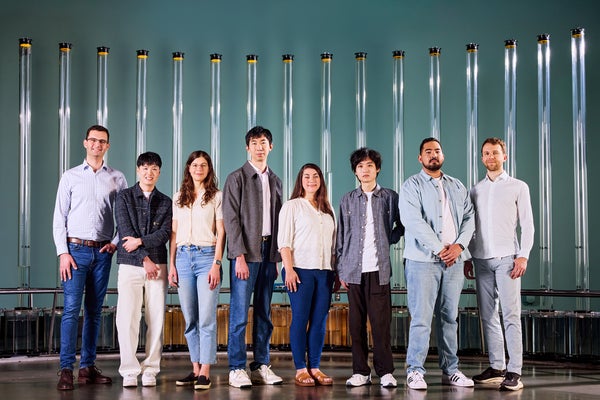
From left: Allie Balter-Kennedy, Emily Finn, Colin Carlson, Alice Stanton, Jaye Gardiner, Samagya Banskota, Alex Zhang.
Tony Luong
We then referenced those articles against our qualifications for the award using public information, including curricula vitae (CVs) and LinkedIn pages, and eliminated candidates as necessary. When the process identified an eligible candidate, we asked their mentors and collaborators to confirm and nominate them if those individuals felt the candidate was deserving.
Once we had a final pool of nominations, we used multiple factors to narrow our choices, including publication record, presence in high-impact journals, h-index, information from their nomination letter and sources of funding. We also considered patents, presence in software platforms, and other indicators of innovation and applicability of their work.
We also used a large language model, Qwen3.5-397B-A17B, to help with these assessments. These artificial intelligence scores were not used to eliminate or select any nominees; rather they were used in holistic ways for the judges to evaluate alongside other factors. In a convenience sample audit, the judges’ evaluations of the papers generally aligned with the model’s evaluation.
Although scientific merit was the foremost consideration in selecting the award winners, consideration was given to producing a list that represented a diverse range of scientific fields, geographic locations, races, genders and types of institutions. Consideration was also given to researchers who took nontraditional career paths. Each candidate’s age was considered, with greater scrutiny placed on researchers who were older and thus generally more senior in their career.
Once we determined a pool of finalists, a Scientific American editor spoke to each candidate to verify personal information and confirm eligibility. After this process was completed, all nominees were evaluated by a panel of Scientific American editors, who ultimately trimmed the list down to a final group of 28 researchers and, following a background check, confirmed those candidates. A few candidates who were initially selected for the award declined it or did not respond to messages from our editors. These candidates were ultimately replaced with alternate selections.
The selection process had significant limitations. Many of the experts we asked for nominations did not respond or have any suggestions. Asking experts for nominations limited our ability to find researchers who hadn’t networked as well as their colleagues or who worked at smaller labs or institutions. Some disciplines received more nominations than others or had nominations that significantly over- or underrepresented the actual number of researchers in that field. And some of the researchers who received nominations did not respond to us when we attempted to follow-up and verify their eligibility for the list.
In the end, we are confident that we identified 28 exceptional early-career researchers for our Young American Scientists list, but we don’t claim to have found the “top” or “best” scientists in their fields. We also recognize that there are many excellent early-career scientists who weren’t nominated, even though they might have made the final list if they were.
Do you know a researcher you think should have made our list? We’re already looking for the Young American Scientists class of 2027. Submit your nominations here.