
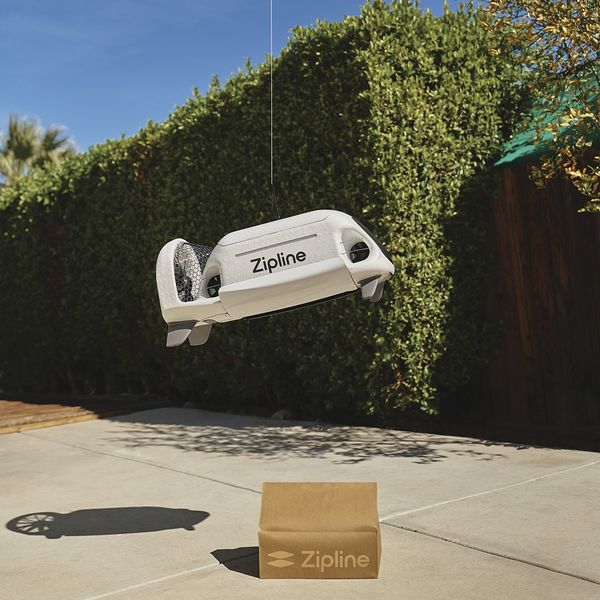
With barely a whir of propeller noise, we’ve got incoming: At the top of a grassy hill, next to a simulated suburban backyard—lawn chairs, a wood play structure, the works—a smooth-cornered white box about the size of a gym bag drops out of the sky. It looks like a pre-CGI special effect because I can see the line—specifically, the one connecting the pod to a drone hovering about 260 feet up, only just visible against the overcast sky. A dinner plate–size rotor at the box’s rear spins as the box course-corrects in midair and then sets down on four small gray fins.
The delivery is here. It’s a demo, but the same basic system is operating thousands of times a day in Arkansas and across neighborhoods in Texas, where Zipline is flying these drone-and-pod combos to carry a Chipotle burrito bowl or the cat’s special food to people’s homes.
Keenan Wyrobek, Zipline’s chief technology officer, ushers me over to the drone-pod and clicks open its clamshell lid to show off the insulated, carbon-fiber-paneled interior. If we were, say, a local deli, this is how we’d load sandwiches for the drone to deliver. During a drop-off, doors on the bottom would slide open, and whatever the pod was carrying would fall about an inch to the ground. It’s meant to be easy, simple and safe. Wyrobek clicks the door shut. Most users get it right.
On supporting science journalism
If you're enjoying this article, consider supporting our award-winning journalism by subscribing. By purchasing a subscription you are helping to ensure the future of impactful stories about the discoveries and ideas shaping our world today.
Had we blown it, the electric motor would’ve grunted, and a red light would’ve flashed. But all is well. We back away, and the pod rises up into the belly of the drone, which flies off. I’m expecting the angry-mosquito noise of a typical quadcopter, but it never comes.
At this testing facility, on a cattle ranch an hour south of San Francisco, Zipline is staging a distinctly old-school kind of future: actual flying robots. “That requires solving a lot of near-edge-of-physics technical problems,” says Keller Rinaudo Cliffton, Zipline’s CEO. “You need the vehicle to be very aerodynamically efficient to have a meaningful range. You need an energy-dense battery. You need special electric motors designed from scratch to be incredibly light.”
That tomorrow may now be in sight. For more than a decade drone delivery has been the tech industry’s easiest joke: the demo that never quite became a service. Zipline argues otherwise. Its global network, built largely on its earlier fixed-wing aircraft, has flown more than 130 million autonomous miles and made more than 2.5 million commercial deliveries. And a proposed Federal Aviation Administration rule known as Part 108 could give drone delivery companies a clearer path for flights beyond operators’ sight lines. What’s being tested in the suburbs is whether the aircraft can be quiet enough to live under, precise enough to find a backyard and safe enough to share neighborhood airspace at scale—and whether anyone wants it.
A decade ago Zipline’s drones did a different kind of delivery—moving medical laboratory samples and blood products in Ghana and Rwanda between metropolitan areas and remote clinics. The service used fixed-wing drones, bite-size planes, launched by magnetic slingshot. They dropped their cargo by parachute and were then caught midair by tailhooks and towlines like those on an aircraft carrier.
That service continues to help a lot of people. In Ghana, facilities using Zipline had vaccine “stockouts”—times when no vaccines were in stock—that were 60 percent shorter than those in clinics that didn’t work with Zipline. A 2022 review by researchers in Rwanda found blood products delivered by Zipline to mountainous areas arrived more than an hour and a half earlier than those carried by truck, leading to a 67 percent reduction in expiration losses.
For more than a decade drone delivery has been the tech industry’s easiest joke: the demo that never quite became a service.
Those slingshot-and-catch drones and parachute drops were made for long-range missions and low-precision delivery to drop zones about the size of two parking spaces. That wouldn’t work for delivering food and sundries to North American suburbs, where a delivery has to hit a target about the size of a lounge chair. Though Zipline’s aircraft wouldn’t need to go as far, they’d need to be far more precise. The company needed a new drone.
A drone’s range depends on its batteries, but really, range, weight and carry capacity are all the same problem. Hitting a smaller target means the drone has to hover, but that requires more propellers and more power—especially if the drone is fighting wind or other weather to stay in the same spot. Zipline needed to optimize for cargo. As Wyrobek puts it, “every gram you take out is another gram you can deliver.”
The team didn’t want a drone to land or even come close to the ground, because it’s noisy and less safe. (Zipline’s executives showed me TikTok videos of rival delivery drones descending below treetop level, kicking up dirt or dropping boxes into ponds.) The drones could lower deliveries on a tether, as those from Google offshoot Wing do, but the Zipline team worried that a gust of wind could blow the cargo off target.
Zipline landed on an unorthodox solution: put propellers on the delivery box, too. The drone above provides lift, reeling in or unspooling the line, and the pod below maneuvers with thrusters, using two infrared cameras for depth perception and a wide-angle color camera to find its target. “It can tell the difference between nice, flat concrete and nice, flat swimming pool,” says Zipline’s Zoltan Laszlo, the company’s lead for new products and principal engineer.
On lots of drones, small, fast-spinning blades produce spiky, high-pitched noise. Zipline’s larger, slower-moving custom-designed blades push the sound to a lower frequency. “We’re about six times quieter than the next-closest competitor,” Cliffton says. “And then we made the decision to keep it way high up.” That, he hopes, makes it less obnoxious to neighbors.
So Zipline ended up with a drone like a Transformer or, if you’re old enough to have seen the 1960s series Thunderbirds, a miniature Thunderbird 2. In forward-flying mode, down-facing propellers on arms extending from the drone’s wings draw together like scissor blades, and the propeller on the drone’s rear pushes it forward. In hover mode, the down-facing propellers unfold into X shapes, and the one on the back—mounted on a custom electric motor, ultralight and about the size of a soda can—folds down and pivots like a showerhead for finer control. But all the customer encounters is a small flying box.
Slick aerospace engineering isn’t enough to make a drone delivery company, though. Drones generally carry single deliveries of less than 10 pounds, enough for most personal orders, but trucks can carry thousands of pounds on a single run. It’s easier to solve one Traveling Salestruck Problem than 100,000 Traveling Salesdrone Problems. In the U.S. alone, Amazon delivers 1.6 million packages a day. That’d be a lot of robots.
Drones can be a more energy-efficient way to replace some short delivery trips while still indulging Americans’ desire for instant gratification, but more drones make logistics a real concern. Delivery companies need retailers to load orders correctly, places to charge the drones, and systems to keep all of the aircraft from hitting things or one another.
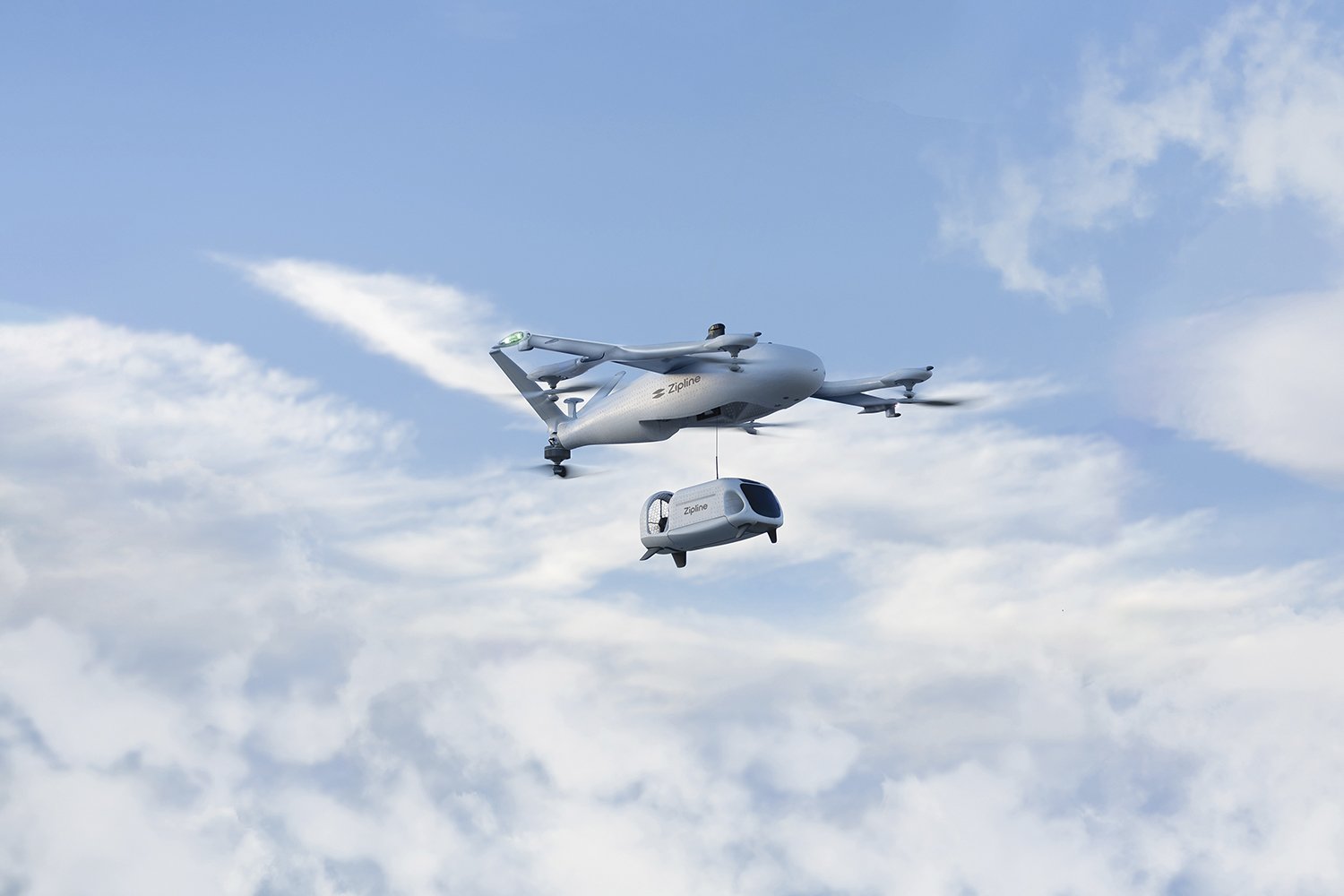
Hovering at roughly 300 feet keeps the aircraft’s rotor noise above neighborhood treetops, far from the people below.
Zipline
This is no longer just a demo. After some turbulence, Amazon’s Prime Air drone service has made about 16,000 deliveries in six states since 2022, with plans to expand further. Wing, the Google offshoot, has made almost half a million deliveries since it launched experimentally in 2012, and it plans to go national with Walmart by 2027. A few other companies are taking a shot, too. Since 2025 Zipline has been doing home deliveries in Pea Ridge, Ark., and in neighborhoods around Dallas; this year it announced expansions to parts of Houston and Phoenix. Like Wing, it’s working with Walmart, as well as with chain restaurants such as Wendy’s and, yes, Chipotle.
That means Zipline already makes thousands of deliveries a day—and is having trouble keeping up with its popularity. On one particularly heavy day, 20 percent of the homes in one of Zipline’s coverage areas called for delivery air support. Demand has strained the fleet. “We thought you’d want 30 to 40 drones serving a 10-mile radius,” Wyrobek says. “It’s very clear you need a lot more drones.”
Those drones need to recharge. That’s handled at docking stations, cyberpunk forests of metal posts sprouting manta ray–shaped awnings that the company can install in pretty much any liminal space as long as there’s power—the back of a parking lot can host 36 individual docks, and a single location can serve hundreds of pickup spots. I watched drones work with these stations at the test site: they arc downward toward the metal poles, maneuver so that they’re directly under one of the awnings and then rise upward so their dorsal fins plug in. “The drones don’t have to return to their original charging location,” Wyrobek says. “We can pick up and deliver and then charge somewhere else.”
Meanwhile at the point of sale, Zipline installs pylonlike structures that capture descending pods to pick up shipments. They have a drawer at the bottom, like an old night-deposit slot at a bank, that also checks for size and weight limits, and they have a keypad for punching in a code that sends a pickup alert for the order. A drone flies in—angled arms at the top of the pylon hug the wire in close—and the pod drops the tube to grab the stuff. “Guess what we call it?” Wyrobek says. “A fly-thru!”
If all these drone companies see hypergrowth or if UPS and FedEx take to the skies, “that’s going to become a problem,” says Giuseppe Loianno, director of the Agile Robotics and Perception Lab at the University of California, Berkeley. “Multiple providers doing delivery will have to share the same airspace. So there have to be ways of allocating flight corridors.” Those corridors, he adds, might not be the most optimized flight paths, which has implications for battery life.
Chase Murray, director of the Structure for Outdoor Autonomy Research drone facility at the University at Buffalo, sees the same mismatch more broadly. “There have been some creative and attractive ideas,” he says, “but the marriage of that idea plus technology plus regulation—it’s been a challenge to get those things lined up.”
The regulatory picture is still taking shape. For now Zipline and similar companies have had to pursue limited approvals and waivers for commercial drone flights beyond their pilots’ line of sight. The FAA’s proposed Part 108 rule would create a broader framework to make those kinds of operations routine. Today Zipline manages all of its U.S. flights from two remote operations centers. But scaling to thousands of drones over American cities and suburbs run by multiple companies would require something closer to an airspace operating system. Regulators, NASA researchers and industry are all still trying to design one.
Zipline is building for that future. In late 2025 the company tripled the size of its manufacturing facility near San Francisco International Airport. Now it’s a vast, brightly lit, high-ceilinged facility festooned with racked, cruciform carbon-fiber frames and polypropylene fuselage parts capable of producing 15,000 drones a year.
In a far corner of that manufacturing facility, I find a space crammed with nearly assembled drones. EV2, the model in use in Texas and Arkansas, is already getting supplanted by the newer EV3. Among other differences, in the older drones, screws connect the top of the fuselage to the bottom. EV3s use plastic locking tabs. Lauren Lacey, Zipline’s head of integration, manufacturing and quality engineering, happens to walk by. She’s in charge of putting those thousands of drones together. Lacey agrees the new clasps are nifty—the polypropylene around the screws tended to break, she says, and her crew can unlock the new tabs with a tiny, keylike tool.
But Lacey’s favorite part, she says, is the dorsal fin.
Not only does that fin lock into the charging dock, but it also hides the cantilevered reel of line that carries the pod. Lacey says it really impressed her 101-year-old grandfather, who’d been a lead engineer on the Harrier, the first jet fighter capable of operational vertical takeoff and landing (VTOL). Grandpa knew all too well that the hardest part of VTOL is the L—that’s when aircraft crash. A Zipline drone “lands” by rising up, so wind pushes it not into the ground but into its dock. If landing is dangerous, the solution is: never do it. When Lacey told her grandfather they could dock in headwind conditions, he was suitably impressed—as Lacey tells it, he said, “Well, by golly gee!”
Lacey feels much the same. She gives the fin a little pat. “It’s just so genius,” she says. “It’s wonderful. It’s beautiful.” After a bit more assembly, this drone will be flat-packed and shipped out to join thousands like it, flitting between docks and backyards, trying to make the strange business of sky delivery feel normal.