
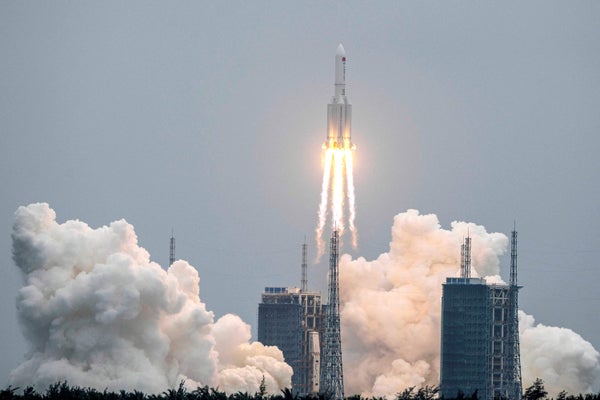
The Chinese rocket has come down.
The 23-ton core stage of a Long March 5B booster crashed back to Earth Saturday night (May 8), ending 10 controversial days aloft that captured the attention of the world and started a wider conversation about orbital debris and responsible spacefaring.
The Long March 5B reentered the atmosphere over the Arabian Peninsula at about 10:15 p.m. EDT Saturday (0215 GMT on Sunday, May 9), according to U.S. Space Command.
On supporting science journalism
If you're enjoying this article, consider supporting our award-winning journalism by subscribing. By purchasing a subscription you are helping to ensure the future of impactful stories about the discoveries and ideas shaping our world today.
“It’s unknown if the debris impacted land or water,” Space Command officials wrote in a brief update Saturday night.
But some analysts have identified a watery grave for any rocket hunks that managed to survive the intense heat of re-entry. For example, Space-Track.org stated on Twitter Saturday night that the Long March “fell into the Indian Ocean north of the Maldives," an idyllic island chain off India’s southwest coast.
The Long March 5B launched the core module for China’s new space station on April 28. Instead of ditching safely into the ocean when its work was done, however, the rocket’s first stage reached orbit, becoming a piece of space junk just waiting to crash down on its home planet after feeling enough atmospheric drag.
And this was not an isolated incident. The same thing happened last year with a different Long March 5B core, which fell uncontrolled over the Atlantic Ocean off the West African coast. Some large pieces of debris from that reentry apparently made it to the ground in the nation of Ivory Coast, though no injuries were reported.
In addition, China’s first prototype space lab, Tiangong 1, which was designed to help pave the way for the new space station, had its own space-junk phase after completing its mission. The 8-ton craft fell to Earth uncontrolled in April 2018, burning up over the Pacific Ocean.
Only three human-made objects heavier than those two Long March 5B cores have ever fallen uncontrolled from space, according to astronomer and satellite tracker Jonathan McDowell, who’s based at the Harvard-Smithsonian Center for Astrophysics.
Those three are the 83-ton Skylab space station, which crashed over Australia in July 1979; the 50-ton upper stage of the Saturn V rocket that launched Skylab, which came down over the Atlantic Ocean west of Madeira in January 1975; and the Soviet Union’s Salyut 7 space station and attached Kosmos-1686 module, which together weighed about 43 tons and re-entered over Argentina in February 1991. (Sadly, the space shuttle Columbia could also be considered here; the 117-ton orbiter broke apart during its reentry in February 2003, killing all seven astronauts aboard.)
Many people in the space community have criticized China over the Long March 5B incidents, accusing the nation’s space program of behaving carelessly, if not recklessly. One such reproval came on Saturday from new NASA chief Bill Nelson.
“Spacefaring nations must minimize the risks to people and property on Earth of re-entries of space objects and maximize transparency regarding those operations,” Nelson wrote in a statement posted before the rocket came down.
“It is clear that China is failing to meet responsible standards regarding their space debris,” he added. “It is critical that China and all spacefaring nations and commercial entities act responsibly and transparently in space to ensure the safety, stability, security and long-term sustainability of outer space activities.”
Copyright 2021 Space.com, a Future company. All rights reserved. This material may not be published, broadcast, rewritten or redistributed.