
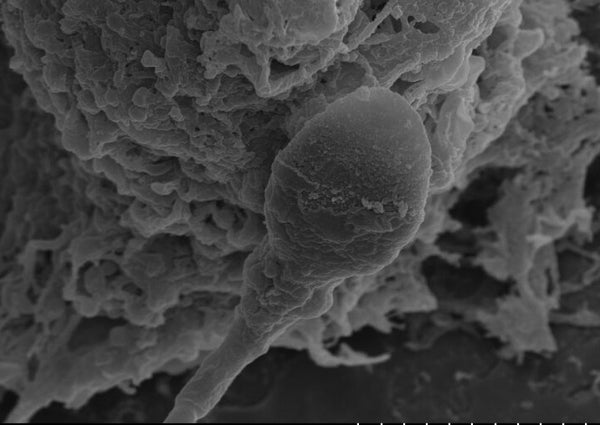
On Earth human sperm tend to know where to go when it comes to fertilizing an egg in utero. But that may not be the case in space. A new study suggests human sperm may struggle to navigate in microgravity—a finding that raises questions about humanity’s ability to reproduce in space.
Researchers put human sperm into a microgravity simulation chamber designed to mimic the female reproductive tract and tested the swimmers’ ability to navigate. Under microgravity conditions, the sperm saw “impaired directional navigation”—in other words, they got lost—more often than under typical gravity conditions on Earth.
And in mouse eggs, the microgravity conditions had a measurable effect on insemination rates compared with Earth’s gravity—a 30 percent decline in fertilized eggs during a period of four hours.
On supporting science journalism
If you're enjoying this article, consider supporting our award-winning journalism by subscribing. By purchasing a subscription you are helping to ensure the future of impactful stories about the discoveries and ideas shaping our world today.
The results, published on Thursday in the journal Communications Biology, could help future humans have children in space. NASA and other governmental space agencies maintain that no one has ever had sex in space, but future human spacefarers may want to have families and reproduce while in a microgravity environment.
“As missions to the moon and Mars move from aspiration to reality, understanding whether humans and the species we depend on can successfully reproduce in those environments is not a curiosity; it is a necessity,” says Nicole McPherson, senior author of the study and a senior lecturer at Adelaide University in Australia, who studies reproduction.
Interestingly, adding progesterone, a hormone released by the cells on a person’s eggs, to the uteruslike chamber helped the sperm better orient themselves under microgravity.
“Progesterone works as a chemical signal, a kind of biological homing beacon that the egg release around the time of ovulation,” McPherson explains. “Sperm have receptors on their surface that detect this signal and use it to orient themselves and swim toward the source.”
“It is one of nature’s more elegant navigation systems,” she adds.
The progesterone only helped the sperm at concentrations that were “considerably higher” than those found in nature, McPherson says. So while the results are interesting, “we are not at the point of suggesting progesterone as a simple fix for fertility in space.”
“It does, however, open up an intriguing line of investigation for the future,” she adds.